
The Return of Restraint
There is something deeply unfashionable about beige, and perhaps that is precisely why it has returned. In an era saturated by color-of-the-year pronouncements and digital renderings that lean toward the hyperreal, a cohort of material manufacturers has begun championing a palette that whispers rather than shouts. We are seeing muted greys, sun-bleached whites, and cement tones emerge not as compromise but as deliberate choice, a tectonic shift that privileges longevity and contextual humility over momentary spectacle.
At World Archi Design, we have been tracking this phenomenon across recent facade commissions, from lab complexes in New England to residential projects in Melbourne's inner suburbs. What unites them is not simply chromaticism but an underlying ethos: these materials aim to age gracefully, to recede when necessary, and to anchor rather than dominate their surroundings. The question is whether this marks a genuine evolution in architectural thinking or merely another pendulum swing in an industry prone to cycles.
Industrial Authenticity Without the Carbon Cost
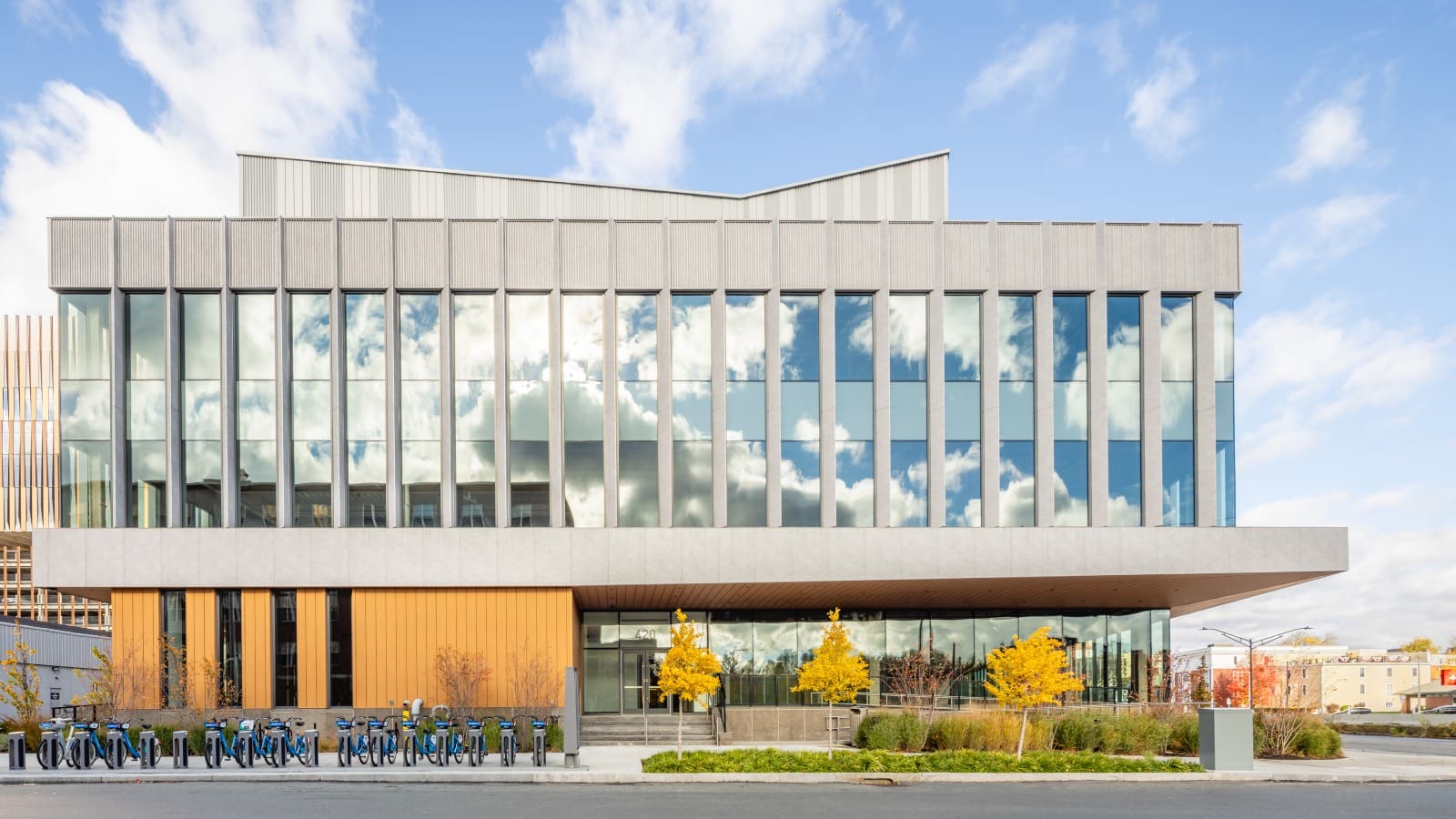
Pure + FreeForm's Urban Cement finish exemplifies the tension between simulation and substance. The product replicates poured concrete's raw, variegated surface on aluminum panels, complete with subtle tonal shifts and a pearl underlayer that lends depth without gloss. NBBJ deployed it across the Charlestown Labs development in Massachusetts, a context where the material's industrial character aligns with the neighborhood's manufacturing heritage while sidestepping concrete's embodied carbon burden.
The aluminum substrate is fully recyclable, and the finish resists the typical degradation patterns of exterior coatings: no chalking, no UV fade, no loss of surface integrity over decades. This durability matters less for its marketing appeal than for its implications on lifecycle analysis. A facade that maintains its appearance without recoating or replacement reduces both material throughput and the labor intensity of building maintenance, two factors that rarely appear in project photography but define a building's environmental footprint over time.
What Pure + FreeForm has achieved here is a form of material honesty that operates on two levels. The finish does not pretend to be concrete; it references it, acknowledging the visual language of poured-in-place construction while embracing the performance characteristics of metal cladding. This is not pastiche but translation, a recognition that architectural expression can be decoupled from structural necessity without sacrificing legibility.
Waste as Feedstock
Eco Outdoor's Full Stone Bricks collection takes a different approach to restraint, one rooted in supply-chain pragmatism. The bricks are sawn from irregular stone blocks that would otherwise be discarded during quarrying, a process that transforms waste into a viable building product. The leftover fragments are crushed and repurposed for roadway aggregate, closing the loop on material efficiency.
The elongated proportions of these bricks distinguish them from standard masonry units, lending facades a sense of horizontal continuity that can either complement or counteract a building's massing. JAK Architecture utilized the stone for the Hermitage residence in Newtown, a project where the material's pale, stratified surface plays against the darker timber elements and recessed glazing. The result is a composition that feels rooted in geological time rather than stylistic trends, a quality that many contemporary residences struggle to achieve.
Because the bricks are not fired at high temperatures, their production generates roughly half the carbon emissions of conventional clay bricks. This reduction is significant, though it must be weighed against transportation impacts and the energy required for cutting and finishing. Stone is heavy, and Australian stone shipped to distant markets carries a different environmental calculus than locally sourced clay. The broader lesson here is that sustainability in facade materials cannot be reduced to a single metric but must account for extraction, processing, logistics, and longevity as an interconnected system.
Chromatic Grounding
Glen-Gery's announcement of Casablanca as its 2026 Brick Color of the Year signals a broader industry recognition that neutral tones have moved from background to foreground. The sun-bleached white hue, part of the Sioux River Series, draws its inspiration from Midwestern geology: the eroded bluffs and sedimentary layers that define the region's visual identity. The brick's subtle variegation prevents it from reading as flat or sterile, a critical consideration when working with pale materials that can appear lifeless under certain lighting conditions.
Brick, as a material, carries its own set of associations: permanence, craft, vernacular continuity. A white brick complicates those associations, evoking Mediterranean villages or mid-century institutional architecture while remaining compatible with contemporary detailing. The versatility Glen-Gery emphasizes is not merely aesthetic but practical; Casablanca can serve as a neutral field for more expressive elements or as the primary character-defining material, depending on how it is deployed and jointed.
The extruded brickface technique used in the Sioux River Series produces a texture that references natural weathering without the decades of exposure required to achieve it. This accelerated patina is a double-edged proposition. On one hand, it allows new construction to integrate more seamlessly into historic contexts or natural landscapes. On the other, it risks the kind of artificial aging that undermines material authenticity. The success of such products depends on restraint in application and an acknowledgment that simulation, however skillful, is not the same as time.
Pale Tones and the Persistence of Context
The convergence of these three products within a single year suggests something more than coincidence. Material manufacturers respond to demand, and demand is shaped by the projects architects are designing, the clients they are serving, and the cultural conditions that frame both. Pale facades offer a form of visual quietude that contrasts sharply with the maximalist gestures of the past decade. They photograph well but do not rely on photography to justify their existence. They can be contextual without being deferential, modern without being aggressively futuristic.
There is also a practical dimension to this shift. Lighter tones reflect rather than absorb solar radiation, reducing cooling loads in warm climates and mitigating the urban heat island effect in dense cities. This thermal performance is not incidental but increasingly central to facade design as energy codes tighten and climate adaptation becomes a non-negotiable aspect of architectural practice.
Yet we should be cautious about overstating the environmental case for any single material or finish. Recyclability, waste reduction, and lower firing temperatures are all meaningful improvements, but they do not absolve the construction industry of its larger responsibility to build less, build smaller, and prioritize adaptive reuse over new construction. The most sustainable facade is the one that already exists, maintained and updated rather than demolished and replaced.
What Endures
The materials discussed here share a common ambition: to endure not just physically but aesthetically, to remain legible and valued as tastes shift and contexts evolve. This is a difficult proposition in an industry that often prizes novelty over longevity, where the next facade system is always more compelling than the last. If pale tones do represent a meaningful shift, it will be because they enable a kind of architectural restraint that has been difficult to achieve in recent years, a willingness to let buildings recede when appropriate and to foreground program, landscape, or urban fabric over object-making.
The test will come not in the initial installation but in the decades that follow, as these materials weather, as maintenance regimes prove adequate or insufficient, and as the buildings they clad either integrate into their surroundings or stand as artifacts of a particular moment. Muted tones may be having their moment now, but the real question is whether they can transcend it.
Save this story. A free account keeps your reading list and the 07:00 email in one place.
CREATE FREE ACCOUNT →SIGN IN