
Reading the Landscape
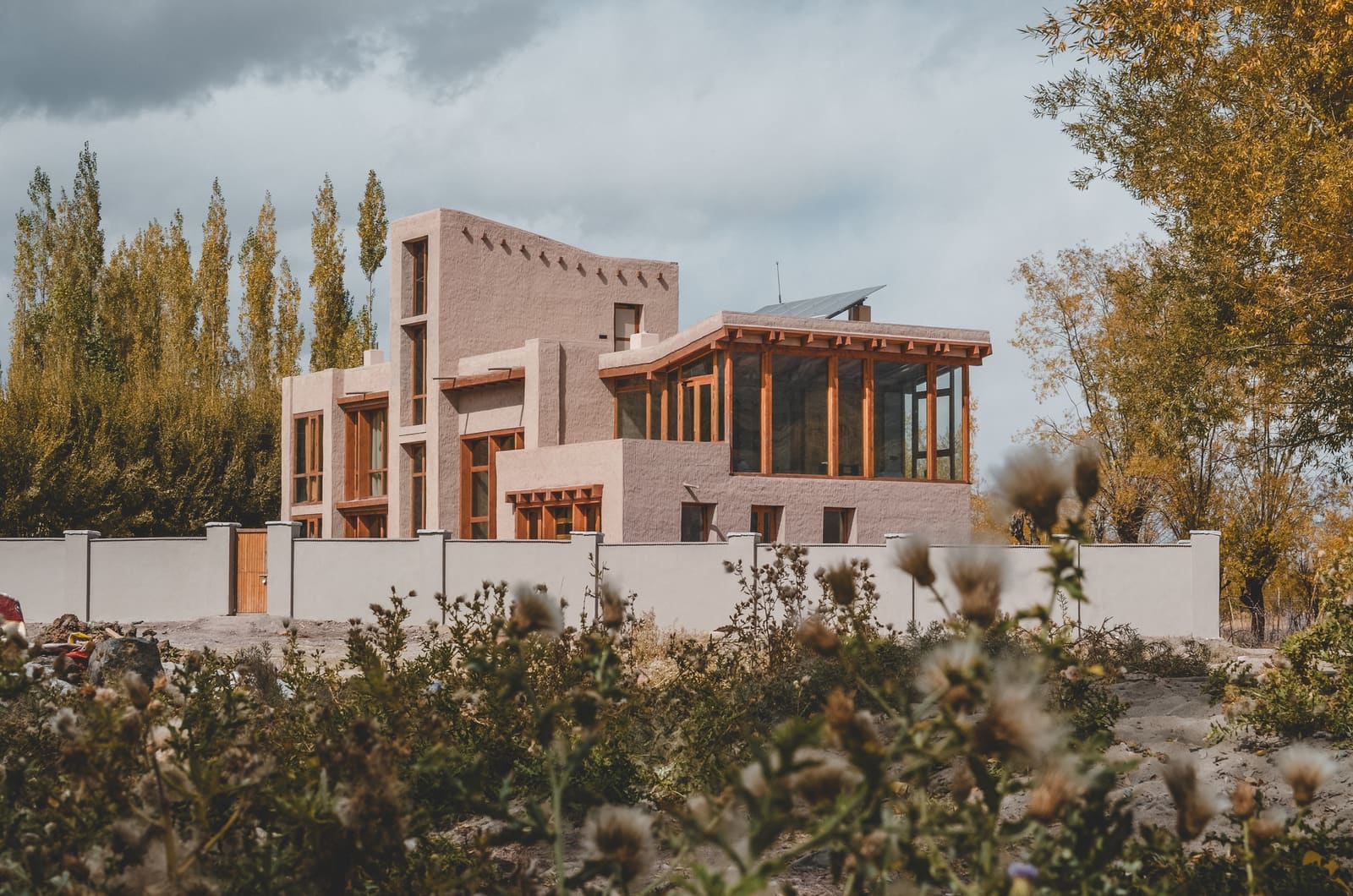
High-altitude cold deserts don't forgive lazy thinking. In Chuchot, a village nestled within Ladakh's Trans-Himalayan belt, the environment writes the first draft of every building. Field Architects approached their residential commission here not as a blank canvas but as a palimpsest, where centuries of human adaptation have already inscribed the terms of engagement. The resulting 3,225-square-foot dwelling, completed in 2024, operates less as a statement piece and more as a careful interpretation of what the place has been saying all along.
At World Archi Design, we've tracked a growing cohort of practices turning to vernacular precedent not for aesthetic plunder but for systematic insight. Field Architects positions itself squarely within this lineage, treating traditional building forms as archives of climate knowledge, material economy, and social structure. Their Chuchot project synthesizes these informative layers into a contemporary residence that foregrounds adaptive geometry over stylistic mimicry.
The Vernacular as Data Set
Ladakh's architectural heritage evolved across millennia of trade and anthropological exchange, yielding building forms calibrated to extreme diurnal temperature swings, fierce solar gain, and material scarcity. Thick rammed-earth walls, compact massing, south-facing orientation, and minimal fenestration on windward elevations are not decorative choices but thermal necessities. Field Architects mines this repository as one might a technical manual, extracting principles rather than copying motifs.
The residence translates these principles into a plan that balances thermal mass with contemporary spatial expectations. Walls remain robust, their thickness a buffer against the cold desert's temperature volatility. Openings are deliberate, sized and positioned to capture winter sun while shading summer interiors. The massing is restrained, avoiding the sprawl that would hemorrhage heat and complicate construction logistics in a region where material transit is itself an economic calculation.
Material Politics and Local Craft
In Ladakh, material choices are inseparable from questions of economy, ecology, and labor. Field Architects engaged local craftspeople for both carpentry and finishes, a decision that extends beyond procurement into the realm of tectonic coherence. The carpentry contractor, Field Studios, brought familiarity with Ladakhi joinery traditions and an understanding of how timber behaves at altitude. Civil construction was led by Abrar Dar, whose knowledge of local building practices informed structural decisions that might otherwise have defaulted to generic templates.
This collaborative framework allowed the project to sidestep the common pitfall of importing urban construction logic into a context where it performs poorly. Materials were sourced with an eye toward minimizing environmental and financial transport costs. Finishes, handled again by Field Studios, reflect a continuity of craft rather than a rupture between "traditional" and "modern" aesthetics. The result is a building whose material palette feels inevitable rather than imposed.
Spatial Organization and Family Structure
Vernacular architecture is rarely abstract; it encodes the social rhythms of the people who inhabit it. Ladakhi homes historically accommodated extended family structures, with spaces that could flex between communal and private use. Field Architects' plan for the Chuchot residence acknowledges these precedents while accommodating contemporary domestic patterns that may differ in scale or formality.
The layout negotiates between openness and enclosure, offering zones that can support both collective activity and individual retreat. Circulation is efficient, avoiding the labyrinthine plans that can emerge when rooms are added incrementally over generations. Yet the design retains a certain porosity, a quality inherited from vernacular homes where thresholds are negotiated rather than absolute. This spatial flexibility is particularly relevant in a region where seasonal migration and family gatherings remain part of the domestic calendar.
Climate Responsiveness Beyond Insulation
Designing for a high-altitude cold desert demands more than thickening walls. Solar orientation becomes a primary organizing principle: maximizing south-facing exposure to capture low-angle winter sun, while managing summer overheating through calculated shading devices and thermal lag. Field Architects calibrated the residence's fenestration to these dual imperatives, treating each opening as a thermal event rather than a compositional gesture.
Natural ventilation strategies, informed by vernacular precedent, mitigate indoor air quality issues that can arise in tightly sealed envelopes. Thermal mass, concentrated in the building's core, stabilizes interior temperatures across Ladakh's dramatic day-night temperature swings. These strategies are not novel in the abstract, but their integration within a contemporary residential program requires a level of synthesis that many architects, trained in temperate climates, struggle to achieve.
Precedent and Innovation
The Chuchot residence invites comparison with other high-altitude projects that engage vernacular wisdom without pastiche. One thinks of Studio Mumbai's work in the Indian Himalayas, where material authenticity and craft-based construction methods produce buildings that feel both ancient and immediate. Closer to Ladakh, the late Sonam Wangchuk's vernacular-inspired educational campus in Phey demonstrated how traditional Ladakhi building techniques could be adapted to institutional scale.
Field Architects distinguishes itself through a certain analytical rigor, treating vernacular forms as problem-solving frameworks rather than aesthetic reservoirs. The practice's emphasis on observable patterns and adaptive geometry suggests an interest in extracting transferable principles, a methodology that could inform projects well beyond Ladakh's specific context.
Building in Place
Architecture in extreme environments often becomes a referendum on hubris. The temptation to impose, to demonstrate mastery over inhospitable conditions, produces buildings that fight rather than negotiate. Field Architects' residence in Chuchot opts for negotiation. It listens to what the cold desert says about thermal performance, what millennia of building practice say about material economy, and what local craft traditions say about construction feasibility.
The outcome is a home that feels calibrated rather than compromised, contemporary without being deracinated. It suggests that engaging vernacular precedent need not result in nostalgic reproduction, but can instead yield architecture that is both of its time and of its place. In a discipline often distracted by novelty, that remains a rare and necessary balance.
Photo: Suril Patel
Save this story. A free account keeps your reading list and the 07:00 email in one place.
CREATE FREE ACCOUNT →SIGN IN