
The Exhibition That Left the Building
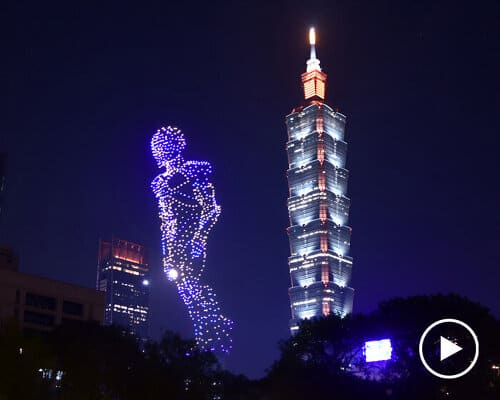
At World Archi Design, we've long argued that the most compelling exhibitions are those that escape their containers. A recent drone performance above Taipei literalized that impulse, transforming the city's skyline into a temporary venue for an event that redefined what it means to stage technology within urban space. Over four nights in early June 2026, a fleet of one thousand LED drones choreographed twelve-minute performances above Xinyi District, treating the civic plaza, surrounding towers, and the illuminated mass of Taipei 101 not as backdrop but as co-participants in a three-dimensional spatial composition.
The project extended the annual COMPUTEX and InnoVEX technology trade fair beyond the convention center, repositioning its themes of semiconductors, artificial intelligence, and networked systems as public spectacle. Project director and creative producer Yu-Ying Chen conceived the performance as an urban exhibition canvas, one that engaged the architectural identity of central Taipei rather than merely floating above it. The result was a work that blurred the line between installation art, civic ceremony, and technology demonstration - a hybrid typology that raises questions about the role of temporary interventions in dense metropolitan contexts.
2026 COMPUTEX x InnoVEX Drone Show / Yu-Ying Chen (project director and creative producer), Noki Asia Limited (design consultant), Taiwan Swarm Innovation Inc. (flight operations), Taipei, 2026
Choreography in Three Dimensions
The performance was staged between Taipei City Hall Plaza and Taipei 101, situating the aerial choreography within one of the city's most legible urban zones. Rather than selecting an isolated launch site removed from built context, Chen and her collaborators embedded the drones within the architectural and visual vocabulary of Xinyi District. The illuminated silhouette of Taipei 101 - a tower whose tectonic expression and symbolic heft have long anchored the district's identity - became an active element in the composition. One sequence featured a robotic figure that appeared to interact with the building's profile, a gesture that acknowledged the tower not as passive scenery but as a formal counterpart to the ephemeral formations overhead.
This approach reflects a broader shift in how temporary installations engage urban architecture. Across the projects we've covered over the past decade, from Rafael Lozano-Hemmer's relational architectures to Studio Drift's kinetic light works, the most successful interventions are those that read the existing built environment and respond to its massing, rhythm, and symbolic weight. Chen's project extends that lineage, using programmable flight paths and LED arrays to construct volumetric forms that dialogue with the skyline rather than merely occupying airspace above it.
The drones themselves were coordinated by Noki Asia Limited in Hong Kong, which translated Chen's creative direction into two- and three-dimensional flight paths and animation sequences. Taiwan Swarm Innovation Inc. adapted those designs to its flight systems and operated the fleet during the live performances. The collaboration required navigation of aviation restrictions, electromagnetic interference in a dense urban core, and the operational complexity of flying a thousand-unit swarm in a space crowded with high-rise structures and civilian air traffic.
From Microstructure to Monumental Form
The twelve-minute performance visualized themes central to Taiwan's position within global technology networks: semiconductor lattices, artificial intelligence, and computational infrastructure. The drones transitioned between abstract geometries that evoked microscopic chip architectures and large-scale figurative forms that gestured toward human interaction with technology. These sequences were conceived not as flat animated images projected onto the sky but as volumetric compositions with depth, layering, and spatial hierarchy.
This is an important distinction. Much drone choreography relies on two-dimensional patterns legible from a single vantage point - essentially billboards rendered in light. Chen's project, by contrast, constructed formations that possessed genuine three-dimensionality, visible from multiple angles across the plaza and surrounding streets. The drones formed lattice structures that referenced the crystalline organization of semiconductor wafers, then reconfigured into abstract geometries that suggested data flows, network topologies, and algorithmic processes. The result was a performance that operated simultaneously as data visualization, spatial installation, and civic spectacle.
The choice to visualize semiconductor industry themes is telling. Taiwan occupies a critical node in global technology supply chains, and the island's semiconductor fabrication capacity underpins everything from consumer electronics to military infrastructure. By translating these otherwise invisible processes into legible aerial forms, the performance made visible the economic and technological systems that structure contemporary urban life. It's a strategy reminiscent of the way Diller Scofidio + Renfro's Blur Building used mist to materialize environmental data, or how Olafur Eliasson's Ice Watch brought climate abstraction into tangible public space.
Digital Fireworks and the Case for Ephemerality
Chen described the project as "Digital Fireworks," framing the drones as a programmable, reusable alternative to conventional pyrotechnics. The comparison is instructive. Fireworks are ephemeral, celebratory, and tied to civic ritual - but they are also single-use, polluting, and constrained by their combustion chemistry. Drone formations, by contrast, can be reprogrammed, redeployed, and choreographed with precision impossible in explosive displays. They produce zero emissions during operation and leave no physical residue.
This positions the technology within a growing discourse around sustainable public art and temporary installations. Across cities we've been tracking - from Singapore's biophilic interventions to Copenhagen's adaptive reuse projects - there is increasing interest in interventions that deliver visual and experiential impact without permanent material footprint. Chen's drones exist only through light, movement, and synchronized flight. Once the performance concludes, nothing remains but documentation and memory.
Yet this ephemerality also raises questions about access and equity. The performance ran for four nights, visible only to those who could be physically present in Xinyi District or within sightlines of the plaza. Subsequent circulation through international news outlets and digital media platforms extended the audience, but those experiencing the work through screens encountered a fundamentally different artifact - one mediated by camera angles, compression algorithms, and editorial framing. This is a tension inherent to all site-specific public art, but it becomes especially pronounced in work designed for nocturnal viewing in a specific urban context.
Urban Context as Co-Author
The decision to stage the performance in Xinyi District was not incidental. The area functions as Taipei's de facto civic center, anchored by City Hall, the plaza, and Taipei 101. It is a zone of high pedestrian activity, tourist traffic, and symbolic importance. By situating the drones within this context, Chen ensured the work would be legible not just as technological demonstration but as urban event - a moment when the infrastructure of the city itself becomes part of the exhibition.
This approach aligns with precedents in urban-scale installation work. Christo and Jeanne-Claude's Running Fence engaged the rolling topography of Sonoma and Marin counties as essential to the work's meaning. Janet Echelman's net sculptures are site-responsive, their forms shaped by wind patterns and the massing of surrounding buildings. Chen's drones similarly treat the city as co-author, with Taipei 101 serving as both formal anchor and symbolic reference point.
The project also tested the regulatory and logistical frameworks that govern airspace in dense metropolitan areas. Coordinating a thousand-drone fleet required collaboration across aviation authorities, municipal government, and electromagnetic spectrum managers. These are not trivial constraints, and their negotiation shapes what is possible within urban airspace. As drone technology becomes more accessible and formations grow larger, questions about airspace allocation, visual pollution, and the privatization of the sky will become increasingly urgent. Chen's project operates within these emerging regulatory landscapes, demonstrating both the potential and the complexity of aerial urbanism.
Precedent and Implication
Drone choreography as a medium is still young, but it has rapidly evolved from novelty to established practice. Intel's Shooting Star platform, used at the 2018 Winter Olympics, established the technical feasibility of large-scale swarm performances. Studio Drift's Freedom series explored drones as autonomous agents with emergent behavior. Chen's project builds on these precedents but distinguishes itself through its integration with existing urban architecture and its explicit framing as exhibition infrastructure rather than standalone spectacle.
The implications extend beyond this single performance. If trade fairs and biennales can extend into urban airspace, what other institutional programs might follow? Could architectural exhibitions stage drone formations that visualize unbuilt proposals at full scale? Could urban planning processes use aerial choreography to test massing scenarios or visualize zoning changes? The technology opens possibilities for representing spatial ideas in ways that physical models and digital renderings cannot.
There are also questions about authorship and collaboration in projects that span creative direction, engineering, regulatory negotiation, and flight operations. Chen's role as project director and creative producer suggests a model closer to film production or large-scale installation art than traditional architectural practice. The work required coordination across Noki Asia's design team, Taiwan Swarm Innovation's flight operations, and municipal authorities - a distributed authorship that reflects the complexity of contemporary spatial production.
The Exhibition as Urban Event
What distinguishes this project from other drone performances is its explicit framing as an extension of an exhibition. COMPUTEX and InnoVEX are industry events focused on technology trade, startup ecosystems, and investor networks. By staging a public-facing drone performance, the organizers repositioned these themes within the urban public realm, making the exhibition legible to audiences who would never enter the convention center. The drones became a form of architectural communication, translating the abstract content of a trade fair into a visual language accessible from the street.
This strategy recalls earlier experiments in bringing exhibitions into urban space. The 2000 Hannover Expo dispersed pavilions across the city, treating the metropolis itself as exhibition ground. The Chicago Architecture Biennial has staged installations in transit stations, parks, and civic buildings. Chen's project extends this lineage into the vertical dimension, using airspace as exhibition venue and the skyline as framing device.
The performance also functioned as a form of place branding, projecting an image of Taipei as a city at the intersection of technology, design, and urban innovation. The choice to feature Taipei 101 prominently within the choreography reinforced the building's role as symbol of the city's global ambitions. This is not inherently problematic, but it does situate the project within broader dynamics of urban competition, tourism marketing, and the instrumentalization of culture for economic development. The drones were, among other things, an advertisement - for the city, for the trade fair, for Taiwan's technology sector.
What Remains
When the final performance concluded on June 5, 2026, nothing physical remained. No structure was built, no material deposited. The project existed only in the memories of those who witnessed it and in the documentation that circulated afterward. This ephemerality is both strength and limitation. It allows for bold interventions that would be untenable as permanent installations, but it also means the work's impact is concentrated in a brief window and a specific location.
Yet the project's circulation through media platforms extended its reach far beyond Taipei. Images and videos of the performance appeared across international news outlets, television broadcasts, and social media, creating a secondary life as digital artifact. This raises questions about the relationship between live event and mediated representation. Which version of the work is definitive? The twelve-minute performance witnessed by thousands in Xinyi District, or the edited highlights viewed by millions online?
These are not new questions, but drone choreography amplifies them. The work is designed to be spectacular, photogenic, and shareable - qualities that ensure its circulation but also risk reducing it to content. At World Archi Design, we remain interested in how temporary installations navigate this tension, creating experiences that are both site-specific and globally legible, ephemeral and endlessly reproducible.
Chen's project suggests one possible path forward: using temporary interventions to test ideas about urban space, exhibition design, and public engagement without the permanence and expense of built architecture. In a moment when cities are rethinking their relationship to technology, sustainability, and public space, the ability to stage large-scale spatial experiments that leave no trace is not a limitation - it's a provocation.
Save this story. A free account keeps your reading list and the 07:00 email in one place.
CREATE FREE ACCOUNT →SIGN IN