When Architecture Becomes Pedagogy
There is a particular tension in asking children to play inside a museum dedicated to the built environment. The impulse is typically to protect, to cordon, to keep small hands away from precious artifacts. What Snarkitecture has done inside the Great Hall of the National Building Museum in Washington, DC, inverts that instinct entirely. Their installation, open through late August, occupies the institution's Italian Renaissance Revival interior with nine distinct zones where industrial materials become instruments of exploration.
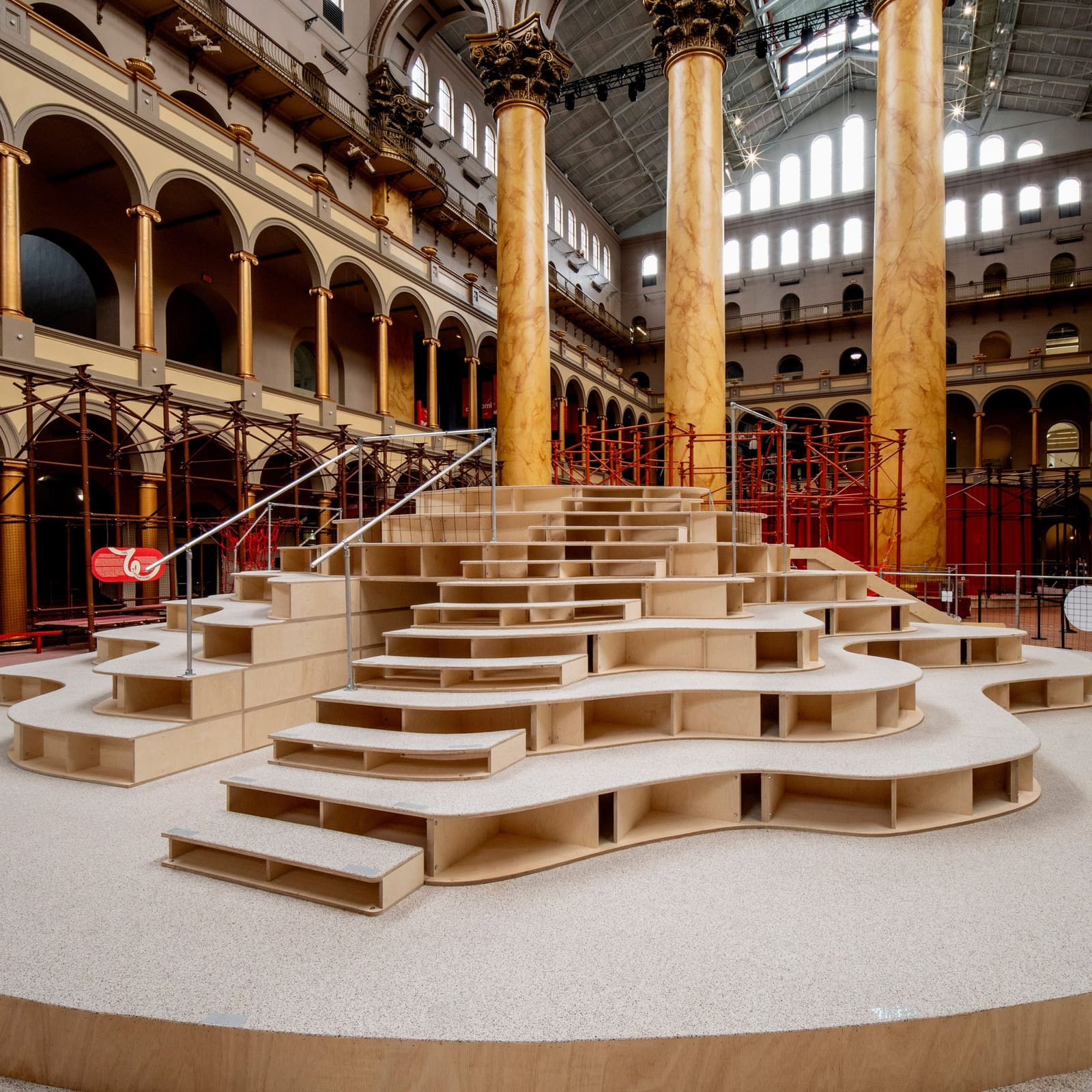
This is the largest indoor intervention the museum has ever hosted. The scale matters not because it is record-setting, but because it allows the installation to inhabit the hall's volume without being dwarfed by it. The Great Hall's monumental columns, famously constructed from plaster-covered brick and painted to mimic the marble of Michelangelo's Santa Maria degli Angeli in Rome, remain visible and contextual. Snarkitecture's structures do not compete; they converse.
Birch, Cork, and the Vocabulary of Construction
At the center sits The Hill, a stepped landscape fabricated from birch plywood. It includes slides, tunnels, and platforms that function simultaneously as sculpture and infrastructure. The material choice is deliberate: birch plywood, ubiquitous on construction sites and in fabrication shops, is here stripped of its utilitarian anonymity and elevated into something tactile and inviting.
Nearby, the Wavy Walls maze, also rendered in birch, weaves around the hall's columns. The gesture is architectural in the truest sense: it acknowledges the existing structure, engages with it, and creates new spatial relationships. The maze does not ignore the columns; it choreographs movement around them, turning circulation into play.
Cork appears in the Dig Pit, a zone where children can excavate, bury, and manipulate a natural, granular material. Cork is lightweight, renewable, and forgiving. It also carries none of the associations of sand or gravel, making it feel less like a playground cliché and more like an encounter with a material system. The choice reflects a broader trend in contemporary play design: moving away from brightly colored plastic toward materials with texture, weight, and a connection to the natural or built world.
Scaffolding as Invitation
Perhaps the most conceptually ambitious element is the use of scaffolding as both metaphor and material. Red-painted metal structures support hammocks in one area and form an obstacle course in another. Scaffolding is typically a symbol of transformation, of a building in progress. Here, it becomes a framework for physical engagement.
This is where Snarkitecture's approach aligns with the museum's educational mandate. By foregrounding materials and forms associated with construction, the installation implicitly asks: what does it mean to build? The Adventure Yard pushes this further, offering wood, piping, and metal components that children can assemble, disassemble, and reconfigure. It is less a playground and more a construction site without a predetermined outcome.
The studio's co-founder, Alex Mustonen, has described Snarkitecture's work as making "the familiar unfamiliar." In this case, the familiar is not just the playground but the very materials of the built environment. By placing them in a context where exploration is encouraged and failure is inconsequential, the installation reframes construction materials as pedagogical tools.
Precedents and Divergences
Snarkitecture is not the first to explore the intersection of play and industrial materiality. Aldo van Eyck's postwar playgrounds in Amsterdam used modular steel elements and prefabricated components to create flexible, open-ended environments. More recently, Assemble's Turner Prize-winning work in Liverpool involved community members in the making of materials and spaces, blurring the line between construction and play.
What distinguishes this installation is its institutional context. The National Building Museum is not a public park or a vacant lot; it is a space dedicated to the analysis and celebration of architecture and design. To stage an intervention here is to argue that play is not ancillary to the built environment but central to how we understand it. The installation is temporary, running only through the end of August, but its implications are durable.
Open-Ended Systems and the Design of Agency
One of the more subtle achievements of the installation is its resistance to over-determination. Many contemporary playgrounds are designed to elicit specific behaviors: climb this, slide down that, swing here. Snarkitecture's approach is more systemic. The Hill can be a stage, a gathering place, or an obstacle. The Wavy Walls can be a maze, a backdrop, or a boundary. The Adventure Yard is explicitly unfinished, requiring children to complete it through their own actions.
This open-endedness is not a lack of design; it is a different kind of design. It prioritizes agency over instruction, improvisation over prescription. In this sense, the installation shares more with the work of landscape architects like Michael Van Valkenburgh, who design frameworks for change, than with traditional playground equipment manufacturers.
The recycled flooring that underlies the entire installation is worth noting. It is a practical choice, cushioning falls and protecting the museum's floor, but it also reinforces the sustainability ethos that increasingly defines contemporary design practice. Materials are not disposable; they are part of a larger cycle.
A Temporary Architecture of Discovery
Installations like this one raise questions about permanence and value. If it succeeds, should it stay? If it is dismantled, what remains? The answer, perhaps, is less about the physical structure and more about the ideas it seeds. By demonstrating that industrial materials can be playful, that grand civic spaces can accommodate unstructured activity, and that children are capable of engaging with complexity, the installation models a different relationship between architecture, education, and public life.
At World Archi Design, we have tracked a growing interest in adaptive reuse of institutional interiors, not for new programs but for temporary, participatory interventions. Museums, in particular, have begun to see their galleries not as static containers but as active sites of engagement. This installation is part of that shift, and its success will likely be measured not in visitor numbers but in how it changes perceptions of what a museum, a playground, and a building can be.
Photo: Noah Kalina
Save this story. A free account keeps your reading list and the 07:00 email in one place.
CREATE FREE ACCOUNT →SIGN IN