
The Ordinary as Infrastructure
We rarely think of a folding chair as architecture, yet the way we inhabit terraces, parks, and beaches increasingly depends on objects we can carry, unfold, and adapt. At World Archi Design, we've been tracking how the boundary between indoor and outdoor space has grown porous, not through grand gestures of glass and steel but through the quiet accumulation of portable, functional things. The Danish brand HAY has spent two decades arguing that good design should be democratic rather than exceptional. Now, working with Jasper Morrison, the studio extends that thesis to open air.
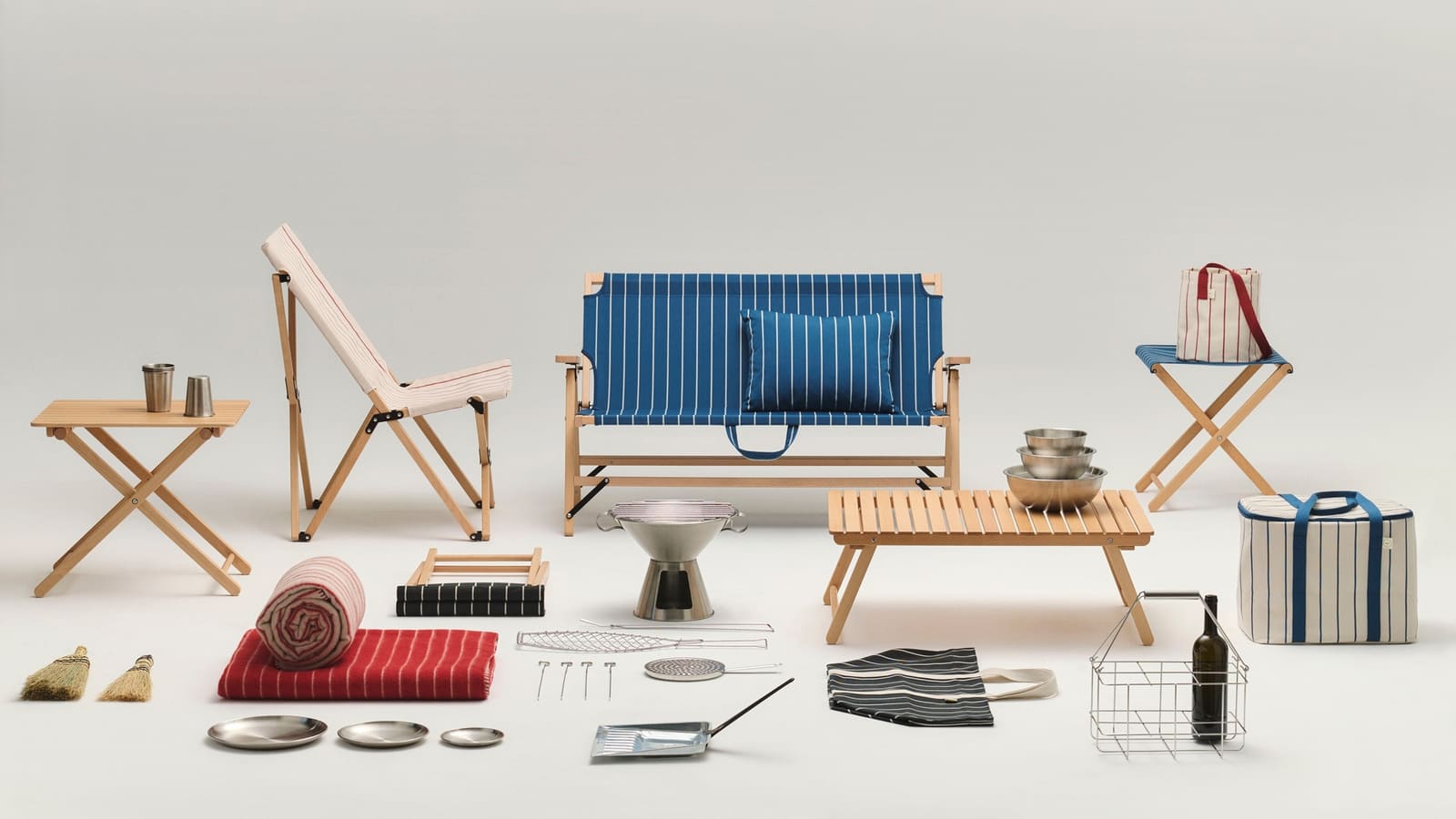
Outdoor Market is not a furniture collection in the conventional sense. It is a system of more than thirty pieces, folding chairs and sofas, hammocks, barbecues, cooler bags, steel tableware, textiles, brooms, that together propose a way of living outdoors rooted in simplicity and repetition rather than spectacle. Morrison, whose London shop has long championed anonymous utility, brings to the project a design language stripped of ornament. Every object here is legible at first glance, its function inseparable from its form.
Folding as Formal Logic
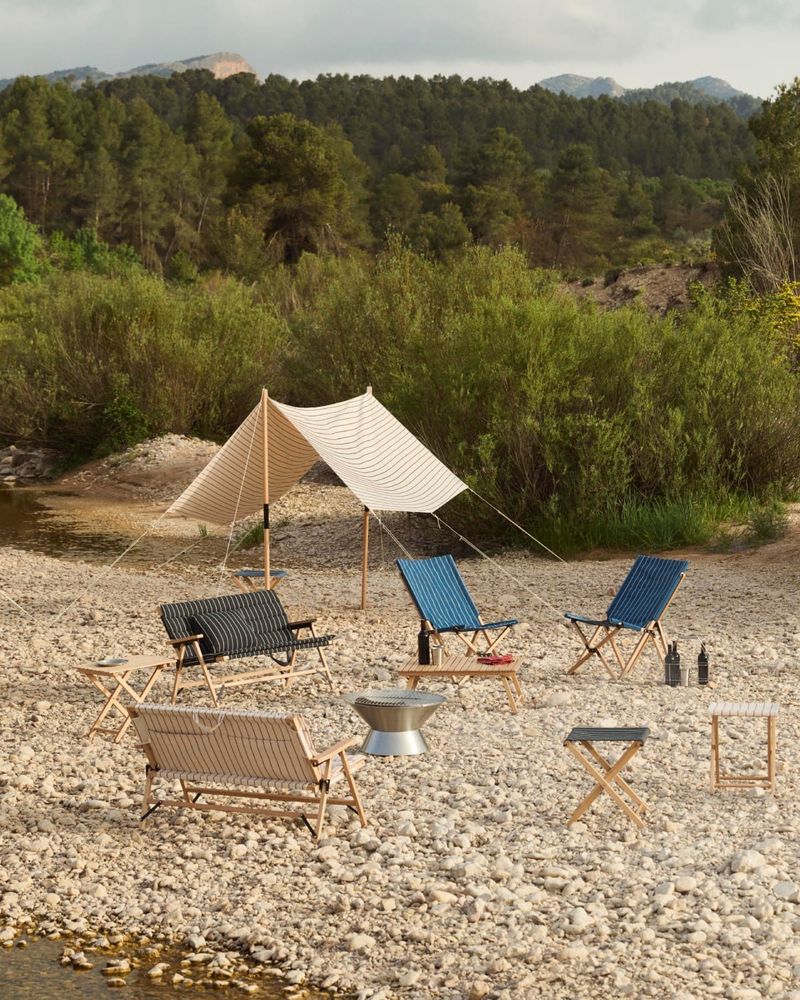
The core of the collection rests on a family of folding furniture: chairs, sofas, stools, and tables crafted from water-lacquered beech. The folding mechanism is not concealed but foregrounded, a tectonic expression of portability. Each piece collapses into a form compact enough to fit into a dedicated carrying bag, transforming furniture into luggage. This is not a new typology, camping gear has always negotiated the tension between structure and transport, but Morrison refines it, paring away excess until what remains is irreducible.
The Folding Chair, for instance, employs a frame geometry that distributes weight evenly while minimizing material. The beech slats are spaced to allow air circulation, a detail that responds to the realities of outdoor use: heat, moisture, the need for surfaces that dry quickly. The Folding Sofa extends the same logic to a two-person scale, its proportions calibrated to offer comfort without bulk. These are not lounge chairs designed for leisure estates but tools for nomadic domesticity, equally at home on a rooftop, a riverbank, or a public plaza.
The choice of water-lacquered beech is deliberate. The finish protects the wood from the elements while retaining a tactile warmth that powder-coated aluminum or injection-molded plastic cannot match. It is a material decision that signals durability without pretense, a refusal of the disposable aesthetics that dominate much seasonal outdoor furniture.
The Social Hearth, Reimagined
Morrison and HAY understand that outdoor living is rarely solitary. The collection includes a stainless steel BBQ and Fire Pit, objects designed to anchor social space. The Fire Pit, in particular, functions as a contemporary hearth, a focal point around which bodies gather. Its form is elemental: a perforated steel cylinder that allows airflow while containing embers. It references the archetype of the campfire without resorting to nostalgia, a reduction to first principles rather than a revival of rustic imagery.
Surrounding these anchors is a constellation of cooking tools and accessories. Stainless steel skewers, a toaster pan designed for open flames, insulated mugs, bowls with fitted lids. Each object is conceived not as a standalone product but as a component in a larger system. The cooler bag, for example, is sized to fit the steel bowls precisely, creating a nested storage logic. This is modular design in the truest sense, not the click-together modularity of prefabricated systems but the looser, more human modularity of objects that can be combined, recombined, and adapted to circumstance.
The tableware, all stainless steel, rejects the throwaway culture of plastic picnicware. Steel cups and bowls are heavier, yes, but they age rather than degrade. Scratches and dents become a patina, a record of use. In this, Morrison aligns with a longer tradition of utilitarian design, one that values longevity over novelty.
Textile as Memory
The striped patterns that appear across the collection's textiles, on seating, throws, and carrying bags, are not arbitrary. Morrison sourced the inspiration from a Basque textile he found at a flea market, a fragment of vernacular craft that carried the weight of everyday use. The stripes are woven from 100 percent recycled polyester, a material choice that reconciles nostalgia with contemporary imperatives around sustainability.
This is a subtle move. The stripes evoke the deck chairs and beach umbrellas of mid-century leisure, but they do so without pastiche. The colors are muted, the weave tight. The result is a textile that feels familiar without being sentimental, a visual language that bridges generations. It is worth noting that Morrison has long been interested in the design of overlooked objects, the kind of things that populate flea markets and second-hand shops, and his approach here is consistent: to honor the intelligence embedded in vernacular forms while translating them into a contemporary idiom.
The Hammock, another textile element, is designed for quick installation. It avoids the complex rigging systems of traditional hammocks in favor of a straightforward suspension method that requires only two anchor points. The fabric, again recycled polyester, is taut enough to support weight without sagging but flexible enough to conform to the body. It is a study in economy of means.
The Unnoticed Object
Among the collection's more unexpected inclusions are handcrafted brooms made by Japanese artisans. On the surface, this seems an odd addition to a line of outdoor furniture, but it reveals something essential about Morrison's design philosophy. Brooms are almost invisible, tools so ordinary that their design is rarely questioned. Yet a well-made broom, one with bristles that hold their shape and a handle balanced for prolonged use, is a pleasure to use. By including them in Outdoor Market, Morrison insists that design attention should extend to every object, not just the ones that photograph well or carry symbolic weight.
This aligns with the ethos of the Jasper Morrison Shop, which has always positioned itself as a curator of honest objects. The shop stocks not only Morrison's own designs but also anonymous industrial products, vintage finds, and vernacular tools, anything that demonstrates intelligence in its making. Outdoor Market can be read as an extension of that project, a collection that values utility over authorship.
Precedent and Context
The idea of camping equipment as a design category is not new. In the 1960s, Italian designers like Marco Zanuso and Richard Sapper explored folding furniture with pieces like the Lambda chair, which used injection-molded plastic to achieve structural rigidity in a collapsible form. Morrison's approach is different. Where Zanuso and Sapper embraced new materials and manufacturing techniques as ends in themselves, Morrison works within established craft traditions, water-lacquered wood, handwoven textiles, welded steel, and pushes them toward clarity rather than innovation for its own sake.
There are also echoes of the Scandinavian camping culture that HAY, as a Danish brand, inherits. The tradition of friluftsliv, or open-air living, emphasizes simplicity, respect for nature, and the value of unstructured time outdoors. Outdoor Market does not explicitly reference this tradition, but it operates within the same value system. The collection is not about conquest of the outdoors but about coexistence, about creating temporary structures that leave no trace.
Material Honesty, Structural Transparency
The materials used across Outdoor Market, beech, stainless steel, recycled polyester, are chosen for their durability and their capacity to age gracefully. This is a collection designed to be used hard and often, not stored away for special occasions. The water-lacquered beech resists moisture but will still weather over time. The stainless steel will tarnish. The polyester will fade. These are not flaws but acknowledgments of time, evidence that the objects have been lived with.
Morrison's design language has always favored transparency. Joints are visible, materials are legible, construction methods are evident. In the Folding Chair, you can see how the frame articulates, how the slats attach, how the whole thing collapses. This is not a fetishization of craft but a pedagogical clarity, a way of showing how things work. It demystifies design, which is, in its own way, a democratic gesture.
Beyond Seasonal Furniture
Most outdoor furniture is marketed as seasonal, objects that appear in showrooms in spring and disappear in autumn. Outdoor Market resists this logic. By framing the collection as a toolkit rather than a suite of matching pieces, HAY and Morrison suggest that these objects should be in constant use, brought out for a picnic, stored under a bed, deployed on a balcony, folded into a car trunk. The portability of the furniture is not a convenience feature but a conceptual shift, a proposal that outdoor living need not be tethered to a single location or a single season.
This aligns with broader shifts in how we inhabit space. Urban dwellers, particularly those in dense cities, increasingly treat public parks, rooftops, and sidewalks as extensions of their homes. The COVID-19 pandemic accelerated this tendency, but it predates the crisis. What has changed is the recognition that outdoor space is not a luxury but a necessity, and that the objects we use to inhabit it should be as thoughtfully designed as the ones we use indoors.
The Ecosystem of Objects
Outdoor Market is best understood not as a collection of individual products but as an ecosystem. Each object is designed to work in concert with the others, but none is indispensable. You can own just the Folding Chair, or just the Fire Pit, or the entire system. This flexibility is central to the project's logic. It refuses the totalizing vision of most furniture collections, which require you to buy into a complete aesthetic in order for any single piece to make sense.
The modularity here is social as much as formal. A family might use the collection one way, bringing the Folding Sofa and cooler bags to the beach. A group of friends might use it another, setting up the Fire Pit and BBQ in a park. A solo user might take only the Hammock and a steel cup. The collection adapts to different scales of use, different contexts, different needs.
What Endures
In an interview, Mette Hay noted a growing cultural appetite for slowing down, for finding joy in simple experiences. Outdoor Market can be read as a response to that appetite, but it is also a critique of the idea that simplicity requires sacrifice. These are not ascetic objects. They are comfortable, well-proportioned, pleasurable to use. What they reject is not comfort but excess, not beauty but decoration.
Morrison has spent his career arguing that the ordinary can be extraordinary if it is well made. Outdoor Market is perhaps the fullest expression of that argument. It takes the humblest category of design, camping gear, and treats it with the same seriousness that architects bring to buildings. The result is a collection that does not announce itself, that does not demand attention, but that quietly reshapes how we think about living outside. In a discipline often obsessed with the new, that kind of patience is rare.
Photo: Jasper Morrison and HAY
Save this story. A free account keeps your reading list and the 07:00 email in one place.
CREATE FREE ACCOUNT →SIGN IN