

The Studio as Laboratory
For decades, the discourse around design has pivoted on a single axis: the relationship between creator and industry. Whether modernist manifestos championing the machine aesthetic or postmodern critiques of commodification, the conversation has rarely escaped the gravitational pull of manufacturing. What happens, then, when we acknowledge that the factory is no longer the inevitable destination for every design idea?
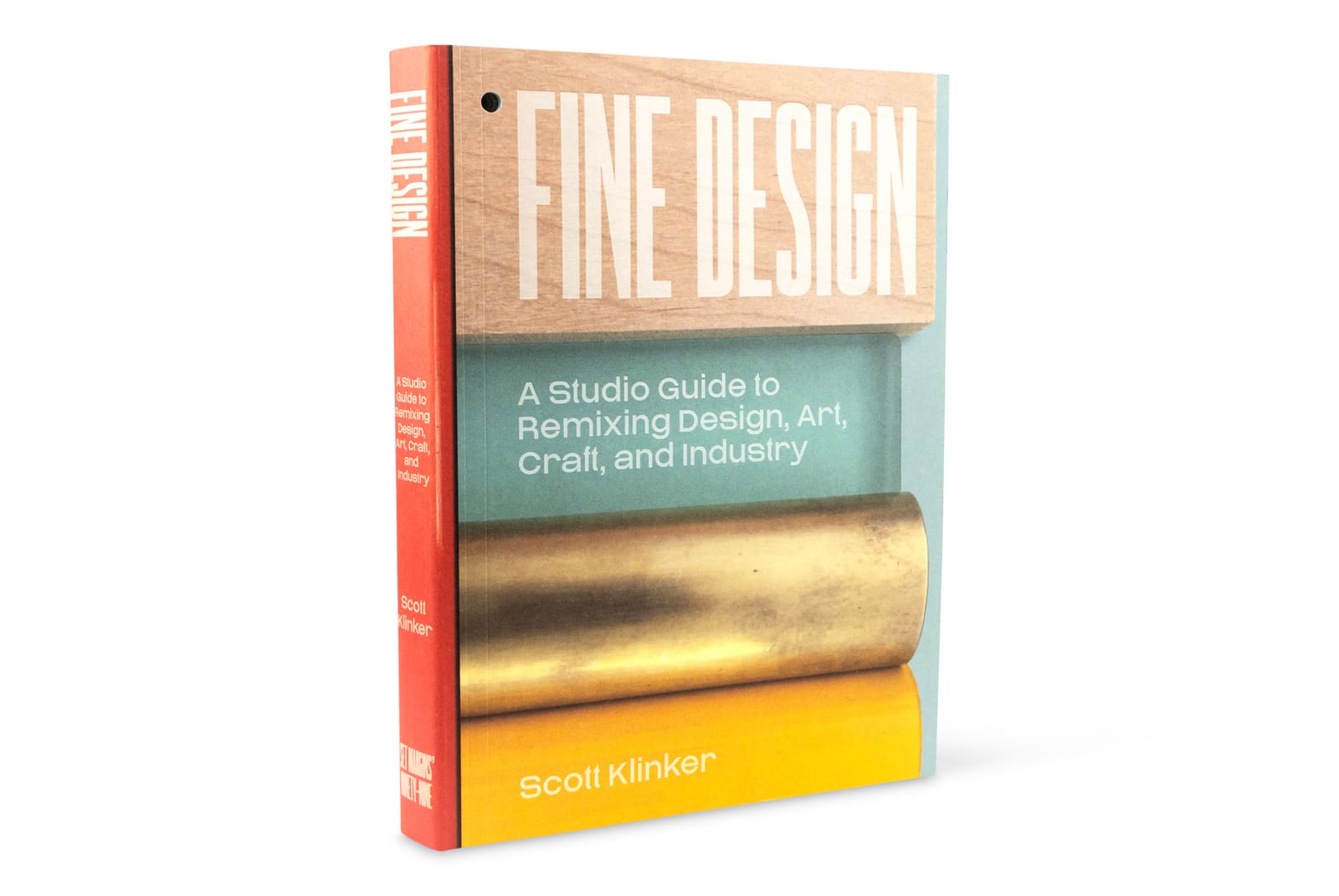
Scott Klinker's Fine Design offers a conceptual apparatus for practitioners who have already intuited this shift. The book does not present a manifesto so much as a taxonomy, a way of naming what many studios have been doing quietly for years: working at the intersection of art, craft, and design without apologizing for the hybridity. With a foreword by Andrew Blauvelt, the text situates itself within a lineage of design writing that seeks to expand, rather than police, disciplinary boundaries.
Material Intelligence Over Production Logic
At the core of Klinker's argument is the notion that contemporary design practice can be organized around material intelligence rather than industrial scalability. This is not a romantic return to pre-industrial craft, nor is it a rejection of technology. Instead, it acknowledges that digital fabrication, small-batch production, and direct-to-consumer models have fundamentally altered the economics of making.
Where twentieth-century design education trained practitioners to think in terms of tooling costs, minimum order quantities, and supply-chain logistics, Fine Design proposes a studio model in which these considerations are secondary to questions of materiality, form, and authorship. The designer becomes less an intermediary between client and manufacturer and more an investigator working within a specific set of material and conceptual constraints.
This shift has precedents. We have seen it in the work of studios like Formafantasma, whose research-driven practice blurs the line between design and curatorial inquiry, or in the output of Lindsey Adelman, whose lighting designs are as much about the performance of craft as they are about illumination. What Klinker provides is a language to describe these practices not as exceptions but as representatives of a broader realignment.
Authorship Without Apology
One of the more provocative threads in the book is its unapologetic embrace of authorship. In an era when participatory design and user-centered methodologies dominate institutional discourse, Klinker makes space for the designer as author, a figure whose vision and material expertise are central to the work's meaning.
This is not a call for ego-driven design. Rather, it is an acknowledgment that certain kinds of knowledge, particularly those rooted in sustained material experimentation, cannot be fully democratized or crowd-sourced. The studio, in this model, becomes a site of specialized inquiry, much as an artist's studio or a scientist's lab might be.
The comparison to fine art is deliberate. Fine Design draws on the art world's tolerance for limited editions, bespoke commissions, and gallery distribution, but it does so without abandoning design's functional imperatives. Objects produced under this framework are meant to be used, not merely contemplated. They occupy a zone that the market has struggled to categorize: too expensive for mass retail, too functional for the white cube, too conceptual for the furniture showroom.
Beyond Industrial Paradigms
Klinker's framework also makes room for practices that operate outside the client-commission model. This includes speculative projects, self-initiated research, and work produced for exhibition rather than sale. In doing so, it challenges the assumption that all design must be commercially viable at the moment of its creation.
This is where Fine Design diverges most sharply from industrial design orthodoxy. The latter has always been predicated on a clear path from prototype to production, from drawing board to market. But as cultural institutions increasingly commission designers, as biennales and design weeks proliferate, and as platforms like Kickstarter and Patreon enable direct audience support, the traditional gatekeepers of design production have lost some of their authority.
The result is a more fragmented but also more diverse ecosystem. Designers can pursue lines of inquiry that would never survive a corporate design review. They can work at scales, price points, and levels of conceptual ambition that would be impossible within a conventional product-development cycle.
The Risk of Marginalization
There is, of course, a risk in championing studio-based practice as a distinct mode of operation. It can easily become a boutique niche, celebrated in design media but disconnected from the broader material culture. If Fine Design is to be more than a justification for a privileged subset of practitioners, it must contend with questions of access, pedagogy, and economic sustainability.
How does one train for this kind of practice? What institutions support it? Who can afford to work this way, and who is excluded by the financial precarity that often accompanies it? Klinker does not claim to answer all of these questions, but by naming the practice, he opens the door for more systematic inquiry.
At World Archi Design, we have tracked the emergence of hybrid practices that resist easy categorization. From architects who design furniture as a form of tectonic research to product designers who treat each commission as an opportunity for material experimentation, the boundaries between disciplines have become productively porous. Fine Design offers a framework for understanding these overlaps not as disciplinary confusion but as a coherent, if still-evolving, mode of practice.
A Taxonomy, Not a Manifesto
What Klinker has produced is less a set of prescriptions than a set of coordinates. Fine Design does not tell practitioners what to make or how to work. Instead, it provides a conceptual map for those already operating in the spaces between established categories. It names a territory that has been occupied but not yet fully theorized.
In this sense, the book is most useful as a tool for self-recognition. For designers who have felt caught between the expectations of the art world and the demands of commercial production, between the autonomy of the studio and the constraints of the client brief, Fine Design offers a vocabulary and a lineage. It says: this is a legitimate way to work, and here are some of the intellectual resources you might draw on.
Whether this framework will gain traction beyond a certain subset of design practitioners remains to be seen. But as the economic and technological conditions that gave rise to industrial design continue to erode, the need for new models becomes more urgent. Fine Design is one contribution to that conversation, and a timely one.
Photo: Annette Behrens
Save this story. A free account keeps your reading list and the 07:00 email in one place.
CREATE FREE ACCOUNT →SIGN IN