
The New Frontier: From Object to Inner Experience
For decades, design has concerned itself with the relationship between the human body and the built environment. Scale, proportion, ergonomics, materiality: these were the terms through which we understood comfort, utility, and delight. But a new tendency is emerging, one that reaches beyond the physical envelope toward something more elusive. The question is no longer only how a chair supports the spine or how a doorknob fits the hand, but whether a wearable device can detect anxiety, whether a lamp can guide breathing, whether a garden rendered in pixels can visualize personal growth.
At World Archi Design, we have been tracking this shift across installations, product prototypes, and speculative systems. What we are witnessing is not merely the application of sensors to everyday objects. It is the ambition to make the invisible legible, to transform subjective emotional states into data that can be observed, interpreted, and acted upon. The implications are profound, and they raise questions that extend far beyond the domain of industrial design into psychology, ethics, and the politics of self-care.
The Premise: Emotion as Measurable Information
The core premise underlying these projects is that emotions, long considered private and subjective, can be quantified through biological markers. Heart rate variability, electrodermal activity, brainwave patterns, vocal tone: each becomes a proxy for inner state. This is not a new idea in clinical settings, where biofeedback has been used therapeutically for decades. What is new is the domestication of these techniques, their translation into consumer products and ambient systems that claim to support mental wellbeing without medical supervision.
Consider Map Project Office's Cognitive Bloom, developed with researcher Chanwoo Lee. The system combines a handheld interface that prompts reflective questions with a display that visualizes responses as a continuously evolving garden. Buds, leaves, and blossoms represent personal growth, translating introspection into a horticultural metaphor. The garden does not judge or diagnose; it simply grows, suggesting that the inner self is something to be cultivated rather than fixed. The metaphor is ancient, the interface is contemporary, and the result is a ritual that sits somewhere between journaling and gaming.
Or take Pulse Pack, a wearable bag by creative studio Konel. The object detects the wearer's heartbeat and translates it into gentle haptic pulses at a slower frequency, encouraging physiological calm. There is no screen, no notification, no interruption. The interaction is embodied, discreet, and continuous. The bag becomes a companion that whispers rather than shouts, a feedback loop that operates below the threshold of conscious attention.
Breathing, Light, and the Domestic Ritual
Several of these systems focus on breathing, arguably the most direct bridge between the autonomic nervous system and conscious control. Ohm, a lamp that guides resonant breathing exercises through light, sound, and haptic feedback, exemplifies this approach. A small stone element embedded with biometric sensors detects real-time physiological signals and adapts the rhythm of the session accordingly. The object is simple, almost minimal, designed to blend into the domestic environment rather than announce itself as a medical device. Resonant breathing, a technique that synchronizes breathing with heart rate, has been shown to activate the parasympathetic nervous system, promoting relaxation. Ohm translates this clinical practice into an everyday gesture, a ritual that requires no app, no login, no data dashboard.
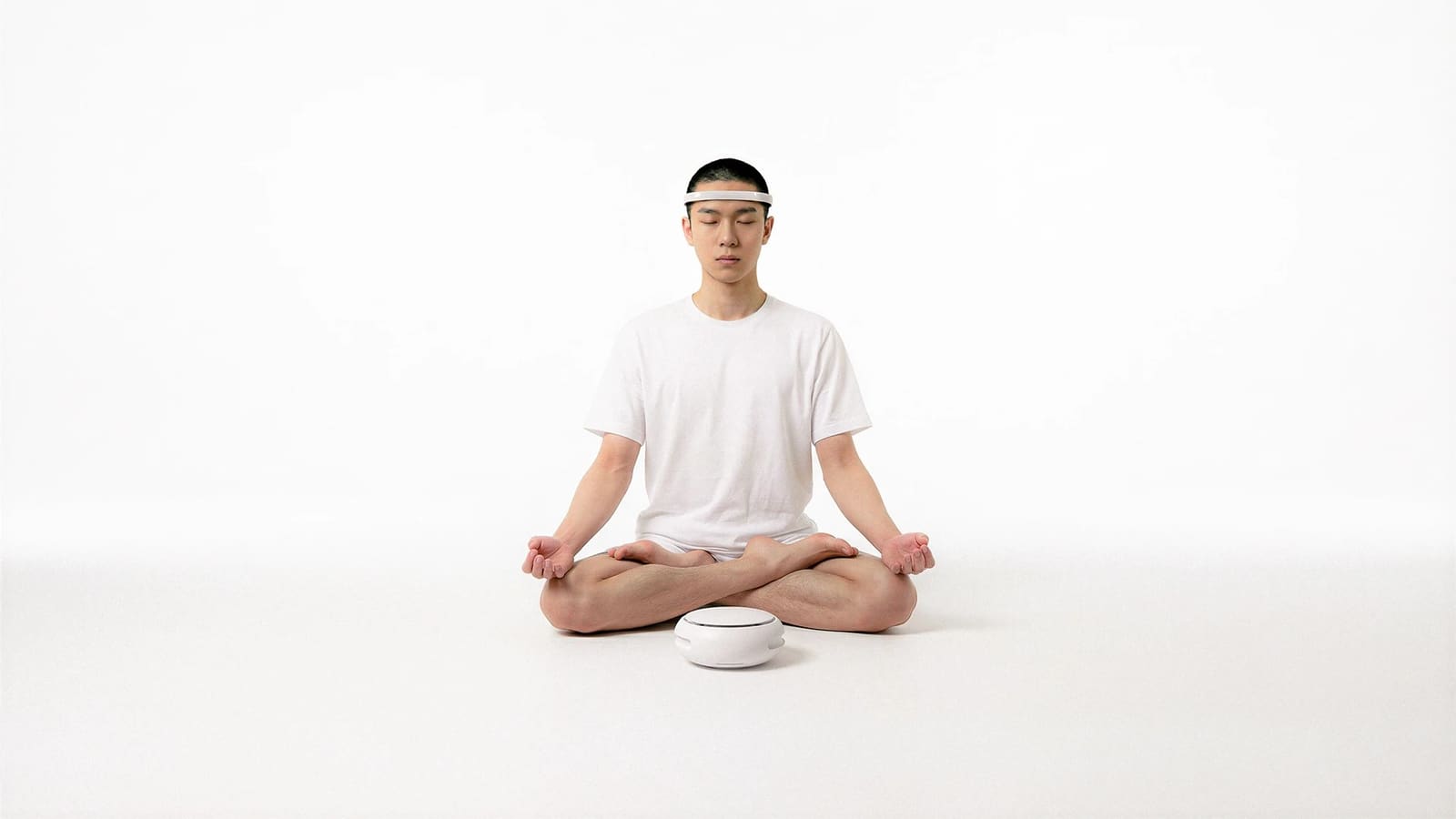
Siwoo Kim's Flow, developed through the Samsung Design Membership Intensive Course, takes a different tack. The system comprises two components: StillFlow, a headband and station for home use that provides real-time feedback through light and sound, and AirFlow, a set of earbuds that extends the practice beyond the home by adapting audio based on the user's state. Flow is explicitly designed to support meditation, using multimodal sensors to track physiological data during sessions. The ambition is to make meditation more accessible, to provide scaffolding for those who struggle with the practice, and to help users develop consistency over time.
These projects share a common strategy: they embed therapeutic techniques within objects that feel familiar, even comforting. They avoid the clinical aesthetic of medical devices and the intrusive logic of smartphone apps. Instead, they propose a middle ground, a space where self-care becomes part of the architecture of everyday life.
Beyond Monitoring: Memory, Ritual, and the Temporal Dimension
Not all of these systems operate in real time. Some take a longer view, focusing on memory and reflection rather than immediate feedback. Clover, a system designed by Seyeon Park, Jiwon Park, Yujin Song, Jina Kim, and Bin Son, consists of a voice recorder and a calendar that allows users to capture and revisit positive experiences. Memories are recorded and associated with specific dates, building a personal archive over time. The calendar brings these memories back through visualization and reflective prompts, encouraging users to reconnect with the sensations and emotions of past moments. The premise is simple: by preserving positive experiences, we can cultivate a more balanced relationship with our inner lives.
Clover does not measure stress or detect anxiety. It does not claim to intervene in real time. Instead, it creates a ritual of attention, a practice of noticing and returning. The design is modest, but the ambition is significant: to suggest that small, repeated actions can contribute to psychological wellbeing. This is a different model of care, one that emphasizes continuity and intentionality rather than optimization and control.
The Clinical Reimagined: Studio Pong's Wellbeing Collection
Studio Pong's Wellbeing collection takes yet another approach, reimagining the aesthetics of therapeutic products. The collection includes light therapy lamps, meditation speakers, nebulizers, and massage devices, all designed to integrate seamlessly into contemporary domestic environments. The materials are natural, the forms are soft, and the sensory experience is multisensory. The goal is to move beyond the cold, clinical aesthetic traditionally associated with medical products, making practices related to mental and physical wellbeing feel more accessible and less stigmatized.
This is design as translation: taking tools developed in clinical contexts and recoding them for everyday use. The challenge is not only technical but cultural. How do you signal care without signaling illness? How do you design for vulnerability without reinforcing it? Studio Pong's answer is to emphasize familiarity, to make these objects feel like companions rather than instruments.
Emotional Regulation as Wearable: The Case of Novan
Novan, developed by students at the Institute of Design at Illinois Institute of Technology, pushes further into the territory of emotional regulation. The bracelet uses tactile feedback to support users during moments of stress or discomfort, translating principles from cognitive behavioral therapy, dialectical behavior therapy, and eye movement desensitization and reprocessing into a wearable format. The device can be worn on the wrist, where it delivers gentle rhythmic stimulation, or held between the hands to activate an experience inspired by bilateral stimulation techniques used in trauma therapy.
This is perhaps the most ambitious of the projects surveyed here, because it attempts to translate complex therapeutic interventions into a consumer product. The risks are obvious: oversimplification, misapplication, the potential for harm if used without proper guidance. But the impulse is understandable. Therapeutic techniques are often inaccessible, expensive, and stigmatized. If a wearable device can provide even a fraction of the support offered by a trained therapist, the argument goes, it is worth pursuing.
The Fragile Boundary: Care or Control?
These projects raise a question that cannot be avoided: do these technologies help us understand ourselves better, or do they risk turning even our inner lives into something to be monitored, optimized, and controlled? The boundary is fragile. On one hand, making the invisible legible can be empowering. It can provide insight, support self-regulation, and reduce the isolation that often accompanies emotional distress. On the other hand, the quantification of emotion carries risks. It can reduce complex, ambiguous experiences to simple metrics. It can create new forms of self-surveillance. It can reinforce the idea that wellbeing is something to be achieved through constant effort and vigilance.
The precedent here is not reassuring. The wellness industry has a long history of co-opting therapeutic language and techniques, repackaging them as consumer products, and selling them as solutions to problems that may be structural rather than individual. These design projects, however well-intentioned, operate within this context. They must be evaluated not only on their technical merits but on their broader implications for how we understand care, agency, and the self.
What Design Can and Cannot Do
Design has always shaped experience. Spatial arrangements influence behavior, material choices evoke emotion, lighting alters mood. But the ambition to design for mental wellbeing is of a different order. It assumes that inner states can be influenced through external interventions, that the architecture of emotion can be mapped and modified. This assumption is not without foundation. Environmental psychology, neuroscience, and therapeutic practice all provide evidence that context matters, that small changes in environment or routine can have significant effects on mental state.
But there are limits. Design cannot replace therapy, community, or systemic change. It cannot address the root causes of distress, which are often social, economic, and political. What it can do is create conditions that support care, that make certain practices easier, more accessible, and more integrated into daily life. The challenge is to do this without overpromising, without suggesting that a wearable device or a smart lamp can solve problems that require far more than a better interface.
A Cultural Shift in Progress
These seven projects, diverse as they are in form and function, represent a broader cultural shift. Wellness is no longer only about the body. The mind, once considered the exclusive domain of psychology and psychiatry, is now a site of design intervention. Emotions are data, inner states are interfaces, and the domestic environment is a therapeutic landscape.
This shift is still in its early stages, and its outcomes are uncertain. The projects discussed here are prototypes, research explorations, speculative proposals. Some will become products, others will remain experiments. But together, they signal a new direction for design, one that demands not only technical skill but also ethical care, psychological literacy, and a willingness to ask difficult questions about what it means to design for the invisible architecture of the mind.
Save this story. A free account keeps your reading list and the 07:00 email in one place.
CREATE FREE ACCOUNT →SIGN IN