
When the Site Is the Experiment
Most institutional gardens serve as decoration, softening the edges of buildings with predictable plantings and paved paths. The Circulating Garden at Madrid's Circular Economy Innovation Center (CIEC) inverts that relationship entirely. Here, the landscape itself is the research apparatus, a 2,400-square-meter field where theories about resource cycles, material reuse, and urban ecology move from whiteboard to soil.
gaSSz arquitectos, led by Diego García-Setién and Silvia Sánchez, completed the project in 2025. The garden occupies the full extent of the CIEC plot in Vicálvaro, a district on Madrid's eastern periphery that has become a testing ground for the city's environmental ambitions. Rather than treating the outdoor space as ancillary to the center's indoor programs, the studio positioned it as an equal partner, a place where circular economy principles could be demonstrated at full scale and in real time.
The distinction matters. Circular economy discourse often remains abstract, confined to policy documents and corporate sustainability reports. A garden that embodies those principles, where visitors can observe decomposition cycles, material transformations, and closed-loop water systems, translates ideology into tangible experience. It's a move we've seen in recent years at facilities like the Resource Rows project in Copenhagen by SLA, where landscape becomes pedagogy.
Designing for Flux
The architectural strategy hinges on adaptability. gaSSz arquitectos conceived the garden not as a finished composition but as a framework capable of accommodating ongoing change. Pathways, planting beds, and gathering zones were organized to allow for periodic reconfiguration as research priorities shift or as certain material experiments reach completion.
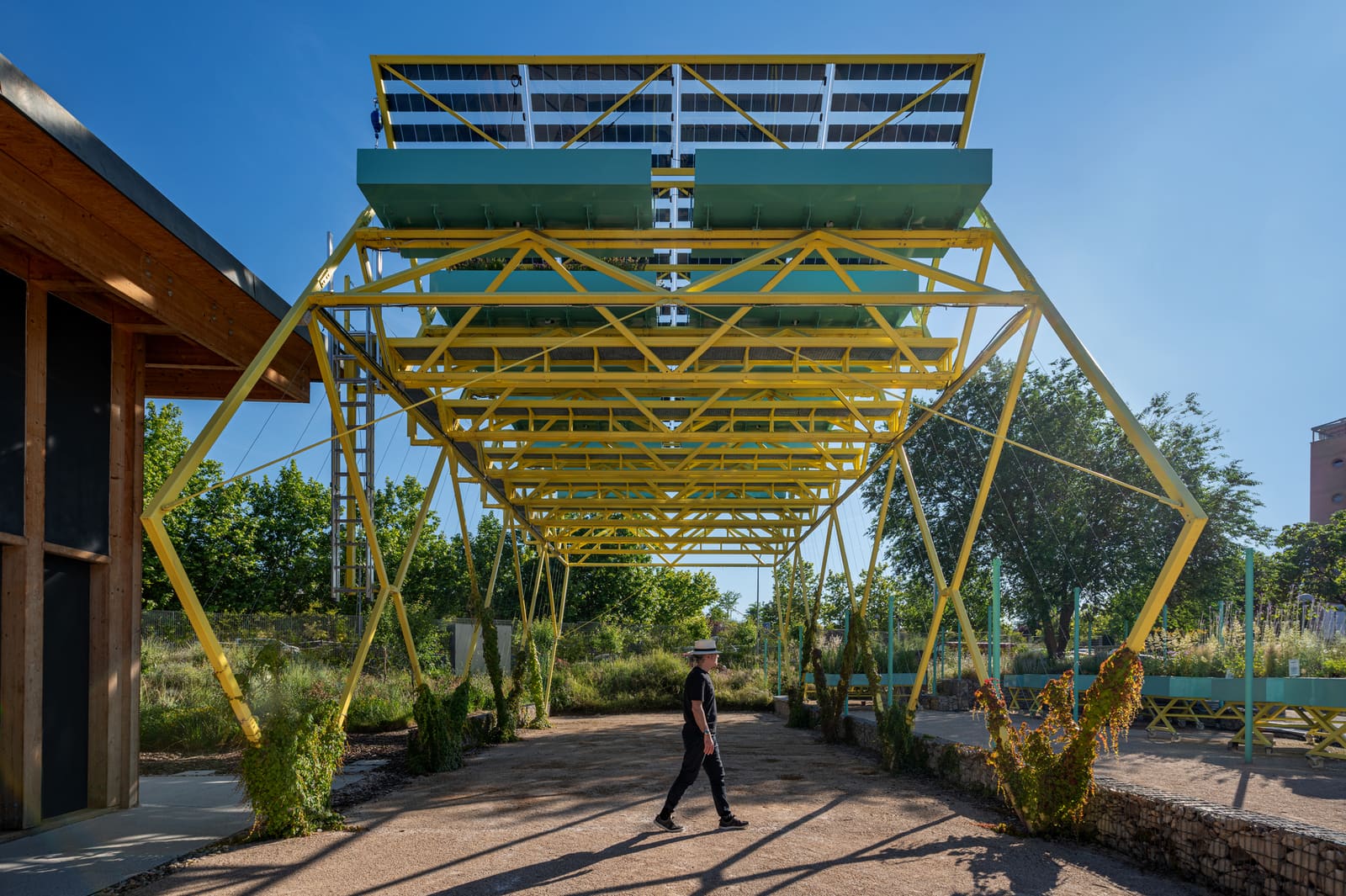
This approach required a different kind of detailing than conventional landscape architecture. Fixed elements, such as benches and planters, were fabricated from reclaimed materials sourced within Madrid's construction waste stream. Structural engineer Ricardo Cuevas collaborated with the design team, which included María Abad, Ainhoa Church, and Mario Beltrame, to ensure that salvaged components met safety standards without compromising their visible history. The result is a material palette that wears its provenance openly: weathered timber, repurposed steel, aggregate from demolished structures.
Water infrastructure, developed with consulting support from Antonio Moreno and SYLTEC, employs a closed-loop system. Rainwater harvesting feeds irrigation networks and experimental wetland cells, reducing potable water demand while providing data on gray water treatment performance. These systems are not hidden beneath the surface but exposed, legible to visitors as active components of the garden's metabolism.
Precedent and Departure
The Circulating Garden operates within a lineage of landscape projects that foreground process over permanence. One thinks of Peter Latz's Duisburg-Nord Landschaftspark, where industrial remnants were preserved and recolonized by vegetation, or more recently, the adaptive landscape strategies employed by James Corner Field Operations at Freshkills Park in New York. Both projects embrace temporal change and ecological succession as design tools.
What distinguishes the CIEC garden is its explicit didactic function. While Duisburg-Nord and Freshkills are primarily parks, spaces for recreation and contemplation, the Madrid site is first and foremost a demonstration facility. Every planting decision, every material choice, is intended to be read and questioned. Signage and interpretive elements, integrated subtly into the design, provide context without overwhelming the spatial experience.
This dual identity, as both functional landscape and educational exhibit, creates tension. The garden must perform aesthetically, offering a welcoming environment for public use, while simultaneously serving as a laboratory where experiments may fail, plants may die, and systems may require visible maintenance. gaSSz arquitectos navigated this by zoning the site: some areas prioritize visual coherence and comfort, while others are explicitly marked as test zones where rougher, more provisional conditions are expected.
Vicálvaro and the Urban Periphery
The garden's location in Vicálvaro is not incidental. This district, historically working-class and industrially focused, has been targeted by Madrid's municipal government for green infrastructure investment. The CIEC itself is part of a broader initiative to establish the area as a hub for environmental innovation, attracting research institutions, startups, and educational programs.
Situating the garden here rather than in a more central, affluent neighborhood carries political and social implications. It signals that circular economy infrastructure is not a luxury amenity but a practical necessity, equally relevant to peripheral districts as to historic cores. It also provides Vicálvaro residents with direct access to a high-quality public space, addressing longstanding disparities in green space distribution across Madrid.
The garden's design acknowledges this context. It functions as a neighborhood park as much as a research facility, with seating areas, shaded pathways, and open lawns that accommodate informal use. On weekends, families gather; on weekdays, CIEC staff conduct workshops and field studies. This programmatic overlap enriches both functions, grounding abstract research in everyday social life while elevating a local park into a site of metropolitan significance.
Material Legibility and the Aesthetics of Reuse
One of the project's most compelling gestures is its refusal to disguise the origins of its materials. In much contemporary architecture, sustainability is often invisible, hidden behind sleek finishes and polished surfaces. The Circulating Garden takes the opposite approach. Salvaged timber retains its original fastener holes and weathering patterns. Steel elements bear the marks of their previous installations. Aggregate pathways incorporate visible fragments of brick and concrete.
This aesthetic choice aligns with a broader movement in architecture and design toward material honesty, but it also serves a pedagogical purpose. By making the history of materials legible, the garden encourages visitors to rethink assumptions about waste and value. A length of timber that once framed a demolished building is not trash; it is a resource awaiting redeployment. The garden models this shift in perception at every turn.
There is risk in this strategy. Exposed wear and improvised assemblies can read as unfinished or neglected if not carefully calibrated. gaSSz arquitectos managed this through meticulous detailing and a clear hierarchy of finishes. High-traffic areas and gathering spaces feature more refined treatments, while experimental zones embrace a rougher aesthetic. The result is a landscape that feels intentional rather than haphazard, even as it celebrates imperfection.
The Garden as Urban Laboratory
The Circulating Garden extends the CIEC's mission into the public realm, transforming the entire plot into a field of inquiry. It demonstrates that circular economy principles are not merely technical adjustments to existing systems but require fundamental rethinking of how we design, build, and inhabit our cities. By making that rethinking visible and accessible, the garden becomes a pedagogical tool as much as a physical space.
As Madrid and other European cities grapple with resource scarcity, climate adaptation, and social equity, projects like this offer a model. They show that infrastructure can be both functional and expressive, that research facilities need not be sealed behind walls, and that the urban periphery can be a site of innovation rather than an afterthought. The Circulating Garden is small in scale, but its implications reach far beyond Vicálvaro.
Save this story. A free account keeps your reading list and the 07:00 email in one place.
CREATE FREE ACCOUNT →SIGN IN