
The Forgotten Interface
We open doors dozens of times a day. We pull drawers, press latches, grip handles. And yet we rarely pause to consider the sensory contract embedded in that gesture - the weight, the temperature, the grain under our fingertips. In a profession obsessed with form and space, hardware has long occupied a curious blind spot: essential but invisible, functional but rarely intentional.
Bankston, the Australian hardware brand, has spent the better part of a decade dismantling that oversight. This year, the company extended its argument beyond the architectural community with a pair of exhibitions staged in collaboration with For Scale, the interiors platform helmed by design critic David Michon. Mounted in New York and Copenhagen within the span of a month, the installations framed hardware not as specification detail but as tactile event - a deliberate counterpoint to the screen-mediated distance that defines so much of contemporary experience.
The thesis is deceptively simple: touch is information. And in architecture, the door handle is one of the few elements we are guaranteed to engage with physically, repeatedly, and often unconsciously. What happens when that engagement is designed with intention?
A Manifesto on Touch
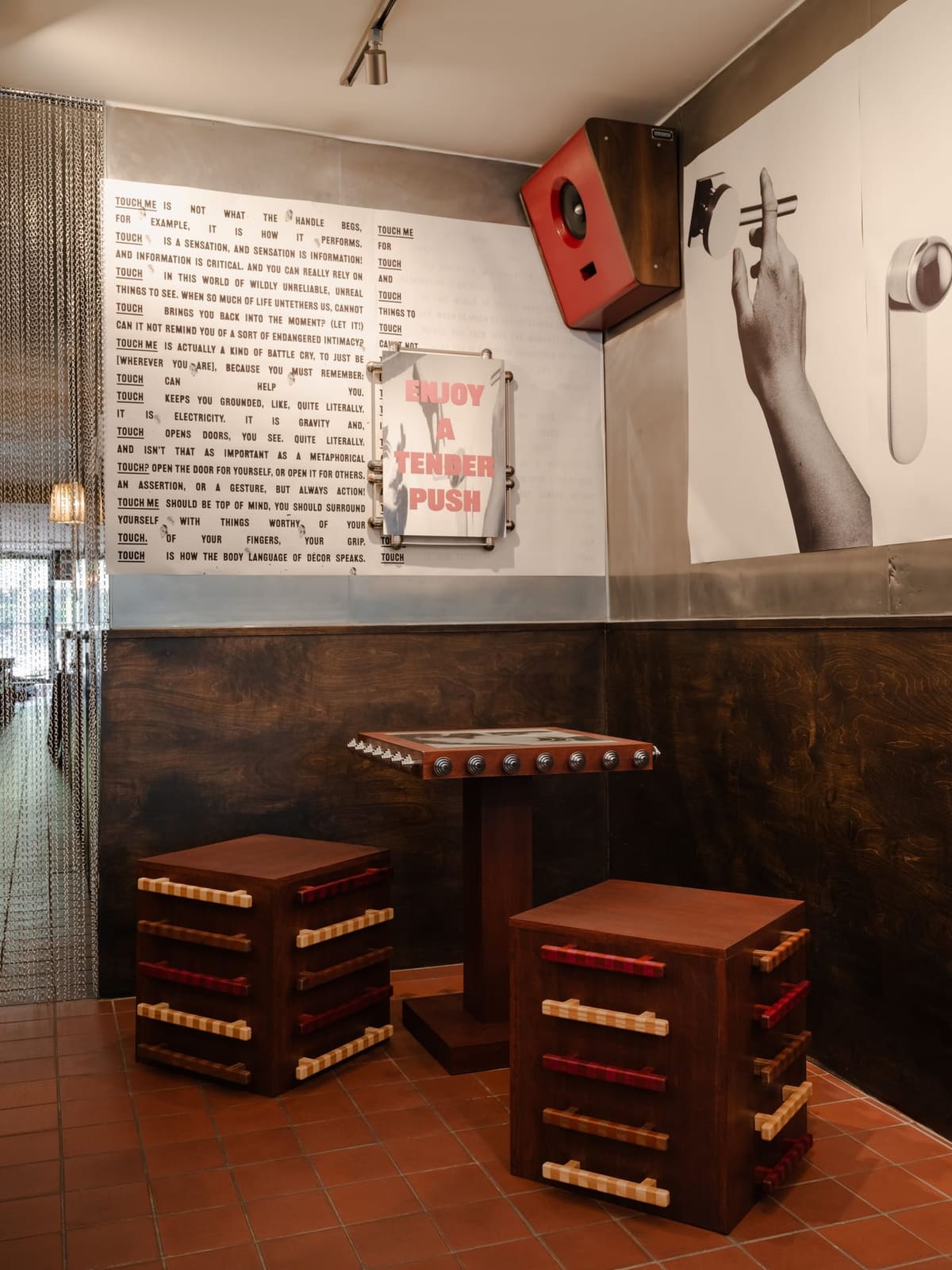
The collaboration debuted in May during NYCxDesign, when Bankston and For Scale transformed Colbo, a wine bar on Manhattan's Lower East Side, into a tactile laboratory. Titled A Manifesto on Touch, the installation centred on a written provocation by Michon - a meditation on sensation as a form of knowing, and hardware as a medium for that knowledge.
Custom furniture by Los Angeles artist Caleb Engstrom populated the space: stools and tables fitted with hardware from Bankston's catalogue, including the Super Collection by Sans-Arc Studio and The Streaks by YSG Studio. Mirrors edged with Civilian Projects' Hemispheres collection carried hand-painted excerpts from the manifesto, their surfaces reflecting both text and viewer. Visitors were invited to tear strips from posters mounted throughout the space - a gesture that collapsed the distance between observer and object. A rip is a pull, after all, and a pull is a kind of handle.
The move was characteristic of Michon's editorial practice, which tends to favour provocation over prescription. But it also reflected a broader ambition: to reposition hardware as an active participant in spatial experience rather than a passive component. At For Scale, Michon has long argued that interiors are constructed not just through material and colour but through sequence, ritual, and touch. Hardware, in this reading, is the hinge - literal and metaphorical - between intention and inhabitation.
How to Handle
A month later, the partnership reconvened in Copenhagen for 3daysofdesign, this time with an expanded installation titled How to Handle. Developed in collaboration with spatial set designer Currie Ritchie and Engstrom, the presentation borrowed the visual vocabulary of manifestos and protest graphics - bold typography, high contrast, layered messaging - to frame hardware as something worth rallying around.
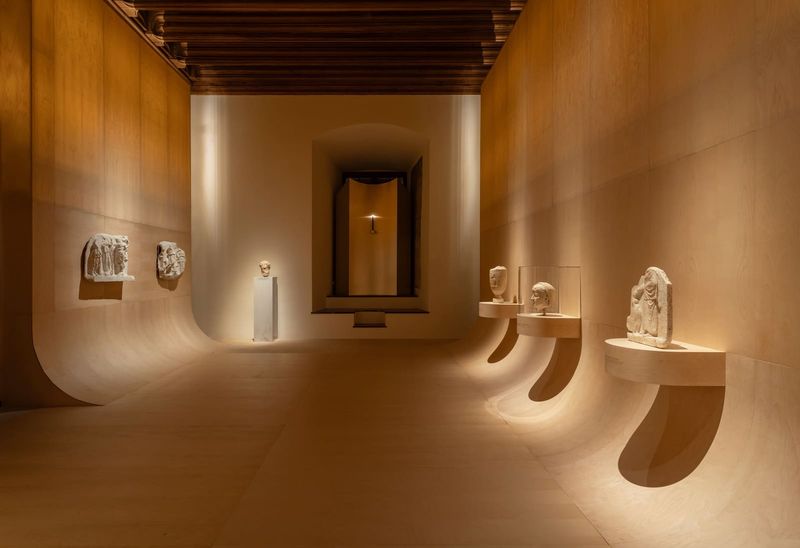
The space was not a showroom but an environment to be used. Visitors were encouraged to open, grip, press, and manipulate. Casts by Edition Office, Super Collection, Hemispheres, and The Streaks were installed not on plinths but as functional elements embedded in the architecture of the installation itself. The effect was immersive and slightly disorienting: hardware as protagonist, space as script.
The Streaks, in particular, anchored both presentations. Designed with Yasmine Ghoniem of YSG Studio and launched at the previous year's 3daysofdesign, the collection comprises timber levers, pulls, and joinery pieces distinguished by horizontal banding - a subtle articulation that registers as both graphic and haptic. The grain shifts direction at each band, creating a tactile rhythm that rewards close attention. It remains one of the more inventive responses to the lever typology in recent memory, and its presence lent both exhibitions a sense of material confidence.
The Bankston Model
Bankston operates less like a conventional manufacturer and more like a curatorial platform. Each collection in its catalogue is authored by a different architecture or design studio - Sans-Arc, YSG, Edition Office, Civilian Projects - and each is developed with a high degree of formal and conceptual autonomy. The result is a portfolio that reads less like a product line and more like a series of design arguments, each advancing a distinct position on materiality, proportion, or detail.
It is a model that privileges specificity over universality, and it has allowed Bankston to occupy a particular niche within the Australian design landscape: hardware as editorial gesture. The brand does not attempt to offer something for everyone. Instead, it offers something very particular for designers who value authorship and are willing to specify accordingly.
The partnership with For Scale extends that logic into the realm of exhibition and discourse. By staging the work in cultural contexts - wine bars, design festivals - rather than trade environments, Bankston signals an interest in reaching beyond the architecture profession to engage a broader design-literate public. The exhibitions are less about selling hardware than about asserting a point of view: that the built environment is experienced not just visually but physically, and that the quality of that physical engagement matters.
The Case for Sensation
Michon's manifesto, which threaded through both installations, made the case that sensation is not supplementary to design but constitutive of it. We understand space through movement, temperature, texture, weight. A cold brass handle in winter. The resistance of a heavy door. The slight give of timber under pressure. These are not incidental details but the substance of inhabitation.
In an era increasingly mediated by screens - where so much of our daily interaction is gestural but immaterial - the argument for physical engagement carries a particular urgency. Architecture has always been a discipline of embodied experience, but the profession has not always been good at articulating that dimension. We have precise language for fenestration and massing, for tectonic expression and spatial sequence. We have far less vocabulary for the moment your hand meets the door.
Bankston and For Scale are attempting to build that vocabulary. The exhibitions were not didactic; they did not lecture. Instead, they created conditions for noticing - spaces where the act of opening a door or pulling a drawer became momentarily strange, and therefore visible.
Forward
The two-city format was strategic. NYCxDesign and 3daysofdesign represent different nodes in the global design calendar, each with its own audience and tenor. By presenting in both, Bankston positioned itself within an international conversation about materiality, craft, and sensory design - a conversation that has gained traction in recent years as a counterbalance to the digital sublime.
Whether the exhibitions translate into broader cultural impact remains to be seen. Hardware is not an easy sell, conceptually or commercially. It is expensive to produce well, difficult to photograph, and often undervalued by clients who view it as a line item rather than a design decision. But for practices that understand the cumulative effect of detail - the way a building is experienced not as a single image but as a sequence of small, repeated gestures - hardware is one of the most leveraged investments available.
Bankston has built its practice around that understanding. The exhibitions with For Scale simply made it explicit. At their core, both presentations advanced the same proposition: that design is not something we look at but something we live with, and that the quality of that living is determined, in part, by the things we touch. In a profession that privileges the visual, it is a surprisingly radical claim. And in an increasingly intangible world, it is one worth holding on to.
Save this story. A free account keeps your reading list and the 07:00 email in one place.
CREATE FREE ACCOUNT →SIGN IN