
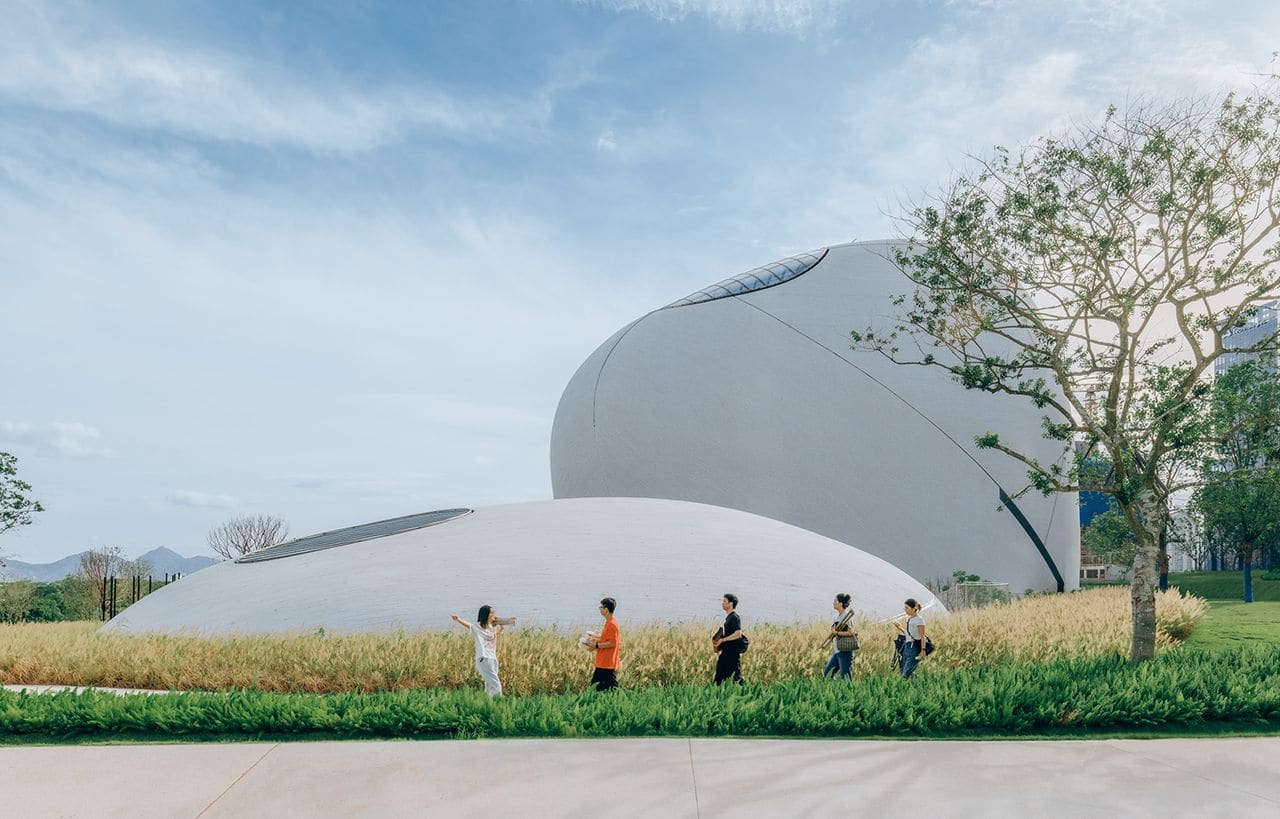
The Paradox of Building "Ancient" in a City Without History
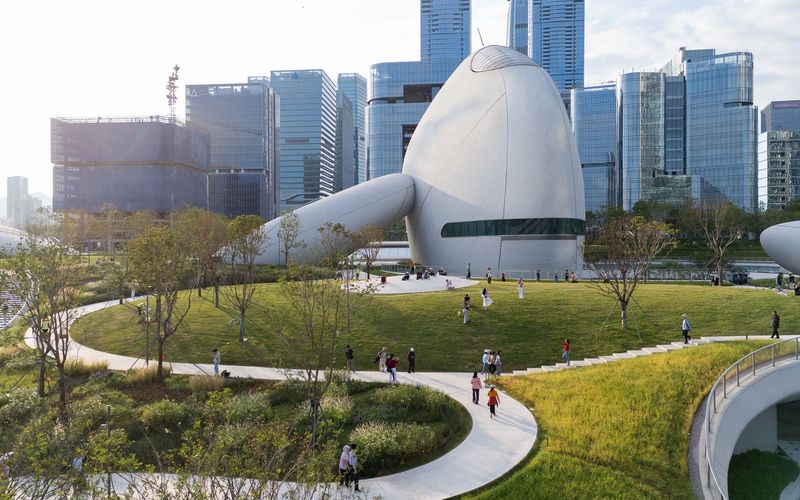
Shenzhen is younger than many people who live there. Founded as a special economic zone in 1980, it has spent four decades constructing its identity entirely in the present tense, one glass tower at a time. So when Beijing-based practice MAD completed the Shenzhen Bay Culture Square, a sprawling 18.8-hectare cultural complex whose stone-clad forms evoke geological formations, the project arrived with an inherent contradiction: here was a building attempting to suggest permanence and deep time in a metropolis that has never paused long enough to accumulate either.
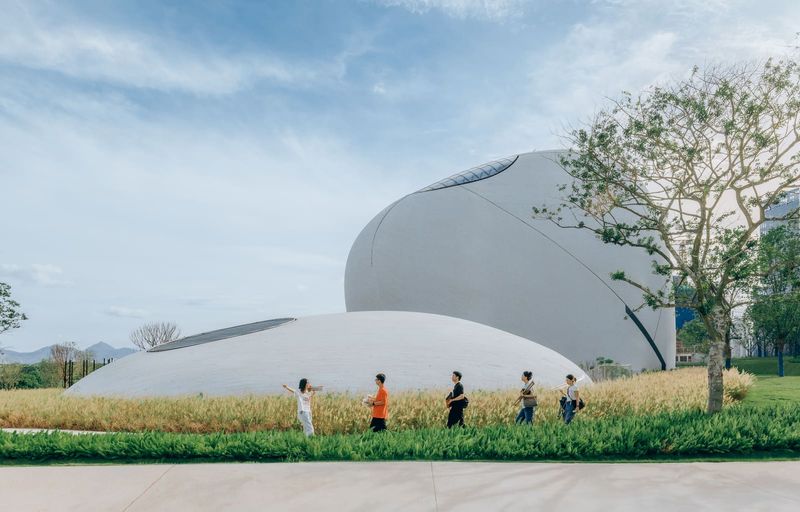
Yet against the backdrop of Houhai's International Style financial district, those undulating volumes read less as nostalgic pastiche and more as something genuinely speculative. The complex houses museums, performance halls, retail, and public amenities beneath a series of flowing roof planes that rise and fall like topography shaped by water. Rather than punctuating the skyline, the project dissolves into it, offering an alternative model for what civic monumentality might mean in a context already saturated with vertical icons.
Landscape as Public Infrastructure
At World Archi Design, we've been tracking the evolution of what MAD founder Ma Yansong calls the "Shanshui City," a framework that attempts to reintegrate natural forms and urban experience within dense metropolitan environments. Shenzhen Bay Culture Square represents perhaps the most complete realization of that vision to date, not because it mimics nature but because it borrows nature's organizational logic: horizontal layering, topographic variation, and circulation structured around wandering rather than efficiency.
The complex is sited along the western waterfront, positioned to function as a threshold between city and sea. Its massing strategy deliberately rejects the object-building model in favor of something closer to infrastructure. Visitors are invited to move across the roofs, descend into courtyards carved from the mass, and navigate spaces connected by organic openings rather than conventional corridors. Cantilevered escalators link different levels, their elegant geometry reinforcing the sense that this is a building designed for movement, not stasis.
This is architecture that prioritizes choreography over iconography. The roofs are accessible, the terraces function as public plazas, and the building's relationship to the waterfront is porous rather than monumental. In a city where most cultural institutions assert their presence through height and enclosure, MAD has proposed a model that invites dispersion and exploration.
Material Tactics and Tectonic Ambiguity
The studio's approach to cladding deserves close attention. The entire complex is wrapped in small stone blocks, their orientation shifting subtly across the facades to follow the curvature of the underlying forms. This strategy serves two purposes. First, it makes possible the cladding of mathematically complex surfaces without resorting to panelized systems that would flatten the geometry. Second, and more interestingly, it disguises the project's actual scale. By breaking down the mass into a field of small, repetitive elements, MAD avoids the visual weight that typically accompanies buildings of this size.
Compare this to earlier projects like the Harbin Opera House or the Absolute Towers in Mississauga, where the sculptural forms were celebrated for their strangeness, their refusal to conform to rectilinear urban grids. Those buildings announced themselves as interventions, alien presences that disrupted their contexts. Shenzhen Bay Culture Square operates differently. The soft curves and the granular materiality read as invitation rather than provocation. The building suggests that it has always been there, or at least that it might have been.
Inside, the spatial sequences reinforce this sense of discovery. The exhibition hall crowning the northern pavilion is a volume of such scale that its low lighting and minimal detailing take on an almost sacred quality. Elsewhere, a lecture theater materializes at the end of a warm, wood-lined corridor, its brilliant illumination a stark contrast to the dim passageway that precedes it. These moments of spatial drama recall the science-fictional sensibility that characterized MAD's earlier work, but they are deployed here with greater restraint, embedded within a larger system rather than presented as singular spectacles.
Cultural Infrastructure and National Ambition
Shenzhen's trajectory has been defined by speed. It went from fishing village to manufacturing hub to technology capital in less than half a century. Now, as the anchor city of the Greater Bay Area, a sprawling megalopolis of 11 cities and nearly 90 million people, it is positioning itself as a cultural powerhouse. The numbers are staggering: the region's combined economy rivals that of several major nations, and Shenzhen itself is home to Huawei, BYD, and Tencent, companies that shape global markets.
In this context, cultural projects carry weight beyond their immediate programs. They are expected to function as destinations, landmarks, and symbols of confidence, both domestically and internationally. Tencent is building an AI museum nearby. The pressure on architecture to deliver not just functional space but also narrative and identity is immense.
MAD's response is to shift the terms of the conversation. Rather than producing another iconic object that broadcasts ambition through sheer verticality, the studio has proposed a building that operates at ground level, that prioritizes public access over visual spectacle, and that measures success not by its ability to dominate a skyline but by its capacity to organize collective life. This is a radical gesture in a context where height and visibility have long been synonymous with importance.
Dissolving the Monument
Perhaps the most striking aspect of Shenzhen Bay Culture Square is what it refuses to do. It does not compete with the towers that surround it. It does not attempt to out-icon the icons. Instead, it proposes an architecture of immersion, where the building becomes a field condition rather than a discrete object, where boundaries between interior and exterior are blurred, and where the experience of the project is fundamentally about movement through space rather than the contemplation of form from a distance.
In a city built on the logic of verticality, where every new tower is a bid for attention and every skyline photograph is a measure of progress, MAD has introduced something that encourages people to look sideways. To wander. To occupy the ground plane as if it were not already claimed by circulation and commerce but instead available for pause, for gathering, for the kind of unscripted public life that density often displaces.
This is not to say the project is without precedent. The lineage runs through landscape urbanism, through Metabolist megastructures, through the terraced social condensers of Soviet constructivism. But it is rare to see these ideas deployed at this scale, in this context, with this level of material and spatial refinement. Shenzhen Bay Culture Square suggests that monumentality need not be synonymous with dominance, that cultural infrastructure can be generous rather than imposing, and that even in a city as relentlessly future-oriented as Shenzhen, architecture can propose a slower, more layered experience of time and place.
Whether this model can be replicated, whether it will influence the wave of cultural projects now under construction across China, remains to be seen. But as a statement about what public architecture might aspire to in the 21st century, it is difficult to ignore. In attempting to dissolve into its surroundings rather than tower over them, MAD has produced a building that may be more memorable precisely because it refuses to shout.
Save this story. A free account keeps your reading list and the 07:00 email in one place.
CREATE FREE ACCOUNT →SIGN IN