
The Curatorial Brief
There is a particular kind of spatial problem that emerges when two entities with deep, separate histories are asked to occupy the same address. Not a merger, exactly, but a cohabitation that must honour difference while acknowledging shared ground. At World Archi Design, we've been tracking how cultural institutions approach this tension, and the new King's Cross headquarters shared by Island Records and EMI offers an unusually refined answer: treat the brief not as branding exercise, but as exhibition design.
The 18-month collaboration between Interesting Projects and Studio Island, the labels' in-house creative team, began from a specific precedent. Holly Williams, creative director at Studio Island, points to the Keith Haring retrospective at Tate Liverpool in 2019 as the conceptual anchor. That exhibition's spatial intelligence, its ability to balance archival rigour with visual energy, became the template for how two music labels might share square footage without diluting their distinct identities.
James Mason and Joana Filipe, directors of Interesting Projects, describe their approach as building "a museum to the labels". The language is telling. Museums don't flatten difference; they sequence it, create thresholds, allow objects and images to carry narrative weight. That thinking runs through every decision in this King's Cross project, from entrance choreography to the placement of a single photograph.
Two Thresholds, Two Personalities
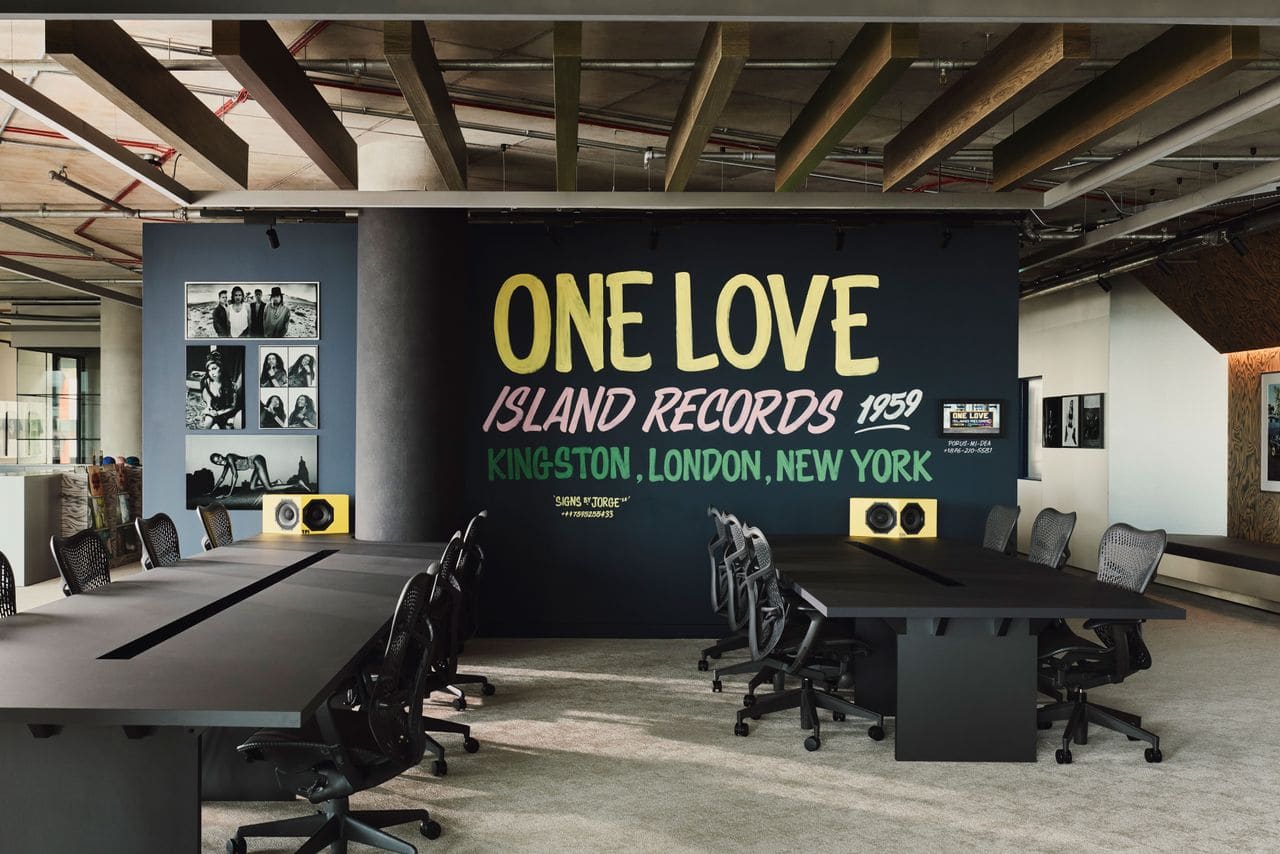
The entrance to Island Records is staged as performance space. Its base references carnival sound systems, a direct nod to the label's foundational relationship with Jamaican music and diaspora culture. The threshold opens onto a mural of Bob Marley's "One Love", painted by British-Jamaican signwriter SignsbyJorge. The mural is a twin to an original in Jamaica by the Nurse Signs Collective, and both carry the signwriters' mobile numbers, painted directly into the composition. Williams explains the logic: if you need a mural, you know who to call. It is a gesture that collapses the distance between art object and working practice, between display and utility.
EMI's entrance takes a different tack entirely. Here, the space functions as curated archive: memorabilia, photography, correspondence. One letter criticises the label's decision to sign the Sex Pistols. Another wall traces nearly a century of British music milestones, including the fact that King George VI's 1939 speech declaring Britain's entry into the Second World War was recorded at Abbey Road. The EMI threshold is less stage than library, less performative than documentary.
Further into the EMI territory, a textile piece by Corbin Shaw titled "Just Four Lads From Liverpool" reworks Burberry check into a Beatles homage. Williams notes that Shaw was the top choice for EMI because his practice explores Britishness, identity, and often masculinity. The Burberry check, a pattern so loaded with class signifiers and subcultural appropriation, becomes the perfect material language for a label whose roster has always been entangled with questions of British identity.
The Shared Territory
The two labels meet in the kitchen and dining areas, and here the spatial choreography becomes more subtle. A window was cut into the kitchen wall, framing a photograph of a young Amy Winehouse from the Frank era. The image sits on the Island side. Opposite, in a separate eating space, a matching window opens onto EMI's red wall, where Shaw's Beatles textile sits in conversation with an iconic shot of the Spice Girls.
These windows function as sightlines, allowing each label's visual language to remain visible from the other's space without collapse or confusion. It is a technique borrowed directly from museum practice: the carefully framed view, the controlled adjacency. Louis Bloom, president of Island Records EMI Label Group, describes the office as embodying a shared ethos while celebrating distinct identities. The windows make that claim legible in built form.
Precedent and Pedagogy
The project invites comparison with other instances where architecture has been asked to hold multiple institutional identities. The Fondation Louis Vuitton in Paris, designed by Frank Gehry, houses both the Vuitton collection and temporary exhibitions, using discrete galleries and circulation paths to maintain curatorial independence. Closer to the scale of this King's Cross project, the recent Soho House headquarters in London used archival displays and artist commissions to create a sense of institutional memory within a working office.
What distinguishes the Island and EMI headquarters is the degree to which the design relies on commissioned work rather than found objects. SignsbyJorge's mural, Shaw's textile, a Jeremy Deller artwork in the listening room: these are not decorative additions but structural elements of the spatial narrative. The office functions as ongoing commission, a live site where artists continue to shape how the labels understand their own histories.
Williams emphasises the pedagogical dimension of the project. EMI's history mural alone spans nearly a century, and staff and artists have learned more about the labels' pasts through the art on the walls. This is spatial design as archive, but also as curriculum. The office teaches its occupants.
Material Choices and Tectonic Expression
The material palette throughout the headquarters leans toward rawness and texture. Exposed brick, painted signage, bespoke TPI speakers mounted in corridors. There is little of the high-gloss, acoustically sealed aesthetic that often characterises music industry offices. Instead, the space reads as porous, permeable. The "Pump Up the Volume" curtain by Interesting Projects, visible in one of the informal meeting spaces, uses textile as both acoustic treatment and graphic gesture, a move that recalls the way Herzog & de Meuron used printed scrim at the Tate Modern's Switch House to modulate light and transparency.
The decision to foreground artisanal techniques, particularly signwriting, aligns with a broader shift we've observed in recent commercial interiors. As digital fabrication becomes ubiquitous, there is renewed interest in the hand-painted, the bespoke, the traceable. SignsbyJorge's inclusion of his mobile number is not just practical; it is a statement about labour, visibility, and the social life of images.
Looking Forward
The Island and EMI headquarters in King's Cross offers a model for how institutional identity can be spatialised without resorting to branding cliches. The project does not attempt to synthesise two legacies into a single visual language. Instead, it creates a field of adjacencies, sightlines, and thresholds where difference remains legible. It is an approach that requires restraint, a willingness to let artworks and archival materials do the heavy lifting rather than imposing a unifying design gesture.
As more cultural organisations face consolidation or co-location, the question of how to preserve institutional memory while fostering collaboration becomes urgent. This project suggests that the answer lies not in compromise, but in curation: in treating space as a medium for storytelling, in commissioning artists whose practices already engage with questions of identity and history, and in trusting that architecture can hold complexity without resolving it.
Save this story. A free account keeps your reading list and the 07:00 email in one place.
CREATE FREE ACCOUNT →SIGN IN