
The Contradiction at the Heart of Pool Design
There is something fundamentally paradoxical about building for water. Architecture, by nature, is about permanence, about drawing lines in space and holding them firm. Water refuses such constraints. It spreads, evaporates, reflects, and constantly reshapes the environment it inhabits. The aquatic center, then, becomes a study in contradiction: a building type that must hold fast to something inherently uncontainable.
At World Archi Design, we've been tracking how contemporary practices negotiate this tension. The results reveal far more than technical problem-solving. These projects articulate a broader question about how architecture mediates between human ritual and natural phenomena, between the choreographed and the spontaneous.
Rituals of Entry and Immersion
Everyone who has entered a pool carries a memory of that threshold moment. Some approach with hesitation, testing the temperature with a cautious toe. Others plunge without pause, seeking the shock of submersion. These small, personal rituals are repeated millions of times across the world, yet each aquatic center stages them differently.
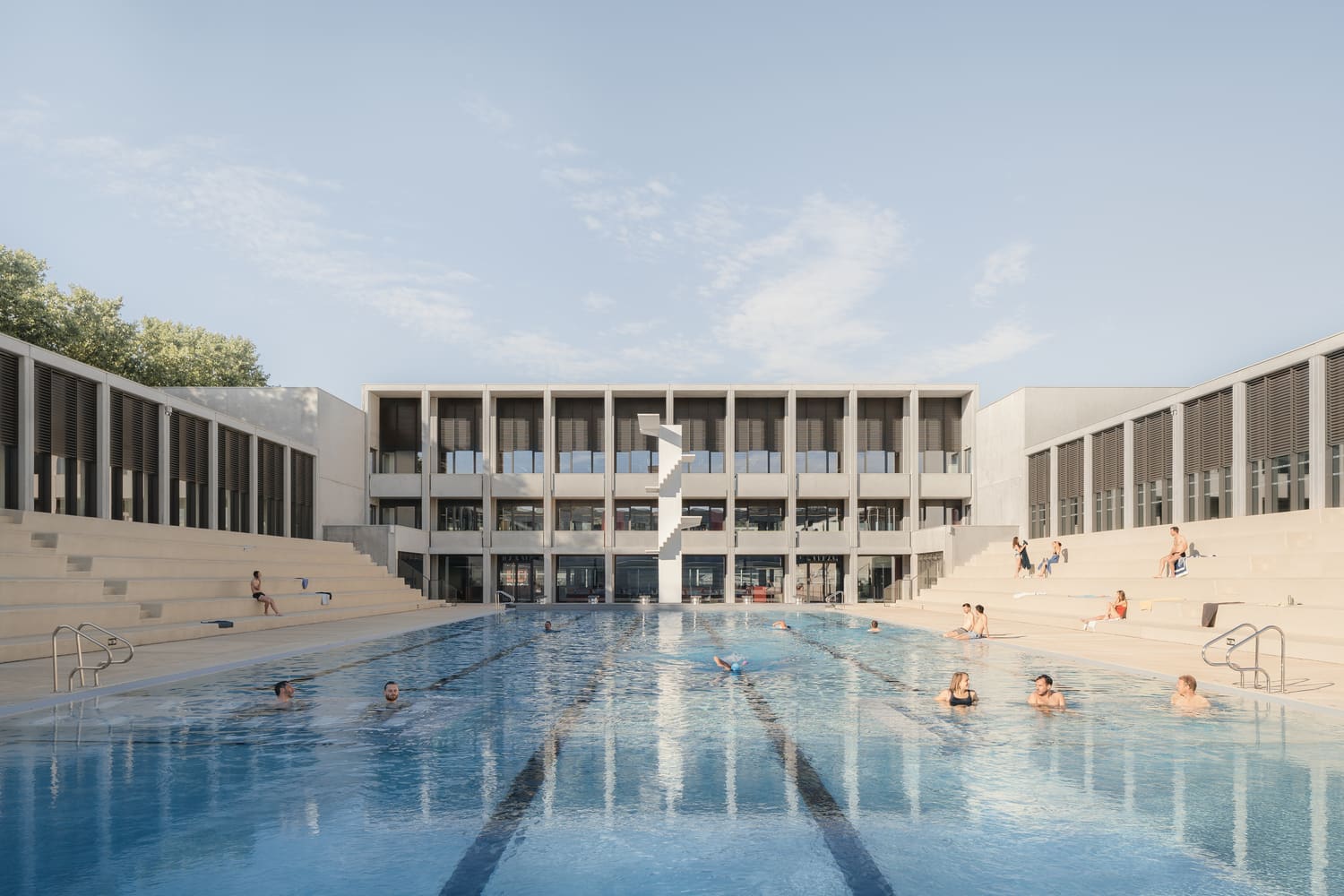
The choreography begins long before the water's edge. Circulation through changing rooms, the transition from dry to humid air, the acoustic shift from hard surfaces to the muffled resonance of a pool hall, all these elements shape how the body prepares for immersion. In projects like the Gerland Aquatic and Sports Center by 4_32 architecte, the spatial sequence acknowledges these rituals without over-determining them. The architecture provides framework, not script.
What distinguishes successful aquatic architecture is its capacity to hold space for both the competitive swimmer counting laps and the child learning buoyancy for the first time. These are not merely different programs but different relationships to water itself: one instrumental, the other exploratory. The building must accommodate both without privileging either.
Material Consequences of Constant Moisture
Water does not remain politely within its basin. It escapes as vapor, as splash, as humidity that permeates every surface. This invisible migration places extraordinary demands on material selection and detailing. Metals corrode, timber swells, concrete wicks moisture through capillary action. The aquatic center is, in effect, a building under permanent siege.
Contemporary practices have responded with increasingly sophisticated envelope strategies. High-performance vapor barriers, stainless steel fixings, and chemically resistant coatings are now standard. Yet the most compelling projects go beyond defensive measures. They understand moisture not as enemy but as condition, designing spaces where the presence of water in the air becomes legible, even celebrated.
Thermal mass plays a critical role here. Concrete, when properly detailed, can moderate the humidity swings that make poorly designed pool halls feel oppressive. The slow release and absorption of heat creates a more stable microclimate, reducing the energy load required for mechanical conditioning. In this sense, the tectonic choices are inseparable from environmental performance.
Light, Reflection, and the Dissolution of Surface
Perhaps no aspect of aquatic architecture is more striking than its relationship to light. Water transforms illumination into something dynamic and unpredictable. Caustic patterns dance across ceilings, walls dissolve into shimmering planes, and the boundary between solid and liquid becomes ambiguous.
This optical quality has fascinated architects for generations. From Aalto's undulating pool ceilings to Zumthor's precisely controlled apertures at Vals, the interplay between water and light has been a recurring preoccupation. Contemporary projects continue this investigation, but with access to computational tools that allow unprecedented control over reflection patterns and daylight distribution.
Large-span roof structures present both opportunity and challenge. The desire for column-free swimming halls often leads to dramatic structural gestures, but these must be reconciled with the need for controlled natural light. Too much glazing creates glare and heat gain; too little results in oppressive, artificially lit spaces. The most successful schemes modulate daylight through orientation, shading devices, and carefully positioned clerestories that bring illumination without direct sun on the water surface.
Acoustic Environments and the Sound of Water
Sound behaves strangely in aquatic centers. Hard, waterproof surfaces create long reverberation times, amplifying every splash, shout, and whistle into a cacophonous wash. Yet water itself absorbs sound, creating pockets of relative quiet. The result is an acoustic environment unlike any other building type.
Addressing this requires more than standard absorption panels. The high humidity rules out many conventional acoustic materials, and those that can withstand the moisture often have limited effectiveness. Some recent projects have turned to volumetric strategies instead, using ceiling geometries and spatial articulation to break up sound reflections before they accumulate into overwhelming noise.
There is also the question of what sounds should be heard. The splash of a dive, the rhythmic breathing of a swimmer, the laughter of children, these are integral to the experience of an aquatic center. Over-dampening can create a sterile, lifeless atmosphere. The goal is not silence but intelligibility, an acoustic environment where individual sounds remain distinct rather than merging into a continuous roar.
Collective Landscapes and Urban Integration
Aquatic centers increasingly function as civic anchors, particularly in dense urban contexts where access to natural water bodies is limited. They become surrogates for the river, lake, or sea, offering not just recreational opportunity but a space for collective gathering around water.
This civic dimension shapes architectural expression. Where once aquatic facilities were utilitarian boxes hidden behind fencing, contemporary examples assert themselves as public buildings. Transparent facades invite visual connection from the street, roof forms become recognizable landmarks, and surrounding landscapes are designed as extensions of the pool hall itself.
The integration of outdoor pools, splash pads, and sun terraces blurs the boundary between building and landscape. In temperate climates, these hybrid spaces can be occupied year-round, creating a gradient of thermal and spatial conditions rather than a binary division between inside and outside. The result is a more permeable, inclusive public realm.
Precedents and Continuities
The aquatic center as a building type has a surprisingly rich lineage. Roman thermae established the model of bathing as social ritual, with elaborate spatial sequences moving from cold to warm to hot water. Nineteenth-century municipal baths brought this tradition into the industrial city, often with exuberant architectural expression that signaled their civic importance.
Modernism stripped away much of this ornament but retained the emphasis on light, air, and structural clarity. Projects like the Stadionbad by Bonatz and Scholer demonstrated how concrete could span large volumes while expressing its structural logic. The Olympic pools of the mid-century, from Tokyo to Munich, further refined the typology, integrating spectator seating and sophisticated mechanical systems.
Contemporary practice inherits this trajectory but with expanded programmatic complexity. Today's aquatic centers must accommodate competitive swimming, recreational play, hydrotherapy, fitness classes, and often climbing walls or other non-aquatic activities. The challenge is to maintain spatial coherence while serving these diverse functions.
Sustainability and the Energy Intensity of Heated Water
Aquatic centers are among the most energy-intensive building types. Heating large volumes of water, maintaining air temperature and humidity, and providing adequate ventilation all require substantial mechanical systems. This creates a tension between civic aspirations and environmental responsibility.
Recent projects have explored various strategies to reduce operational energy. Heat recovery from pool water and exhaust air can significantly lower heating loads. Solar thermal panels, when properly sized and integrated, provide renewable energy for water heating. Some facilities have implemented demand-responsive systems that adjust environmental conditions based on occupancy patterns.
Yet there remains a fundamental inefficiency inherent to the program. Water must be heated, air must be conditioned, and both must be maintained at precise parameters for health and comfort. The most honest approach may be to acknowledge this intensity while working to minimize it through passive strategies and efficient systems, rather than claiming false sustainability credentials.
Forward Trajectories
As we look across the aquatic centers designed and built in recent years, certain patterns emerge. There is growing sophistication in how these buildings manage their complex environmental requirements. There is also a renewed attention to the experiential qualities that make aquatic architecture distinct: the play of light on water, the transition between dry and wet, the communal rituals of swimming.
The tension between architecture and water remains unresolved, and perhaps that is as it should be. These buildings succeed not by dominating the fluid element they contain but by establishing a productive dialogue with it. They create conditions for immersion, for play, for the quiet contemplation that comes from watching light move across a pool's surface.
In an era of increasing urbanization and climate pressure, aquatic centers offer something increasingly rare: a space where communities gather around an elemental experience. The architecture that holds these spaces carries a responsibility not just to contain water efficiently but to honor the rituals, both individual and collective, that unfold within them.
Photo: Vladimir de Mollerat du Jeu
Save this story. A free account keeps your reading list and the 07:00 email in one place.
CREATE FREE ACCOUNT →SIGN IN