
When Dreams Become Gardens
A labyrinth built for a man who could not see it. This is the essential paradox of the Borges maze on San Giorgio Maggiore, and perhaps the most fitting tribute to Jorge Luis Borges, the Argentine writer whose fiction turned repeatedly to questions of infinity, recursion, and the limits of perception. Forty years after his death, the installation has been comprehensively restored, its 1,150 meters of boxwood hedging trimmed back to clarity, its weathered infrastructure renewed. The work was supported by PwC Italia.
The origins lie in a friendship and a premonition. In 1979, Randoll Coate, then press secretary at the British embassy in Buenos Aires, woke from a dream in which Borges had died. Writing to a mutual acquaintance, he outlined a plan: to create a labyrinth inspired by the author's short story 'The Garden of Forking Paths', whenever that day arrived. Seven years later, after Borges' death in 1986, Coate fulfilled the promise. The first maze materialized in Argentina. Its success prompted Borges' widow, Maria Kodama, to propose versions in other locations meaningful to the writer. Venice, a city whose canals and alleyways form their own unmappable network, was an obvious choice.
The Tectonic Logic of Type and Hedge
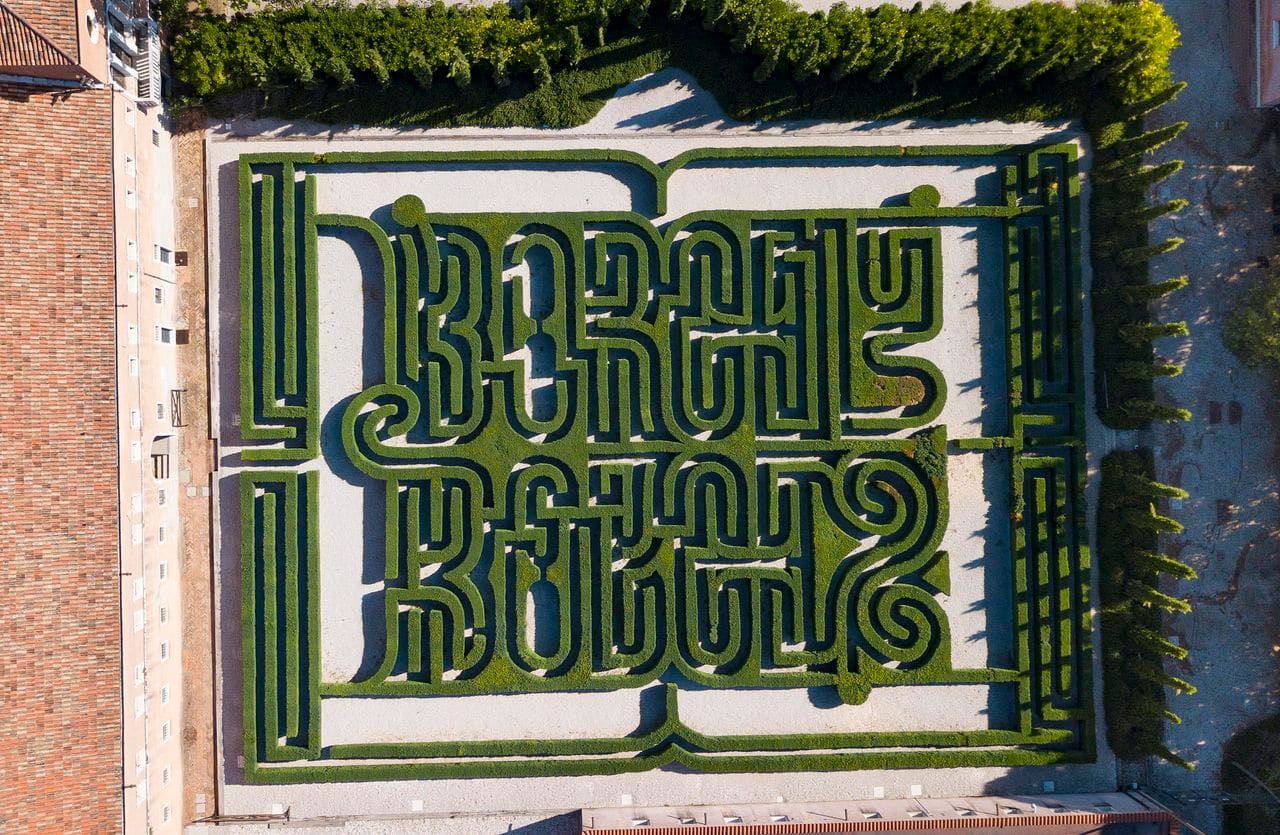
The installation opened in 2011, twenty-five years after Borges' passing. Coate's design arranges boxwood plants within a cordon steel skeleton, forming the outline of an open book. On each 'page', the writer's surname appears in mirrored, intertwined typography. Embedded within the perimeter are symbols: a question mark, a cane, a pair of eyes. Pedro Memelsdorff, musical director of the Giorgio Cini Foundation, describes these as invitations to remember why the labyrinth was planted, calling it a monumental tribute for future generations.
The choice of boxwood is both practical and poetic. Hardy enough to withstand Venetian winters and salt air, the species also allows for the fine articulation required to render letterforms legible from above. The cordon steel frame acts as armature and boundary, protecting the planting from wind while reinforcing the geometry. In this sense, the labyrinth operates less as traditional landscape architecture and more as a kind of three-dimensional typography, a text you navigate rather than read.
At World Archi Design, we have tracked a handful of literary gardens over the years, from the Goethe Park in Rome to the Derek Jarman Prospect Cottage garden in Dungeness. What distinguishes the Borges installation is its commitment to formal abstraction. Where other memorial landscapes lean toward naturalism or nostalgia, Coate's design embraces the modernist grid, the typeface as spatial device, the hedge as line drawing.
Restoration as Transplant
Renata Codello, Secretary General of the Giorgio Cini Foundation, frames the restoration in biological terms. She likens the labyrinth to a mosaic, with each plant a tile that can live or die. Maintenance is not periodic but constant, an ongoing negotiation with organic material. During the recent intervention, 165 boxwood plants were removed due to death or severe damage. The irrigation system, responsible for maintaining color and vigor, was inspected and repaired where necessary.
The challenge now is integration. As Codello notes, the older plants must accept the new ones, much like a body responding to an organ transplant. There is no guarantee. Over the fifteen years since the original planting, change was inevitable. Paths have widened or narrowed. Weeds encroached and were removed by hand. Soil was revitalized with additional fertilization. The restoration seeks not to freeze the labyrinth in time but to reset its trajectory, allowing it to age with renewed coherence.
This tension between control and entropy is central to all living architecture. Unlike concrete or steel, which degrade predictably, plants respond to microclimate, disease, competition, and human error. The Borges labyrinth is less a finished object than a continuous performance, requiring choreography and vigilance. It recalls the work of landscape architects like Piet Oudolf, whose perennial schemes at the High Line in New York and Hauser & Wirth Somerset depend on seasonal cycles and careful stewardship. But where Oudolf celebrates succession and spontaneity, Coate's design demands precision. The typography must remain legible. The symbols must hold.
Designing for Touch in a Visual Medium
The restoration introduces a new element: a tactile map at the entrance, developed in collaboration with the Italian Union of the Blind and Visually Impaired. Visitors can now feel the structure of the labyrinth, tracing its twists and turns before entering. The addition is both practical and symbolic. Borges lost his sight gradually, becoming completely blind at fifty-five. He spent the final decades of his life navigating the world through sound, memory, and the descriptions of others. His later stories are suffused with this condition, returning obsessively to mirrors, libraries, and labyrinths, spaces defined by their infinite recursion and the impossibility of mastery.
The tactile map reframes the labyrinth as an experience accessible to those who cannot see it. This is rare in landscape architecture, a discipline that privileges the visual above all other senses. Even biophilic design, with its emphasis on sensory engagement, tends to foreground sight. The Borges installation challenges that hierarchy. It asks what it means to design a garden for someone who experienced the world primarily through literature and imagination.
There are precedents. The Garden of Five Senses in Delhi incorporates textured pathways and aromatic plantings. The Fragrant Garden in Brooklyn Botanic Garden offers Braille labels and raised beds. But these are typically conceived as accommodations, additions to an otherwise visual experience. The Borges labyrinth, by contrast, embeds blindness into its conceptual DNA. The tactile map is not an afterthought but a recognition of the central paradox: that the maze honors a man who would never have seen it, and perhaps would have preferred it that way.
Memory, Iteration, and the Garden as Text
Borges was drawn to Venice throughout his life, returning to the city multiple times and writing about it with a mixture of fascination and unease. In his essay 'The Disinterested Artifice', he describes Venice as a place where time collapses, where past and present coexist in the same frame. The city's physical structure, with its canals and bridges forming an intricate network without clear hierarchy, mirrors the narrative structures he explored in his fiction: forking paths, infinite regress, stories that loop back on themselves.
The labyrinth on San Giorgio Maggiore extends this logic into three dimensions. It is both a memorial and a puzzle, a space that invites wandering without promising resolution. Unlike classical labyrinths, which offer a single path to the center, Coate's design allows for multiple routes, dead ends, and reversals. The experience is disorienting, which is precisely the point. Borges was suspicious of certainty, of narratives that claimed to offer definitive answers. His stories resist closure. The labyrinth does the same.
In this sense, the restoration is not merely about plant health or aesthetic consistency. It is about maintaining the conditions for a particular kind of encounter, one that privileges ambiguity over clarity, process over product. The new boxwood plants will grow. The paths will shift again. The steel frame will rust. And visitors will continue to enter, guided by touch or sight or memory, tracing the outlines of a writer's name in a language made of leaves.
The Labirinto Borges is now open to the public on San Giorgio Maggiore.
Photo: Fondazione Giorgio Cini
Save this story. A free account keeps your reading list and the 07:00 email in one place.
CREATE FREE ACCOUNT →SIGN IN