The Glass Pavilion Goes Mobile
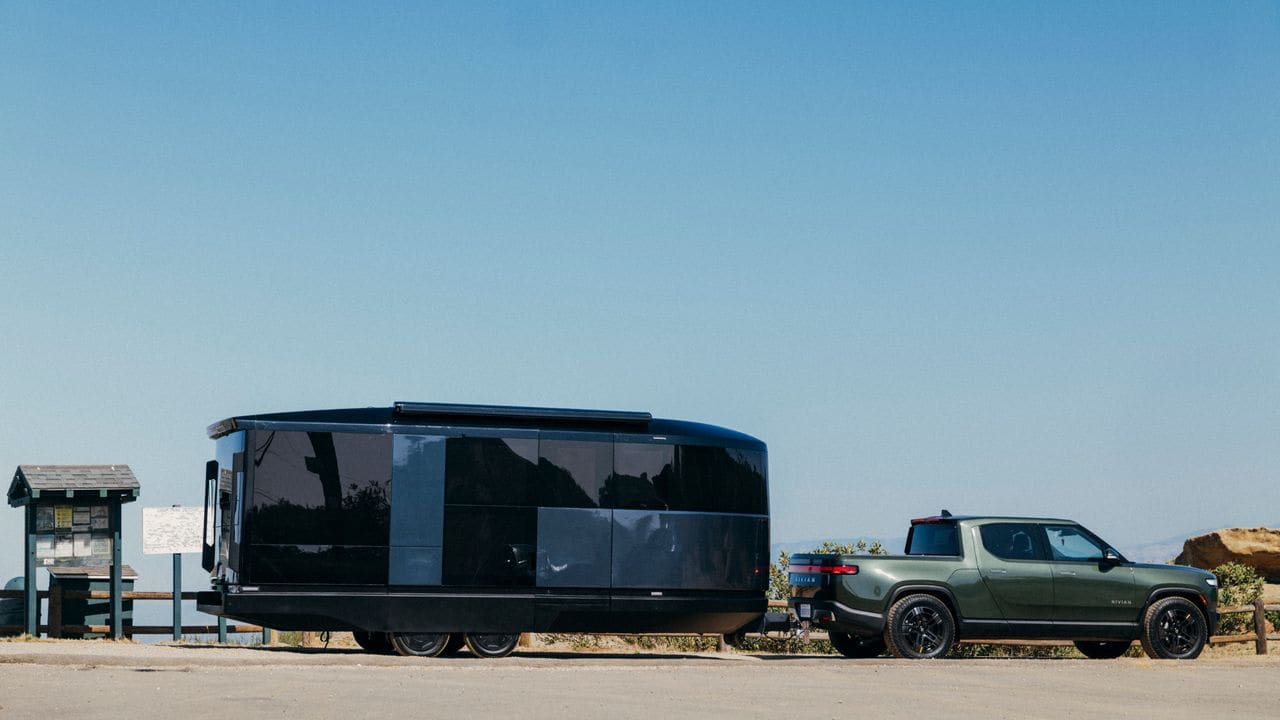
There is a moment in every architectural movement when its formal language escapes the fixed site and begins to wander. Mid-century modernism gave us Airstream's aluminum monocoque; today, California's glassy, light-filled residential idiom is finding new expression in a four-wheeled format. Aboard, a California venture, has designed its T4 travel trailer not as a recreational vehicle in the traditional sense but as a relocatable pavilion, one that privileges transparency, spatial flow, and the erasure of boundaries between interior and landscape.
The T4 measures twenty-five feet in length and eight feet in width, dimensions that place it squarely within the towing capacity of most electric and hybrid vehicles. Yet its visual and experiential ambitions reach well beyond these pragmatic constraints. Floor-to-ceiling glazing wraps the structure, augmented by skylights and a fully opening rear panel that converts the back wall into a threshold rather than a barrier. This is not fenestration for ventilation alone; it is a deliberate compositional strategy, one that recalls the work of Pierre Koenig or Craig Ellwood, architects who understood glass as both material and manifesto.
Power as Infrastructure, Not Afterthought
Electrification in mobile architecture often means bolting a battery onto an existing chassis. Aboard has instead embedded a 41-kilowatt-hour battery into the T4's platform, pairing it with an onboard range extender that functions as a portable power station. The system does more than sustain off-grid living; it actively supports the towing vehicle, using electric motors to offset the trailer's weight during transit. The result is a reduction in drag and an extension of the host vehicle's range, a technical innovation that redefines the relationship between trailer and tow.
The onboard battery supplies 120-volt and 240-volt outlets, enabling external connections and internal climate control via a heat pump. It can charge an electric vehicle overnight, a feature that transforms the T4 from passive cargo into active infrastructure. Control of these systems is routed through a mobile application, reflecting a broader shift in mobile design toward networked, user-managed environments.
Architectural Fixtures in a Rolling Frame
Inside, the design team has specified materials and finishes more commonly associated with residential interiors than with recreational vehicles. White walls provide a neutral backdrop; timber accents punctuate the bathroom and galley. Furniture is free-standing rather than built-in, a choice that reinforces the sense of inhabiting a room rather than a vehicle. The galley features an induction cooktop and ample storage; the bathroom is accessible via a dedicated exterior door, allowing it to function as a mudroom when needed.
Both the front dinette and rear lounge convert into queen-sized sleeping platforms, a spatial flexibility that echoes the transformable plans of Japanese metabolist housing or the convertible interiors of Charlotte Perriand's alpine refuges. The plan is zoned along a single axis, with service functions, galley and bath, occupying the center and social or sleeping areas at either end. This is a parti diagram rendered in aluminum and glass, legible and efficient.
The Aesthetic of Concealment
Externally, the T4 presents a smooth, almost nautical profile. Doors and windows sit flush with the skin; front storage is concealed; the powered twin-axle system is integrated rather than exposed. The design team describes the trailer as seventy percent architecture, thirty percent automotive, a ratio that manifests in the suppression of vehicular cues. There are no protruding vents, no bolt-on appendages, no visual noise. A powered awning deploys when stationary, extending the inhabitable envelope outward.
This aesthetic of concealment is not merely cosmetic. It reflects a broader ambition within mobile architecture to privilege spatial experience over mechanical spectacle. The T4 does not announce its systems; it hides them, allowing the occupant to focus on the view through the glass rather than the machinery that brought them there.
Precedents and Parallels
The T4 joins a growing roster of travel trailers that aspire to architectural rather than automotive identity. Bowlus has pursued a similar strategy with its aluminum-bodied designs, while Living Vehicle has emphasized off-grid autonomy through solar integration. What distinguishes the T4 is its commitment to transparency as a primary design gesture. Where other high-end trailers prioritize luxury finishes or technical performance, Aboard has prioritized openness, both literal and phenomenological.
This emphasis on glass recalls not only California modernism but also the mobile exhibition pavilions of Jean Prouvé, structures designed to be transported, assembled, and experienced as light-filled enclosures. The T4 operates in this lineage, a portable architecture that refuses to apologize for its mobility.
Implications for Mobile Dwelling
The electrified platform and range-extending battery system point toward a future in which travel trailers function not as passive loads but as active participants in a distributed energy network. The T4 can charge a towing vehicle, power external devices, and sustain off-grid living for extended periods, roles that blur the line between vehicle, dwelling, and infrastructure.
At the same time, the architectural emphasis, the glazing, the free-standing furniture, the clean exterior, suggests a shift in how mobile living is conceived. The T4 does not mimic a house; it proposes an alternative spatial model, one rooted in transparency, flexibility, and the deliberate framing of landscape. Whether this model will resonate with a broader market remains to be seen. Aboard expects to begin deliveries in 2027, and the reception will likely hinge on whether buyers value architectural ambition as much as they do towing capacity and storage volume.
For now, the T4 stands as evidence that the travel trailer, long relegated to the margins of design discourse, is becoming a site of genuine formal inquiry. The question is not whether architecture can travel, but whether travel can become architecture.
Save this story. A free account keeps your reading list and the 07:00 email in one place.
CREATE FREE ACCOUNT →SIGN IN