A Question That Opens the Process
Most residential projects begin with a brief. Pensaer starts with a question: "What is your architecture?" It is not the kind of query clients anticipate, and the answers rarely arrive immediately. That hesitation is deliberate. For Rhys Howell Owen, who founded the London practice in 2020, the question is less about extracting a wish list and more about beginning a conversation around how someone inhabits space, what textures they gravitate toward, and which qualities of light or volume feel instinctively right.
The studio's name, taken from the Welsh word for "lead craftsperson," reflects a philosophy that places making at the centre of design thinking. Pensaer does not treat craft as ornament or afterthought. Instead, it treats material knowledge and the experience of skilled makers as foundational to the design itself. This approach yields architecture that feels less imposed and more discovered, as though the final form had been latent in the site, the client's habits, and the materials all along.
Material Intelligence as Design Partner
Across the projects Pensaer has delivered since its founding, a consistent thread emerges: the studio listens to craftspeople. Not in a ceremonial sense, but as active participants whose suggestions can redirect an entire scheme. Howell Owen describes this as tapping into "the intelligence that exists in craft," particularly in the accumulated knowledge of those who work directly with timber, stone, metal, or clay.
A joiner's recommendation about grain direction or a metalworker's insight into how a detail might be fabricated without visible fixings can alter spatial sequences or shift proportions. This collaborative method requires architects to relinquish a degree of authorial control, but the trade-off is a built outcome that carries the logic of its own construction. The result is architecture that reads as coherent not because it follows a stylistic template, but because every junction, every threshold, and every surface responds to how it was made.
Clay House: Extension as Spatial Sequence
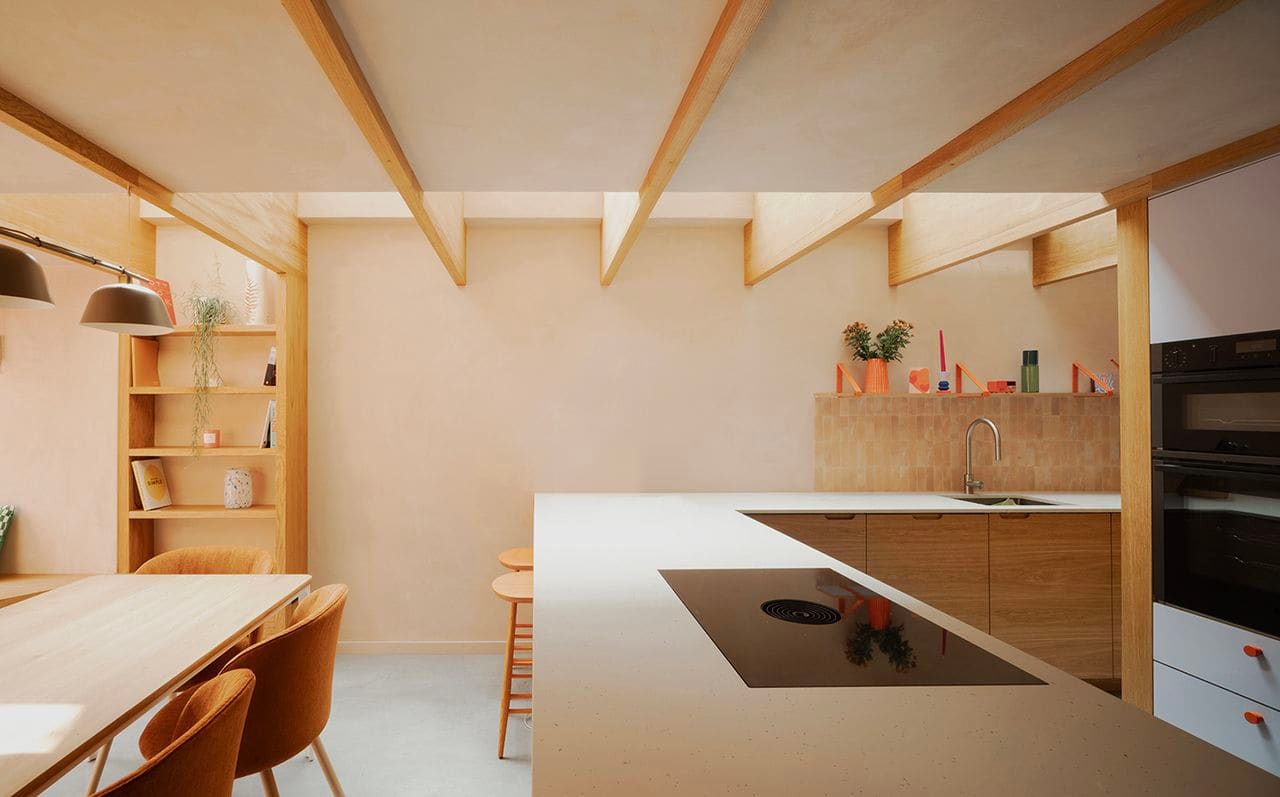
In Peckham Rye, a neighbourhood where Victorian terrace typologies dominate, Pensaer completed an extension that balances sculptural ambition with domestic intimacy. Clay House, as the project is known, was designed for a client with a strong sustainability agenda and a desire for spaces that feel warm and welcoming rather than austere or minimalist.
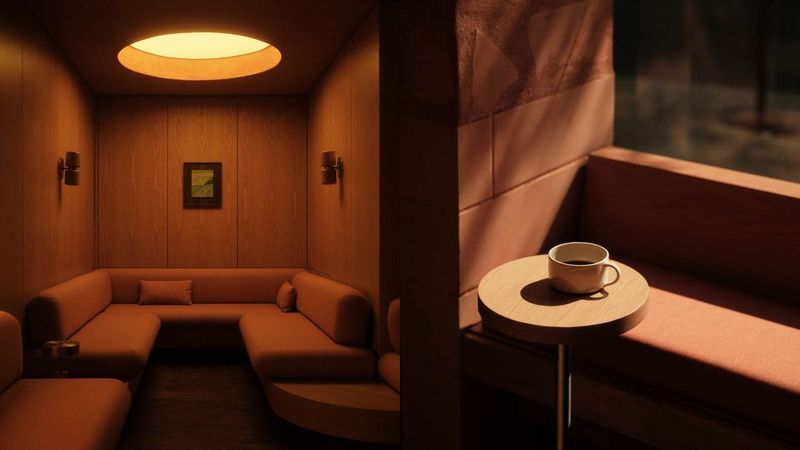
The palette is restrained: warm oak joinery, polished concrete floors, and walls left largely unadorned. A skylight positioned above the kitchen draws natural light deep into the plan, casting shifting patterns across vertical surfaces throughout the day. The joinery extends beyond cabinetry to define spatial zones. An angular window seat, for instance, is carved into the envelope at the garden threshold, creating an alcove that functions as both furniture and architecture.
The extension does not announce itself as a singular volume. Instead, it unfolds as a series of moments, each calibrated to support a different mode of occupation: preparing food, sitting with a book, moving between interior and garden. The sequence is choreographed but never rigid, allowing the inhabitant to linger or pass through according to need.
Detailing as Narrative Device
What distinguishes Clay House from many contemporary extensions is the attention given to junctions and transitions. Door handles, window reveals, and the meeting of different materials are treated not as technical necessities but as opportunities to express the broader design intent. The joinery, executed by collaborators who worked closely with the studio throughout, exhibits a precision that borders on the sculptural. Edges are chamfered or radiused to soften contact; grain patterns are aligned to reinforce sightlines.
These details do more than please the eye. They communicate a hierarchy of touch and use, signalling where the body is invited to rest, lean, or pass. In this sense, the craft embedded in Clay House functions as a form of narrative, guiding the occupant through the extension without overt signage or formal thresholds.
Precedents in Craft-Led Practice
Pensaer's approach recalls earlier moments in twentieth-century architecture when craft and construction were inseparable from design. The work of Carlo Scarpa, with its obsessive detailing and material juxtapositions, offers a historical parallel. Scarpa treated every junction as a tectonic event, a place where different materials and construction logics met and were resolved through careful making.
More recently, practices such as Sergison Bates and Peter Zumthor have demonstrated how a deep engagement with craft traditions can yield architecture that feels both contemporary and rooted. Zumthor's Kolumba Museum in Cologne, for instance, relies on the skill of bricklayers to achieve its atmospheric interiors, where light filters through precisely spaced voids in the masonry. Similarly, Pensaer's reliance on skilled collaborators suggests that the intelligence of craft is not a historical curiosity but a live resource for contemporary practice.
Sustainability Through Longevity
The client's sustainability priorities influenced material selection and construction methods. Rather than pursuing certification schemes or technical systems, Pensaer focused on durability and material honesty. Oak and concrete age well, developing patina rather than degrading. The joinery is designed to be maintained and, if necessary, repaired, rather than replaced. This approach to sustainability is less about metrics and more about fostering a sense of care and attachment, ensuring that the building remains valued over time.
There is also an implicit sustainability in the studio's collaborative process. By involving makers early and deferring to their expertise, Pensaer reduces the likelihood of construction waste, rework, or detailing that proves unbuildable. The building is designed with fabrication in mind, a pragmatic strategy that aligns environmental goals with craft logic.
Recognition and Trajectory
Pensaer's inclusion in the 2026 Architects' Directory, an annual survey now in its twenty-fifth edition, places the studio within a lineage of emerging practices that prioritise thoughtful residential work over large-scale commissions or signature forms. The directory, which has catalogued over five hundred studios since its inception in 2000, functions as a barometer of shifting priorities within the profession. This year's selection spans thirty countries and reflects a growing interest in practices that embed cultural, environmental, and craft considerations into their work.
For Pensaer, still a young studio with a modest portfolio, the recognition signals that the craft-led approach resonates beyond a niche audience. As architectural discourse increasingly grapples with questions of materiality, embodied carbon, and the social dimensions of making, practices that foreground collaboration with skilled trades offer a model that is both technically rigorous and culturally grounded.
Implications for Domestic Architecture
Clay House suggests a way forward for residential extensions that sidesteps the familiar tropes of glass boxes and minimal frames. By prioritising tactile richness and spatial intimacy over visual drama, Pensaer demonstrates that domestic architecture can be quietly ambitious. The extension does not compete with its Victorian host; instead, it extends the terrace's logic into a new register, one where craft and material intelligence guide form.
This strategy may prove particularly relevant in dense urban contexts, where sites are constrained and neighbours are close. Rather than asserting presence through volume or transparency, Pensaer's work suggests that character can emerge from detail, sequence, and the careful orchestration of light and material. It is an architecture of restraint, but one that rewards sustained attention.
Save this story. A free account keeps your reading list and the 07:00 email in one place.
CREATE FREE ACCOUNT →SIGN IN