
Translating Place Through Material
When a café crosses borders, it carries more than a menu. Cup of Joy, which opened its first location outside Turkey on Blandford Street in Marylebone, demonstrates how architecture can function as a bridge between distant cities. The challenge EBBA Architects faced was not simply replicating an aesthetic but distilling the spatial and material qualities that define Istanbul's urban fabric and reinterpreting them within a London typology.
Founded in Istanbul's Bebek district in 2013, Cup of Joy has grown to eight locations across Turkey. The Marylebone site occupies two floors, positioned directly across from Jikoni, and marks the brand's inaugural international expansion. Rather than importing a standardized fit-out, EBBA founder Benni Allan undertook field research across Istanbul, visiting existing Cup of Joy cafés and documenting the city's characteristic stone walls, recessed openings, and the play of light within shaded courtyards. These observations became the conceptual framework for the London interior.
A Contemporary Reading of Historic Masonry
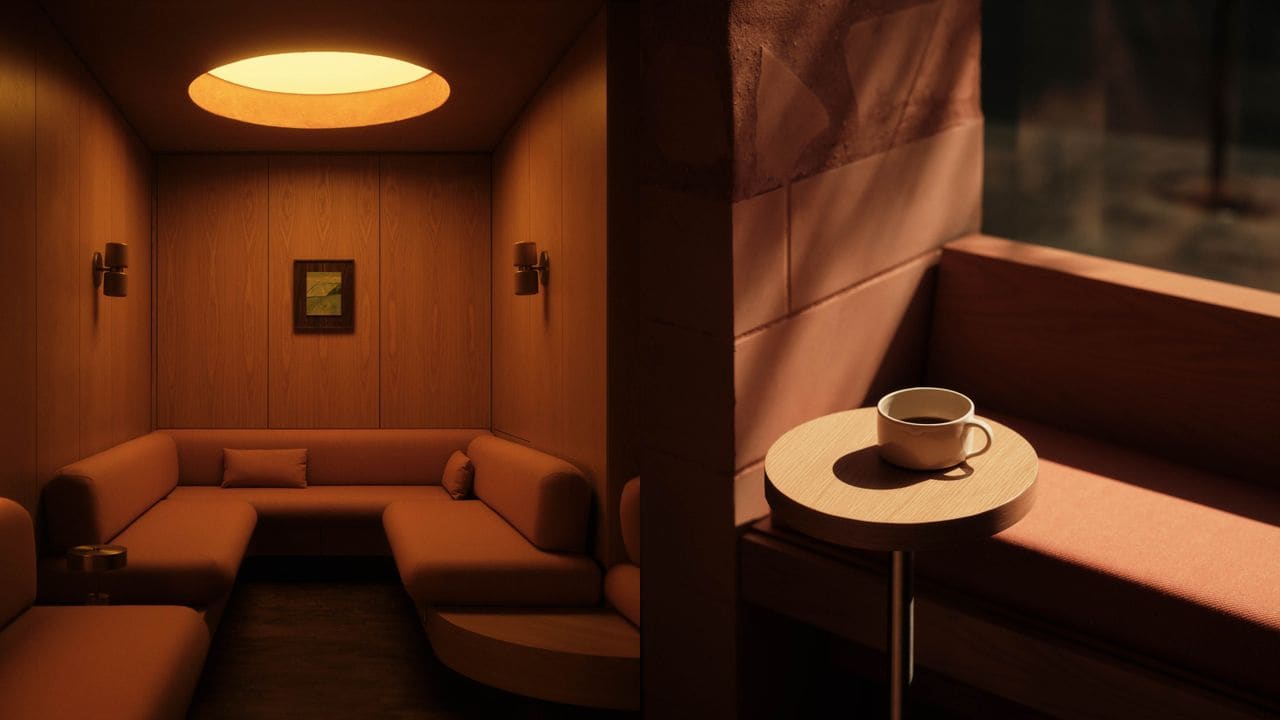
The ground floor reads as a single, cohesive material study. Clay plaster envelops the walls and continues up the stairwell, establishing a monolithic envelope that recalls the texture of aged Istanbul buildings. Portland stone, a quintessentially English material, appears in large sections along the lower wall zones, with smaller fragments positioned higher, creating a stratified composition reminiscent of historic masonry construction.
Each stone piece was selected and positioned on site before the clay plaster was applied around its perimeter. This process generated an irregular, almost geological surface quality, yet the overall form remains distinctly contemporary. A continuous datum line runs across the room at eye level, anchoring the scale and providing visual coherence. Within the thick wall assembly, oak-lined recesses punctuate the clay, housing built-in benches, retail displays, a water fountain, and intimate seating alcoves. These voids echo the recessed openings Allan observed in Istanbul, where depth and shadow modulate the relationship between interior and exterior.
The oak bar is positioned diagonally across the ground floor, and all custom furniture and tables follow the same angular orientation. This subtle shift in geometry introduces dynamism without disrupting the room's calm, enveloping character.
Controlled Light and Tactile Continuity
Overhead, timber and opaque glass panels form a layered ceiling that diffuses natural and artificial light evenly across the clay surfaces. The ambient quality suits the café's extended operating hours, from early morning espresso service through midday meals, without subjecting diners to the harshness of directional spotlights. This approach to illumination aligns with biophilic design principles, prioritizing comfort and circadian rhythm over dramatic effect.
Woodblock flooring runs throughout both levels, providing tactile warmth underfoot and visual continuity. A staircase clad in terracotta-hued concrete, framed by matching steel, connects the ground floor to the lower dining room. Downstairs, the material palette intensifies. Clay plaster extends across the ceiling, while oak panelling wraps the walls, compressing the spatial volume and creating a more enclosed, intimate atmosphere suited to longer, quieter meals.
The Intersection of Craft and Hospitality
Cup of Joy's beverage program centers on a house blend that combines sustainably sourced Arabica beans from El Salvador, Brazil, and Colombia. The roast profile emphasizes notes of dark chocolate, orange, and hazelnut. Coffee is served in one-off ceramic vessels made by co-founder Gökçe Kalyoncu, a self-taught ceramicist whose work introduces subtle variation into the daily ritual. Each cup's uneven profile and hand-glazed finish reinforces the interior's emphasis on craft and materiality.
The all-day menu bridges Turkish and contemporary café culture. Offerings include a bagel filled with feta and heirloom tomatoes, pistachio porridge, toasties, and composed salads. Eggs Istanbul, finished with Aleppo pepper butter, signal the brand's origins without resorting to overt nostalgia. For dessert, Baba Au Tea layers poppy-seed sponge soaked in orange rooibos syrup beneath whipped cream, a playful riff on classic baba au rhum.
Precedent and Context
EBBA's approach recalls the spatial strategies employed by firms like Studio Mutt and Al-Jawad Pike, both of which have explored how material thickness and recessed elements can generate intimacy within compact urban interiors. The use of clay plaster as a primary surface treatment also aligns with a broader return to natural, breathable finishes in hospitality design, seen in projects by Feilden Fowles and Studio Weave.
What distinguishes Cup of Joy is its specificity of reference. Rather than invoking a generalized Mediterranean vernacular, the design engages directly with Istanbul's architectural typologies. The recessed oak niches function not as decorative gestures but as spatial devices that alter perception and use. The diagonal bar orientation subtly resists the orthogonal grid of Marylebone's Georgian streetscape, asserting an alternative spatial logic rooted in a different urban tradition.
Architecture as Cultural Translation
At World Archi Design, we have tracked an increasing number of hospitality projects that attempt to translate cultural identity across borders. Many falter, defaulting to superficial iconography or generic materiality. Cup of Joy succeeds because it operates at the level of spatial experience rather than visual signage. The clay, stone, and oak are not symbols of Turkishness but instruments for recreating the atmospheric and haptic qualities Allan identified during her research.
This approach also acknowledges Marylebone's own architectural heritage. Portland stone, historically quarried on the Dorset coast, has been a primary building material in London for centuries. By integrating it within a clay matrix, EBBA creates a hybrid condition that respects both source and destination, avoiding pastiche while maintaining conceptual clarity.
The project raises questions about how design can carry memory and whether architecture, when thoughtfully executed, can function as a form of cultural exchange rather than appropriation. In an era of homogenized global design, Cup of Joy offers a model for differentiation grounded in research, materiality, and spatial intelligence. The café does not attempt to replicate Istanbul in London but instead constructs a new place informed by both cities, legible to those familiar with either context and rewarding to those encountering it fresh.
Save this story. A free account keeps your reading list and the 07:00 email in one place.
CREATE FREE ACCOUNT →SIGN IN