
The Permanence of a Mould
There is something quietly radical about an object still being cast from the same mould after a hundred years. Not a reproduction, not a reinterpretation - the same physical cavity, the same negative space, pouring out the same positive form. When Svenskt Tenn manufactures Anna Petrus's Lion sculpture today, it uses the identical permanent moulds from the 1920s. The pewter flows into the same channels her hands once approved, cools against the same surfaces, emerges with the same weight distribution. It is a kind of material time travel that few designers achieve.
Petrus - born in Uppsala in 1886 to a paediatrics professor and a countess - spent her career working in materials that were not supposed to belong to her. Pewter and cast iron carried an implicit gender assignment in early twentieth-century Sweden; female industrial artists of the era gravitated toward textiles and ceramics, softer disciplines with less foundry heat and fewer tonnes of molten metal. Petrus ignored the sorting. After studying at Chelsea Polytechnic in London (where she marched with the suffragettes), Tekniska Skolan in Uppsala, Althin's School of Painting, and the Royal Academy of Fine Arts in Stockholm, she turned to the foundry.
Her breakthrough arrived in Paris in 1925, at the Exposition Internationale des Arts Décoratifs et Industriels Modernes - the exhibition that gave Art Deco its name. Petrus exhibited a series of cast iron works she had designed and produced with Näfveqvarn, one of Sweden's oldest foundries. Displayed in both the Swedish pavilion and the Grand Palais, the pieces earned a gold medal. Estrid Ericson, founder of the fledgling pewter business Svenskt Tenn, was also at the fair and also took home gold. The Swedish neoclassical aesthetic that emerged from that exhibition - restrained, refined, a deliberate counter to historical ornament - would later be termed "Swedish Grace" by British critic Philip Morton Shand. Petrus became one of its defining practitioners.
Shortly after Paris, Ericson approached Petrus. The collaboration that followed was brief but generative. Over the next few years, Petrus designed a table lamp, a mirror, decorative boxes, candle holders, and vases for Svenskt Tenn, each decorated with reliefs depicting grape clusters, female figures, and - most persistently - a reclining lion. That lion motif became her signature, recurring across multiple works and scales. A handful of these designs, including the Lion sculpture, have remained in continuous production ever since, still manufactured in Sweden by Humstorp Metall, still cast from those original moulds.
The Exhibition and the Scenography
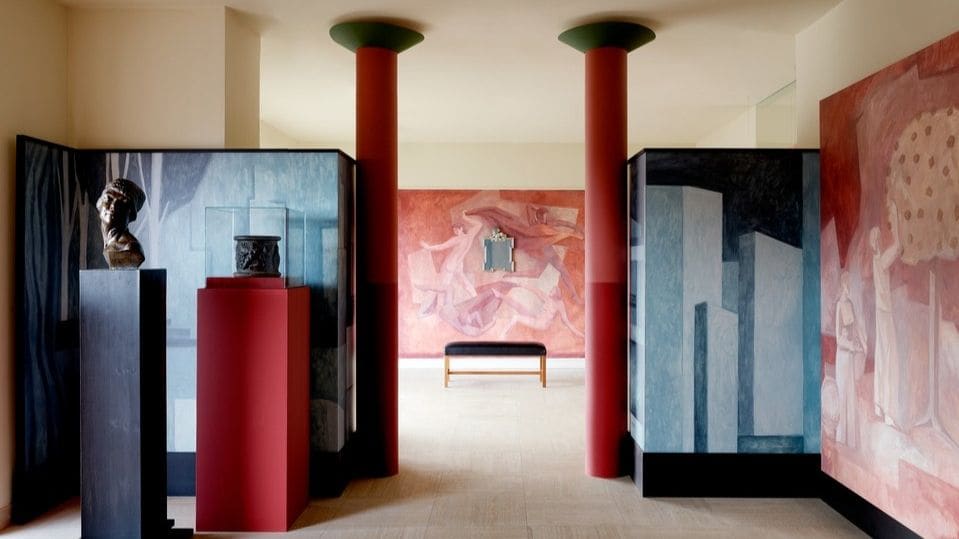
This month, Svenskt Tenn opened Sequence of Spaces, an exhibition devoted to Petrus's work, at its Stockholm flagship on Strandvägen 5. The show draws from the company's design archive and includes sculptures on loan from the Petrus family's private collection. To frame the objects, Svenskt Tenn commissioned Madrid-based artist Elvira Solana, whose practice centres on murals and trompe-l'œil interventions that manipulate spatial perception.
Solana created a three-dimensional scenography that functions as a backdrop for Petrus's metal forms. The inspiration, according to Svenskt Tenn, came from Petrus's own 1916 exhibition, where she displayed her sculptures alongside murals by Swedish artist Greta Ruuth. In Solana's iteration, visitors move through a progression of painted environments - beginning with rigid, architectural landscapes and transitioning toward increasingly organic, liberated compositions. Courtyards and gardens provide the setting for Petrus's sculptures; human figures gradually emerge from the murals, eventually appearing to dance alongside the metal objects.
"It is a celebration of dance and movement, as much as it is a tribute to the longevity of craft and of the meeting between Anna Petrus's creative legacy and Elvira Solana's work today," said Tora Grape, Marketing and Brand Communications Director at Svenskt Tenn. Two trays designed by Solana, based on the scenography, are available for purchase.
The Reissues
To mark the exhibition, Svenskt Tenn has brought two lesser-known Petrus designs back into production. The first is the Lion table lamp, a pewter base featuring relief decorations of female figures and grape clusters. The second is a substantial mirror frame from 1929, crowned by a reclining lion. Both are manufactured by Humstorp Metall, a long-time production partner to Svenskt Tenn that continues to handle the company's most complex pewter work.
The mirror, for example, is cast in seven separate parts using the original permanent moulds, then soldered together to form a whole. The process demands precision; pewter is a soft material, and even minor impurities or miscalculations can render a piece unusable. In such cases, the pewter is melted down and cast again. It is a high-stakes, high-skill operation - one that connects contemporary craftspeople directly to Petrus's original design decisions.
The Chessboard
The exhibition also occasioned the reissue of an archival chessboard designed by Marie-Louise Idestam-Almberg (1898-1988), another Swedish female designer who navigated the male-dominated design world of the early twentieth century. Idestam-Almberg originally presented an ivory and ebony version of the surrealist set at the same 1925 Paris exposition that Ericson and Petrus attended. Ericson acquired the production rights in 1927, and Svenskt Tenn began manufacturing the set in pewter, brass, and gilded pewter.
The sculptural chess pieces draw on Russian peasant culture: a tsar-like king, a pregnant queen, wild horses, peasants with bowed heads. The set has now been put back into production, offering another material link to that pivotal moment in Swedish design history.
The Material Politics of Metal
At World Archi Design, we have long observed that material choice is never neutral. The decision to work in pewter and cast iron in the 1920s was not merely aesthetic - it was a claim to space, to expertise, to the foundry floor. Petrus's entry into these disciplines challenged the gendered sorting of craft labour that persisted well into the twentieth century. Her willingness to engage with heavy, industrial materials - and to do so with formal sophistication - positioned her as an outlier among her female contemporaries.
The neoclassical language she employed - restrained ornament, classical motifs rendered with modern simplicity - aligned with the broader Swedish Grace movement but also carried its own tensions. The lion, for instance, is a symbol freighted with power, authority, heraldry. Petrus deployed it not as a roaring emblem but as a reclining figure, often paired with female forms and organic motifs like grape clusters. The result is a design vocabulary that balances strength with repose, monumentality with domesticity.
Why the Moulds Matter
The longevity of Petrus's designs is not purely a function of aesthetic appeal. It is also a function of the permanent mould - a manufacturing decision that commits a foundry to a design for the long term. Permanent moulds, typically made of metal, allow for repeated casting with consistent detail and dimensional accuracy. They are expensive to produce and require significant upfront investment. To commission a permanent mould is to bet on a design's enduring relevance.
Svenskt Tenn made that bet on Petrus in the 1920s, and the bet has paid off. The fact that the same moulds are still in use nearly a century later speaks not only to the durability of the tooling but to the durability of the design itself. There has been no need to update, refresh, or "contemporise" the forms. They have remained in demand, generation after generation, without modification.
This stands in contrast to much of twentieth-century design, which has required constant reinvention to stay commercially viable. Petrus's work occupies a rare category: objects that feel neither dated nor timeless, but simply present. They do not announce their era loudly, nor do they strain to transcend it. They exist in a kind of steady state, continuously relevant without being trendy.
Recognition Deferred
In the broader narrative of twentieth-century design, Petrus has been largely overlooked. Her male contemporaries - architects and designers who worked in similar neoclassical modes - have received more sustained critical attention. Grape hopes the exhibition will begin to correct that imbalance.
"Anna Petrus's work has a boldness and playfulness that still feels remarkably contemporary," Grape said. "It is our hope that this exhibition will bring forward Anna Petrus's name to a new generation and give her the recognition she deserves."
The question of why certain designers are remembered and others forgotten is never simple. Gender is one variable; material is another. Designers who worked in furniture and architecture - large, visible, often public commissions - tend to dominate design history. Those who worked in decorative objects, particularly objects tied to domestic interiors, are more easily marginalised. Petrus's work sits at the intersection: decorative in function, industrial in material, domestic in context but foundry-made in execution. It does not fit neatly into the categories that design history has traditionally privileged.
The Exhibition as Archive
Sequence of Spaces runs until 18 October 2026 at Svenskt Tenn's Strandvägen 5 location in Stockholm - the company's only physical retail space, which it will celebrate as its home for a century in 2027. The exhibition functions both as a retrospective and as an act of institutional memory, a way for Svenskt Tenn to reckon with its own origins and the figures who shaped its early identity.
By pairing Petrus's metal objects with Solana's painted environments, the exhibition also asks a question about how we experience designed objects. The scenography does not simply provide a neutral backdrop; it actively constructs a spatial narrative, guiding visitors through a sequence of increasingly organic forms. The effect is to situate Petrus's work not as isolated objects but as participants in a larger choreography of space, light, and surface.
It is a curatorial strategy that acknowledges the limitations of the vitrine. Petrus's objects were designed to be handled, to reflect light, to cast shadows, to sit on tables and mantelpieces. Seen behind glass, they become specimens. Seen within Solana's painted rooms, they regain some of their intended context - domestic, inhabited, alive.
The exhibition also underscores the value of the archive. Svenskt Tenn's decision to retain Petrus's original moulds, to keep certain designs in production, and to preserve the rights to others has made this kind of retrospective possible. Without that institutional commitment, Petrus's work might have existed only in museum collections and private hands, inaccessible to contemporary audiences and unavailable for reissue.
What Endures
We return to the mould. A century ago, Anna Petrus designed a lion. She sculpted it, refined it, approved the casting. Svenskt Tenn made the permanent mould. The foundry poured pewter. The object emerged, was sold, was placed in someone's home. And then it happened again. And again. For a hundred years.
That kind of continuity is rare. It requires a design robust enough to survive shifts in taste, a manufacturing process stable enough to persist through economic upheaval, and an institution willing to maintain the tooling. It also requires a design that does not try too hard - that does not chase novelty, that does not date itself with overly specific references. Petrus's lion is alert but at rest, detailed but not fussy, classical but not nostalgic. It is a form that holds its ground.
Sequence of Spaces is a reminder that some objects do not need to be reinvented. They simply need to be recognised.
Save this story. A free account keeps your reading list and the 07:00 email in one place.
CREATE FREE ACCOUNT →SIGN IN