
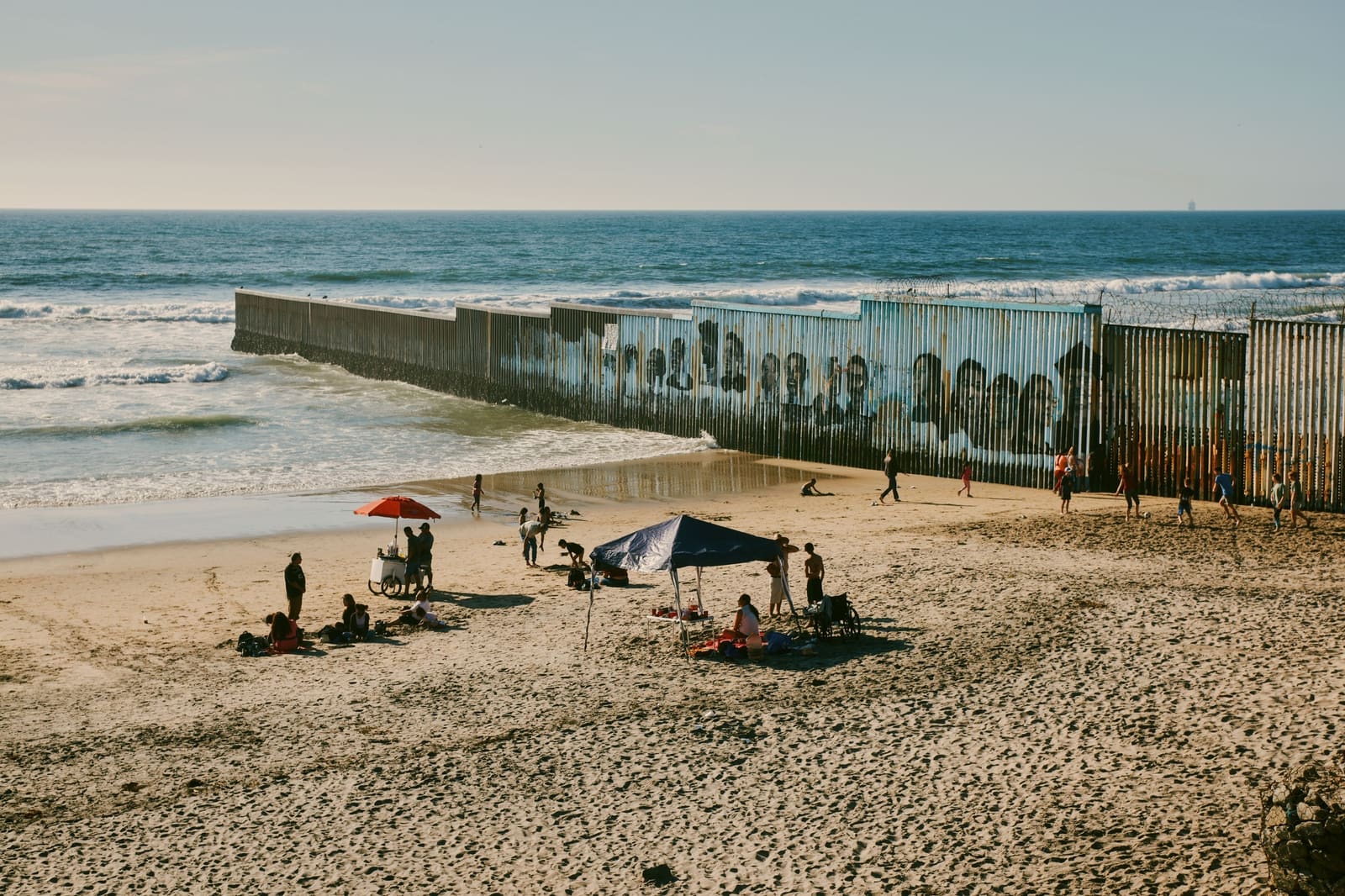
The Corridor Speaks
Picture a narrow passage: concrete sides barely two meters apart, low ceiling, flat fluorescent wash. At the terminus, bulletproof glass; behind it, a uniform. The space needs no signage. Its dimensions and materials already announce the transaction: movement is conditional, discretionary, revocable. This is not neutral infrastructure. It is the architecture of selective permeability, replicated at entry points from Calais to El Paso, Lampedusa to Gevgelija.
At World Archi Design, we have long tracked the tectonics of migration infrastructure, the forensic geometry of walls and queuing zones. What distinguishes these spaces is not merely their severity but their legibility. They are designed to be instantly understood by anyone, regardless of language or origin. The message is baked into the fenestration, the ceiling height, the materiality. Hostility is not an incidental byproduct; it is the organizing principle.
Foucault's Watchtower, Koolhaas's Strip
Michel Foucault's reading of the panopticon remains instructive. In his 1975 text Discipline and Punish, the circular prison with its central tower demonstrates that power need not be embodied by a jailer. The architecture itself disciplines. Inmates internalize the possibility of being watched and regulate their own behavior. Power becomes geometric, ambient, always-on.
Rem Koolhaas understood this early. His 1972 graduation project Exodus, or The Voluntary Prisoners of Architecture, developed with Elia Zenghelis, Madelon Vriesendorp, and Zoe Zenghelis, emerged from a visit to the Berlin Wall. The scheme sliced parallel walls through central London, creating an enclosed strip that functioned as autonomous territory. The provocation was deliberate: what if the wall, devoid of conventional program, possessed greater stability than any other building type? What if the border itself was architecture's purest expression?
Koolhaas argued that the wall's supposed programmatic emptiness granted it permanence. It did not serve the city; it structured it. Inclusion and exclusion became the organizing logic, not ancillary effects. The project's Superstudio-inflected rhetoric may read as satire, but its insight endures. The border derives its architectural power not from isolation but from urban relation. It is the surrounding city that gives the wall its charge, its capacity to define a here and a there, an us and a them.
The Line That Occupies Space
We inherit a cartographic fiction: the border as a thin black vector, a one-dimensional abstraction on a map. In lived experience, that line swells into volume. It acquires square footage, ceiling height, camera angles, queue widths. It becomes a psycho-spatial threshold, elastic and contingent. For some, the border is distant, impassable. For others, it is a formality, crossed with a passport scan and a nod.
The US-Mexico barrier offers the starkest example. At thirty feet, the wall's height is not arbitrary. Engineers and policymakers have described it as sufficient to ensure fatal injury for anyone attempting to scale it. The dimension is a deterrent encoded in vertical measure. Here, the border is not a line but a constructed fact, visible from both sides, casting a shadow that extends far beyond its immediate footprint.
Yet border typologies vary widely. Aleksandar Staničić, in Architectures of Resistance: Negotiating Borders Through Spatial Practices, traces the evolution of the Gevgelija checkpoint between Greece and North Macedonia. In 1960, its modernist pavilion symbolized openness, serving as the primary gateway to the Socialist Federal Republic of Yugoslavia. The structure's demolition in 1990 coincided with the collapse of the federal state and the rise of nationalist projects. Today, Gevgelija is defined by barbed wire, a barrier that halts refugees moving toward Western Europe.
The contrast is instructive. Between the mid-century pavilion and the chain-link fence lies a political chasm. Architecture does not merely reflect these shifts; it materializes them. The design of the checkpoint, the choice of materials, the presence or absence of shelter - all encode a stance on who deserves passage.
Speculative Resistance
If architecture can enforce exclusion, can it also resist it? The question is not rhetorical. A handful of practitioners have tested the border's spatial logic, seeking cracks in its determinism.
Teddy Cruz and Fonna Forman treat the Tijuana-San Diego corridor as a laboratory. Their UCSD Community Stations project establishes a network of hubs in marginalized neighborhoods on both sides of the wall, where university research is co-produced with migrant communities. The stations do not erase the border, but they interrupt its isolating function, creating nodes of exchange where policy typically enforces separation.
In 2019, Ronald Rael and Virginia San Fratello installed a set of pink teeter-totters through the slats of the border wall, allowing children and adults on both sides to play together. The intervention lasted only a few hours, but its symbolic force was undeniable. The seesaw, a mechanism of reciprocal movement, made visible the interdependence of the two territories. An action on one side required a response on the other. The wall remained, but its meaning shifted, if only briefly.
Tatiana Bilbao's curated publication Two Sides of the Border: Reimagining the Region gathers proposals from thirteen offices and student groups in the US and Mexico. Among them: Marilyn Reyes's rest stops for monarch butterflies, non-human migrants whose seasonal journey ignores geopolitical lines; and Hallie Black's floating structure, positioned in binational waters, belonging simultaneously to both countries and testing the limits of territorial sovereignty.
These projects share a common strategy. They do not deny the border's existence or its coercive power. Instead, they inhabit it differently, inserting moments of encounter, care, or absurdity into a spatial regime designed for control.
The Program Problem
Still, we must acknowledge architecture's subordinate position. A port of entry can be designed with dignity - natural light, clear wayfinding, spaces for children - but such gestures remain vulnerable to the first policy shift. As long as the border is conceived as an instrument of selective exclusion, any architecture serving it participates in that exclusion, however humanely.
The hostility of contemporary border spaces is not accidental. It is programmed. The narrow corridor, the low ceiling, the bulletproof glass - these are not aesthetic choices. They are spatial translations of a political agenda. Architecture materializes the choice to exclude.
Foucault's panopticon reminds us that power can be depersonalized, embedded in form. But the inverse is also true: form cannot escape the power relations that produce it. The teeter-totter does not dismantle the wall. The community station does not abolish ICE. These interventions reveal alternative possibilities, but they do not, on their own, alter the logic that generates hostile infrastructure in the first place.
Toward a Different Question
Perhaps the more pressing question is not how to design a more humane border, but why contemporary borders are conceived primarily to exclude rather than to welcome. The thirty-foot wall, the barbed wire at Gevgelija, the fluorescent corridor - all are answers to a question we have normalized: how do we keep people out?
Architecture, in this framework, is a built mirror. It reflects the society that commissions it, the anxieties it seeks to manage, the populations it deems worthy of passage. The discipline's role is not neutral. Architects design the detention center, the queue, the watchtower. They select the materials, set the dimensions, calculate the sight lines.
But architecture also retains a speculative capacity. It can propose, provoke, and reveal. The pink seesaw, the floating pavilion, the butterfly rest stop - these are not solutions, but they are arguments. They demonstrate that the line on the map can be inhabited differently, that the border need not be synonymous with hostility.
We have covered projects this year that test similar thresholds: adaptive reuse of Cold War bunkers, community-led housing on contested land, pavilions that blur property lines. Each suggests that the boundary, rather than being fixed, is negotiable. Not in the legal sense - architects do not write immigration policy - but in the spatial sense. The corridor can be wider. The ceiling can be higher. The glass can be transparent.
Yet these remain marginal gestures unless the underlying program shifts. The border's cruelty is not born of fences alone. It emerges from the political will that shapes them, the economic asymmetries they enforce, the fears they exploit. Architecture can make the wait less brutal, the space less punitive. It can insert moments of dignity into an otherwise dehumanizing process. But it cannot, by itself, rewrite the terms of passage.
The Wall Remains
The thirty-foot barrier still stretches into the Pacific at Playas de Tijuana. The barbed wire at Gevgelija still blocks refugees. The corridor at the port of entry still funnels travelers into a two-meter-wide passage. These are not abstract typologies. They are lived spaces, experienced daily by millions.
What architecture can do - what it has always done - is make visible the choices embedded in built form. The wall is not inevitable. The corridor is not neutral. Every dimension, every material, every spatial relationship encodes a decision about who belongs and who does not.
The teeter-totter reminds us that even a thirty-foot wall can become, briefly, a site of connection. The community station shows that infrastructure can serve those it typically excludes. The floating pavilion asks what happens when territory itself becomes ambiguous.
These are small acts, but they matter. They demonstrate that the border, however rigid it appears, is still a human construction. And what is constructed can be reconstructed, reimagined, resisted. Not by architecture alone, but by the coalitions that commission it, the communities that inhabit it, and the political will to conceive passage not as concession but as right.
The question, then, is not whether architecture can change the border. It is whether we are willing to change the question the border is designed to answer.
Save this story. A free account keeps your reading list and the 07:00 email in one place.
CREATE FREE ACCOUNT →SIGN IN