
The Limits of Problem-Solving
For decades, architectural education has trained practitioners to identify problems and deliver solutions. A site is analyzed, a brief is written, a building emerges. The model is seductive in its clarity, but it presumes a stable world where needs can be neatly catalogued and addressed. That presumption no longer holds.
At World Archi Design, we've been tracking a shift in how leading figures across the discipline talk about their work. The language of "solutions" is giving way to something more provisional: frameworks, experiments, negotiations. This is not semantic drift. It signals a deeper recognition that the conditions shaping built environments are themselves in flux, ecological and social systems undergoing transformation at scales and speeds that resist conventional design thinking.
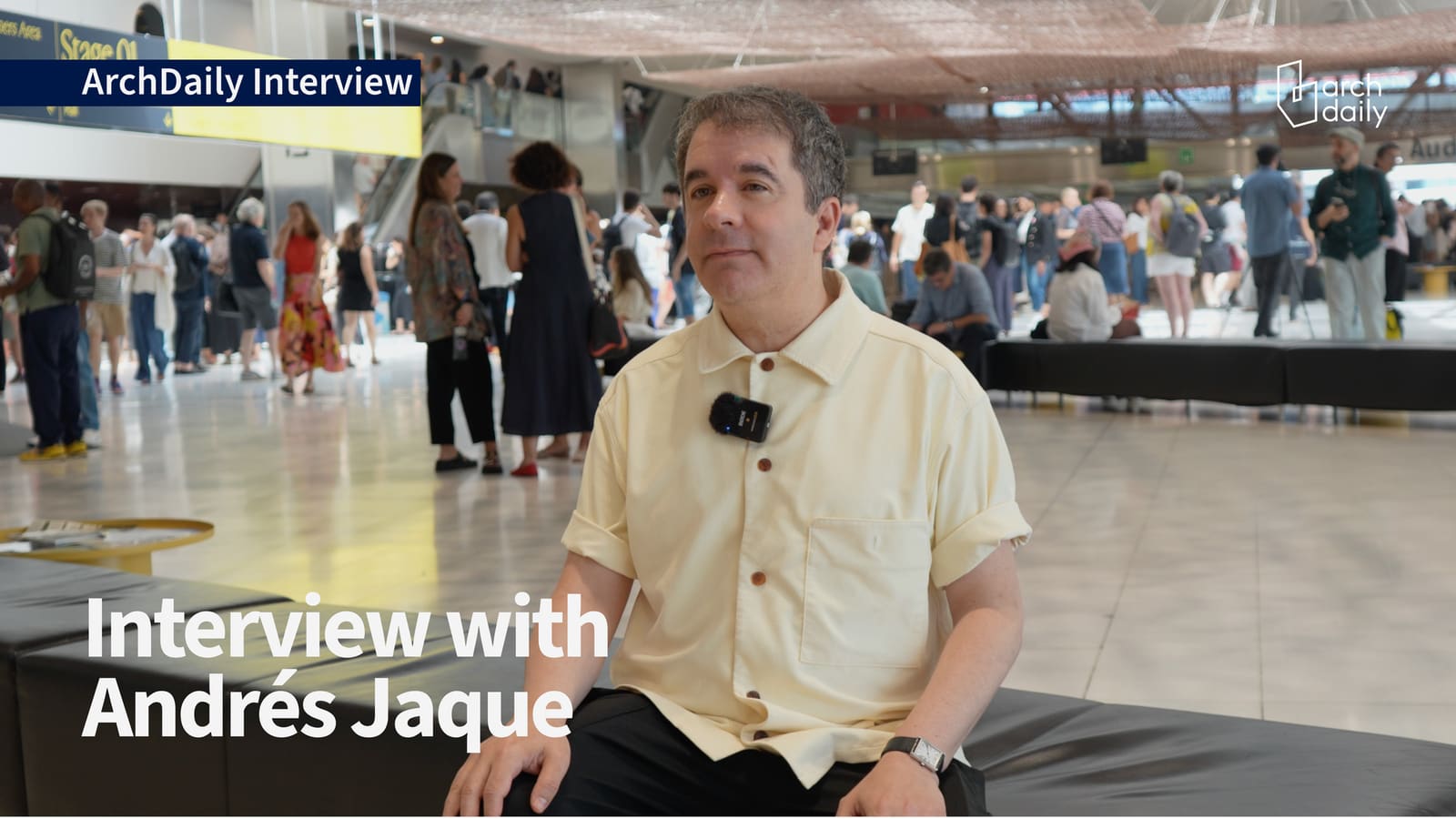
Andrés Jaque, whose Office for Political Innovation has for years operated at the intersection of spatial practice and public discourse, articulated this shift during the recent UIA World Congress of Architects 2026 in Barcelona. The Congress theme, Becoming. Architectures for a Planet in Transition, positioned the discipline not as external observer but as embedded participant in environmental, political, and social change. Jaque's remarks, delivered in his capacity as Dean of Columbia University's Graduate School of Architecture, Planning and Preservation, pressed further: transition, he argued, is not a phase to be managed but a permanent condition to be inhabited.
Pedagogy as Laboratory
If architecture schools historically prepared students to enter existing professional structures, Jaque's vision for GSAPP inverts that model. The institution becomes a site for testing ideas that may have no immediate market, no clear client, no path to realization through conventional channels. This is not abstraction for its own sake. It is an acknowledgment that the most urgent questions facing the discipline, questions about resource flows, about whose knowledge counts, about how power is encoded in spatial arrangements, cannot be answered within the constraints of typical practice.
Experimentation here means more than formal play. It means creating conditions where students can interrogate the assumptions embedded in a program, challenge the neutrality of technical standards, or trace the political genealogies of building codes. It means treating design not as the application of known methods but as a mode of inquiry that generates new knowledge.
This approach has precedents. Cedric Price's Potteries Thinkbelt proposed an entire higher education infrastructure as mobile, adaptable, and integrated with industrial production. Superstudio's continuous monument critiqued modernist universalism by taking it to its logical extreme. Both projects existed primarily as provocations, yet their influence on subsequent discourse far exceeded most built work of their era. Jaque's pedagogy extends this lineage, but with a critical difference: the experiments are not speculative in the sense of detached; they are speculative in the sense of testing possible futures against present constraints.
Design as Political Act
To frame design as inseparable from activism, as Jaque does, is to reject the fiction of professional neutrality. Every choice about material, every decision about program, every assumption about user behavior encodes values. The question is not whether architecture is political, it is whether practitioners are conscious of the politics they enact.
This consciousness demands a different relationship to clients and publics. Rather than accepting a brief as given, the architect becomes a co-author of the brief, surfacing conflicts, making trade-offs explicit, and opening space for voices typically excluded from design processes. The Office for Political Innovation's projects often foreground this expanded role: installations that function as public forums, buildings that document their own material supply chains, spaces that make visible the labor and infrastructure required to sustain them.
Such work does not fit comfortably into conventional categories. It is not purely architecture, not purely art, not purely activism. It occupies a hybrid territory that some critics dismiss as indiscipline. But disciplinary purity has never been architecture's strength. The most influential figures in the field, from Aalto to Koolhaas, have always operated at its edges, importing methods from other domains and exporting architectural thinking into broader cultural debates.
Transition Without Teleology
The notion of a "planet in transition" risks becoming another empty slogan if it implies a known destination. Transition to what? Sustainability? Resilience? Equity? Each term carries its own baggage, its own exclusions. Jaque's intervention is to refuse the teleology. Transition is not a bridge between one stable state and another; it is the condition of contemporary practice.
This has practical implications. It means designing for uncertainty, for multiple possible futures, for systems that can adapt as conditions shift. It means prioritizing reversibility over permanence, modularity over monumentality, processes over objects. It also means recognizing that not all transitions are progressive. Ecological collapse is a transition. Authoritarian consolidation is a transition. The work of architecture, in this frame, is not to facilitate transition in the abstract but to shape its direction toward more just and livable outcomes.
The Institution as Platform
Jaque's dual role, as practitioner and as dean, collapses a boundary that architecture has long maintained between making and teaching. GSAPP under his leadership becomes an extension of the Office for Political Innovation's project: a platform for assembling coalitions, testing propositions, and intervening in public discourse.
This model challenges the university's traditional function as credentialing body. Degrees still matter, but they matter less as markers of technical competence and more as evidence of critical capacity, the ability to read a site not just for its physical properties but for its entanglements with capital, with policy, with histories of dispossession or resistance. Graduates emerge not as stylists but as intellectual actors capable of reframing problems and mobilizing constituencies.
Whether this vision can be sustained within the institutional and economic pressures facing higher education remains an open question. Universities are not neutral spaces; they are shaped by donor priorities, by rankings metrics, by competition for tuition revenue. The autonomy required for genuine experimentation is always partial, always contested. Yet the attempt itself matters. It demonstrates that architectural education can be more than professional training, that it can function as a site of intellectual ambition and political imagination.
Alternatives, Not Blueprints
What does it mean for architecture to generate alternatives? Not utopias, not master plans, but tangible, inhabitable options that exceed the narrow range of what currently seems possible. This is harder than it sounds. The forces constraining architectural production, zoning codes, financing structures, construction industry norms, aesthetic expectations, are deeply entrenched. Deviation is expensive, time-consuming, and often punished by the market.
Yet deviation is precisely what the moment demands. The housing models that dominate global cities are producing segregation and precarity. The infrastructures that underpin daily life are accelerating ecological breakdown. The public spaces that once anchored civic culture are being privatized or securitized. Incremental adjustments to these systems will not suffice. Architecture must articulate, and prototype, fundamentally different arrangements.
Jaque's insistence on the inseparability of design and activism is a call to expand the scope of architectural agency. Not every project can be a manifesto, but every project can be approached as an opportunity to test assumptions, to redistribute resources, to create conditions for different forms of collective life. The alternative is a discipline reduced to styling the infrastructures of inequality and extraction.
Toward a Practice of Becoming
The Congress theme, with its emphasis on "becoming," gestures toward process over product, toward architecture as verb rather than noun. This aligns with longstanding critiques of object-fetishism in the discipline, the tendency to privilege the finished building over the social relations it organizes or the ecological flows it interrupts.
A practice oriented toward becoming would attend to duration, to maintenance, to obsolescence. It would design not just spaces but protocols for their ongoing negotiation. It would recognize that a building's most important phase may be its dismantling, its materials returned to circulation rather than entombed in landfills. It would treat occupants not as end users but as co-producers, capable of adapting and reinterpreting what architects provide.
This is not a romantic vision of participatory design. Participation can be tokenistic, a way of laundering predetermined outcomes with a veneer of consultation. Genuine co-production requires ceding control, accepting conflict, and building capacity among communities to articulate their own spatial needs. It requires architects to become facilitators, translators, and advocates rather than sole authors.
The Discipline's Expanding Terrain
If architecture is to remain relevant, it must expand beyond buildings. This does not mean abandoning construction, it means recognizing that the built environment is produced by forces operating at multiple scales, from material extraction to financial speculation to policy frameworks. Architects have expertise in spatial organization, in the choreography of program and circulation, in the translation between abstract ideas and physical form. That expertise can be deployed in contexts far removed from traditional practice.
Urban policy, supply chain logistics, digital platforms, public health infrastructure: all are spatial problems, all could benefit from architectural thinking. The challenge is to insert that thinking without reproducing the discipline's historical arrogance, the assumption that designers know best. The most effective interventions will be those that emerge from collaboration, from sustained engagement with communities and experts in other fields.
Jaque's work models this expanded practice. Projects function simultaneously as built objects, as research platforms, and as sites of public engagement. They generate not just spatial experiences but also data, discourse, and new forms of collective organization. This is architecture operating at the scale of its actual influence, not confined to the envelope of a single building but networked across social and ecological systems.
What Comes Next
The conversations happening at gatherings like the UIA Congress matter not because they produce consensus but because they surface tensions. Between autonomy and engagement, between disciplinary rigor and interdisciplinary promiscuity, between the architect as expert and the architect as facilitator. These tensions are productive. They prevent the discipline from settling into complacency.
Jaque's provocation, that design and activism are inseparable, will not be universally embraced. Many practitioners will continue to see their work as fundamentally apolitical, a matter of solving technical and aesthetic problems within given constraints. That is their prerogative. But for those who recognize that those constraints are themselves political, that the distribution of space and resources is always a question of power, the challenge is to develop new modes of practice adequate to that recognition.
Architecture's capacity to generate alternatives depends on its willingness to risk failure, to operate outside established frameworks, to align with movements for social and ecological justice even when that alignment complicates professional standing. It depends, in short, on architects understanding their work not as a specialized service but as a form of intellectual and political labor directed toward more livable worlds.
Save this story. A free account keeps your reading list and the 07:00 email in one place.
CREATE FREE ACCOUNT →SIGN IN