
The Room as Character
Few filmmakers understand that space speaks. Across the projects we've covered this year, a recurring pattern has emerged in how contemporary directors deploy architecture, but none with the rigor or emotional precision of Pedro Almodóvar. His latest work, an autofictional meditation on creative struggle opening in UK cinemas this month, continues a career-long investigation into how spatial design can externalize interior states.
The premise is deceptively simple: a filmmaker named Raúl wrestles with writer's block, personal demons, and the recursive nature of making art about making art. Yet what elevates the narrative beyond self-referential exercise is the deliberate construction of environments that function as emotional indices. Art director Antxón Gómez, whose collaboration with Almodóvar spans thirteen films and three decades, describes the approach as one where "decoration is another character." This is not metaphor. In Almodóvar's hands, a bookshelf or a sofa becomes a tectonic element, bearing narrative weight equal to performance or plot.
Spatial Syntax and the Language of Objects
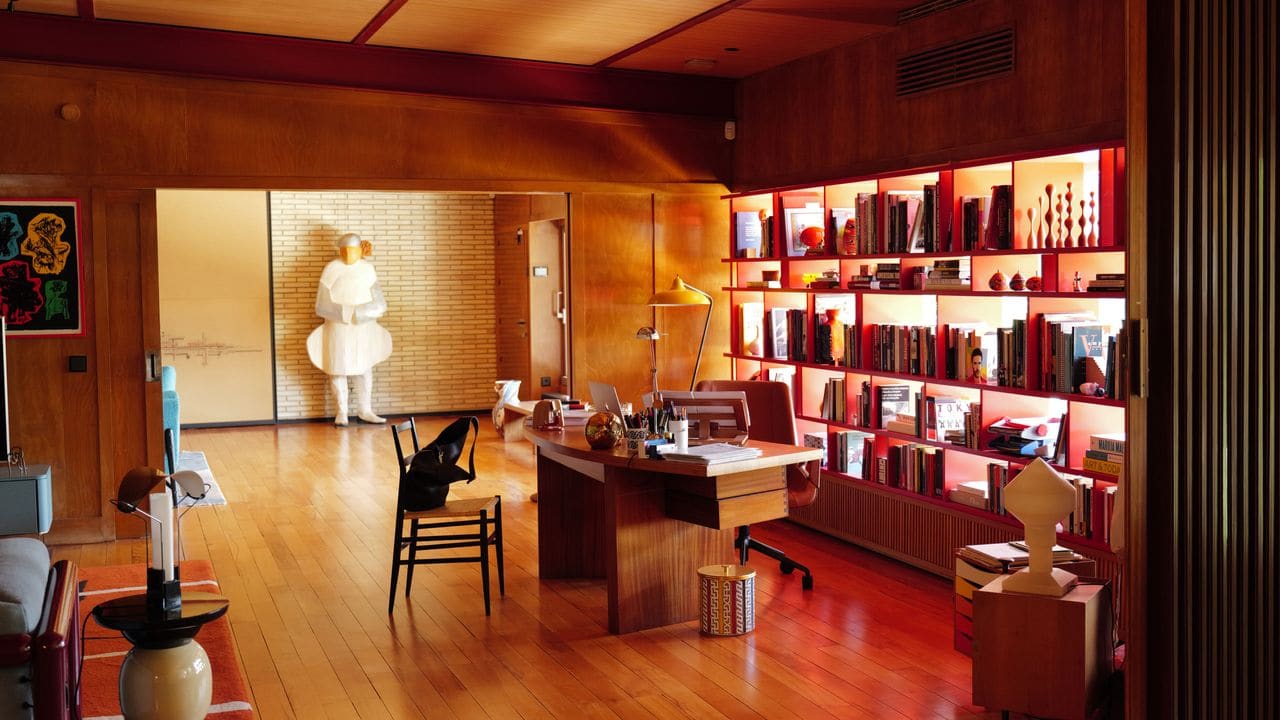
Consider the workspace where Raúl composes his screenplays. Red shelving units hold volumes on cinema and culture, positioned against a glass wall that dissolves the boundary between interior and exterior. The transparency is programmatic. Gómez explains the intent: to convey freedom of thought, an unobstructed creative flow. This is spatial storytelling at its most literal, where fenestration becomes psychology.
The furniture selection amplifies this reading. Raúl's living room assembles a constellation of modernist icons: Gio Ponti's Superleggera armchair, its attenuated form a study in structural efficiency; Carlo Scarpa's Cornaro sofa, with its geometric rigor; an Angel Wing floor lamp by Alvar Aalto, whose organic curves soften the rational vocabulary. The dining area introduces Antoni Arola's Lámina ceiling light for Santa & Cole, a Spanish maker whose commitment to craft-based industrial design aligns with Almodóvar's own aesthetic philosophy.
This is not arbitrary curation. Each piece represents a particular strand of twentieth-century design thought, from the Italian rationalism of Ponti and Scarpa to the humanist modernism of Aalto. The ensemble spans generations and geographies, yet coheres through shared principles: clarity of form, honesty of material, attention to proportion. Jaime Hayon's Explorer table and Multileg cabinet for BD Barcelona introduce contemporary playfulness, while a Cassina sofa by Le Corbusier, Pierre Jeanneret, and Charlotte Perriand grounds the space in canonical modernism.
Color as Temporal Marker
At World Archi Design, we've been tracking the chromatic evolution in Almodóvar's work, a shift that maps onto broader cultural currents in Spain and beyond. His early films celebrated saturated warmth: reds, apricots, the ochre tones of albero clay found in bullfighting rings. These hues resonated with the exuberance of la movida madrileña, the countercultural flowering that followed Francisco Franco's death in 1975 and the end of authoritarian rule.
Recent projects, however, embrace cooler registers. Blues, greens, grays, and notably in this latest film, expanses of white and black. The palette shift is most pronounced in sequences set on Lanzarote, where a character retreats to unlock creative blockage. The location is La Cabaña, a residence designed by French designer Yoann Le Mercier amid the island's volcanic terrain. White walls and floors dominate, punctuated by black lava-rock enclosures and sparse desert vegetation. The chromatic austerity represents a departure for a director synonymous with saturation.
Gómez acknowledges the novelty: "It was very unusual, but that's what the island is." The decision to honor Lanzarote's inherent palette, its contrast of whitewashed architecture against basalt geology, demonstrates Almodóvar's increasing attention to site specificity. The production team retained much of Le Mercier's original decor, including an Honoré armchair, Blasco linen sofa, and Roger Capron ceramic coffee tables, adding only vases by César Manrique as homage to the island's defining architect.
This embrace of monochrome and earth tones signals maturation, a filmmaker less interested in visual spectacle for its own sake and more attuned to how restraint can amplify psychological nuance. The evolution mirrors Almodóvar's thematic concerns: where early work explored liberation and identity formation, recent films interrogate aging, legacy, and the melancholic dimensions of creative life.
Precedent and the Movida Generation
The artworks populating these interiors deserve equal scrutiny. Nearly all originate from Almodóvar's personal collection, a deliberate blurring of his own aesthetic identity with that of his characters. Many pieces are by artists who emerged alongside the director during la movida: Sigfrido Martín Begué's screenprint Santa Cecilia (1987) appears in one character's flat, while Miguel Ángel Campano's abstract oil painting hangs in Raúl's home. Campano, whose work is the subject of a forthcoming exhibition at Madrid's Maisterra gallery, represents the gestural, post-Franco embrace of abstraction as a form of cultural and political expression.
Almodóvar balances these Spanish references with New York-based contemporary voices. Inka Essenhigh's surreal floral compositions hover over a bed where a character suffers migraines, the biomorphic forms echoing internal distress. Asher Liftin's trompe l'oeil painting Studio Window IV (Hot Winter Sun) faces Raúl's desk, another aperture, another symbol of permeability between mind and world. The inclusion of American artists suggests a cosmopolitan sensibility, a recognition that creative lineages cross borders even as they remain rooted in specific cultural soil.
Architectural Authenticity and the Real as Set
Almodóvar's preference for existing architecture over constructed sets introduces a documentary dimension to his otherwise stylized worlds. Raúl's residence is the Madrid home and studio of modernist architect Francisco de Asís Cabrero, completed in 1962. The structure exemplifies Spanish rationalism inflected with Japanese influence: wood paneling, red steel columns and beams, sliding screens that negotiate interior-exterior transitions. The building's openness, both literal and conceptual, reinforces the narrative themes of creative freedom and mental clarity.
Cabrero's architecture belongs to a generation that sought to reconcile international modernist principles with Spanish vernacular traditions. The red steel frame is industrial, even brutalist, yet the wood detailing and spatial organization reference traditional Japanese residential design, particularly the engawa, the transitional space between inside and outside. This hybridity, this refusal of stylistic purity, aligns with Almodóvar's own approach: a director who mines Spanish culture while drawing freely from global influences.
The choice to film in these locations rather than replicate them on soundstages is both practical and philosophical. Real buildings carry histories, textures, and imperfections that resist the sterility of constructed environments. They anchor fantastical narratives in material reality, a counterbalance to Almodóvar's melodramatic tendencies. The architecture becomes a co-author, its spatial logic shaping blocking, framing, and pacing.
The Green Sofa and the Song
One sequence crystallizes Almodóvar's method. A character named Elsa visits her friend Patricia, finding her seated on a green Bubble sofa designed by Sacha Lakic. The piece was part of a collection Almodóvar himself curated for Roche Bobois in 2025, an explicit merging of his curatorial and cinematic practices. The two women sit on the sofa and weep while listening to Chavela Vargas, the Mexican singer whose rendition of "Amarga Navidad" (Bitter Christmas) provides the film's title.
The moment layers meaning: furniture designed under the director's supervision, inhabited by fictional characters who mirror real emotional states, scored to a song that names the work itself. The sofa's biomorphic form, its enveloping softness, offers physical comfort that contrasts with the emotional pain being processed. This is design as empathy, form as consolation. The green hue, neither warm nor cool, occupies a liminal space, much like grief itself.
Forward Vision
What does Almodóvar's spatial practice suggest for architecture and design more broadly? First, that objects and spaces are never neutral. They encode values, histories, and affects that shape how we inhabit them. Second, that eclecticism, when guided by coherent principles, can produce richer environments than stylistic purity. Raúl's home mixes Italian rationalism, Scandinavian organicism, Spanish craft, and contemporary experimentation without descending into incoherence because each piece shares formal rigor and material honesty.
Third, that color is temporal. Palettes shift as cultures and individuals evolve. The move from albero warmth to volcanic monochrome charts not just personal maturation but collective reckoning with history, loss, and possibility. As designers and architects, we might ask: what colors speak to this moment, and what will they signify a decade hence?
Gómez muses on the chromatic journey: "Maybe we'll return sometime, but we all need to change a little, right?" The question is rhetorical but profound. Change is not betrayal of earlier work but its fulfillment, the natural evolution of an aesthetic system responsive to lived experience. Almodóvar's interiors remind us that space is not static backdrop but dynamic participant in the stories we tell and the lives we lead.
Save this story. A free account keeps your reading list and the 07:00 email in one place.
CREATE FREE ACCOUNT →SIGN IN