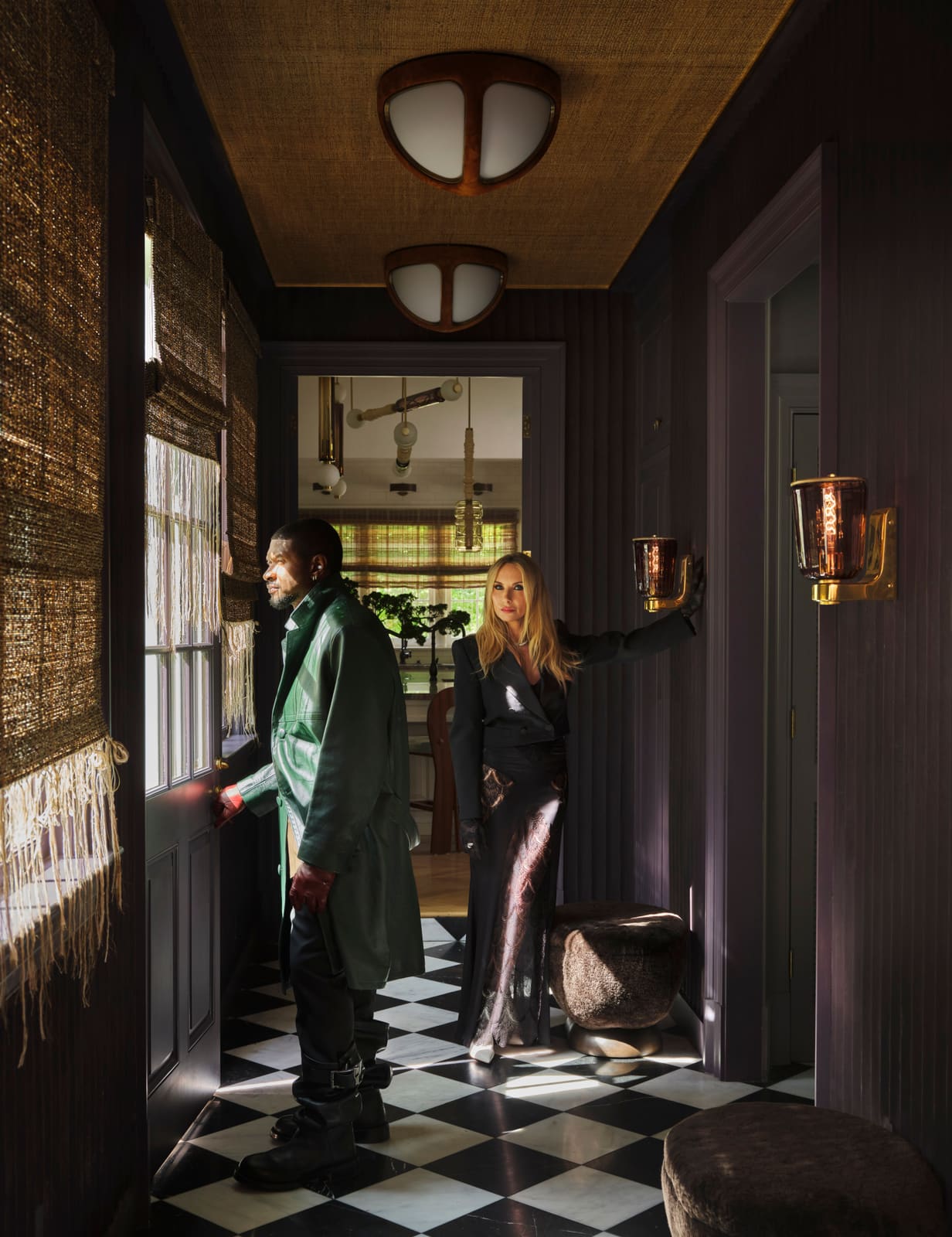
A House Built on Stories
There is a particular intimacy that develops when a designer works with the same client across multiple homes over more than a decade. The relationship moves beyond taste and preference into something closer to shared language. Nicole Fuller, whose eponymous interiors firm maintains studios across New York, Los Angeles, and London, has collaborated with musician Usher on five residences since their professional partnership began roughly 14 years ago. Their most recent project, a Georgian-style estate in Atlanta completed over approximately four years, demonstrates what happens when residential design prioritizes narrative depth over aesthetic formula.
Fuller's approach to the Atlanta house rejected the conventional palette-driven methodology that dominates much of contemporary interior work. Instead, each material selection emerged from conversation and personal history. The result reads less like a decorated home and more like a three-dimensional memoir, where architectural elements function as vessels for memory and cultural reference.
Memorial Architecture in the Study
At the center of one study sits a piano that belonged to Usher's grandmother Tina. Above it, a cross-shaped window installation holds dried flowers from her funeral, backlit to glow softly at night. Fuller worked with contractor Mike Hammersmith to carve this aperture into the home's original brick wall, creating an insulated enclosure that preserves the botanical material while allowing light to pass through.
The technical execution required precise calibration of scale and placement. Hammersmith built up the wall structure around both the exterior and interior perimeters of the cross, then Fuller framed the opening with suede upholstery panels. The reveal detail, a narrow gap between the upholstered frame and the window itself, allows illumination to escape at the edges after dark. The effect transforms a memorial object into living architecture, integrating grief and remembrance into the daily spatial experience of the home.
This kind of devotional design has historical precedents in domestic chapels and prayer niches, but Fuller's interpretation feels contemporary in its restraint. There is no overt religiosity here, only the quiet presence of preserved flowers and the geometry of a cross, rendered in a material language that matches the room's broader palette.
Murals as Collaborative Portraiture
Fuller commissioned Atlanta-based decorative painter Morgan Boszilkov to execute four distinct murals throughout the residence, each responding to a different spatial and emotional context. In the wine vestibule, Boszilkov painted foliage, vines, and birds that reference Chinoiserie traditions without replicating them directly. The pool room features an enlarged interpretation of a tattoo on Usher's chin, scaling personal body art to architectural proportion.
The most collaborative mural occupies the ceiling of daughter Sovereign's bedroom. Boszilkov translated the child's own drawings of ice cream cones, rainbows, and butterflies into a full-scale painted environment overhead. This inversion of typical decorative hierarchy, where a child's imagination literally crowns the room, signals a broader philosophy within the house: that personal expression holds equal weight to professional execution.
Boszilkov, who previously designed eco-friendly wedding garments before transitioning to decorative painting, worked on-site over several weeks. Her process involved direct engagement with the family's daily rhythms, absorbing what she described as the home's atmosphere of collaboration and craftsmanship. The murals function less as applied ornament and more as fixed installations, permanent records of specific relationships and moments in time.
In Sire's room, a three-foot Transformer mural occupies one wall, a scale shift that elevates a childhood fascination to the level of serious artistic subject. This willingness to treat children's interests with formal gravity runs counter to the typical nursery aesthetic, where whimsy often translates to pastels and generic motifs.
The Barbershop Commission
Usher identified a conceptual resonance between his own musical practice and the installations of contemporary artist Lauren Halsey, whose large-scale sculptural environments examine Black cultural production through architectural form. Halsey's work often bridges ancient cosmological systems, particularly Egyptian and Mesoamerican carving traditions, with the vernacular expressions of South Central Los Angeles.
For the home's barbershop, Fuller facilitated a commission with Halsey for a custom artwork depicting a series of heads with intricate haircuts, including a portrait of Usher himself. Halsey executed the piece as what she terms a "protruded engraving," gypsum on wood, a technique she explored in a solo exhibition at Gagosian in the prior year. The work situates Usher within a continuum of grooming as cultural practice, where the barbershop functions as both social institution and site of aesthetic innovation.
The choice to place this commissioned artwork in the barbershop rather than a more traditionally prominent location like an entry hall or living room reflects a spatial hierarchy that privileges use over display. The barbershop becomes a gallery in its own right, a working space where daily ritual intersects with fine art. This approach to art placement has roots in the salon tradition, where domestic spaces doubled as exhibition venues, but it also speaks to a more democratic understanding of where art belongs and who gets to encounter it regularly.
Plush Assemblage in the Playroom
Inspired by the material experiments of the Campana Brothers, particularly their Chairs series that incorporates found objects and textiles into functional furniture, Fuller and Jennifer Goicoechea Raymond developed two installations using stuffed animals from the children's personal collections. A wall piece leading into the playroom assembles more than 250 plush toys, stitched and adhered together to create a tactile, three-dimensional surface. A chair follows similar construction logic, transforming beloved objects into usable furniture.
This approach to children's possessions resists the typical lifecycle of toys, which move from active play to storage to eventual disposal. By fixing the stuffed animals into permanent installations while the children are still young, Fuller and Goicoechea Raymond created a temporal paradox: the objects become both accessible and preserved, present but transformed. The wall installation in particular recalls the assemblage tradition in contemporary art, where accumulation and juxtaposition generate new meaning from familiar components.
The Campana Brothers' work has long explored the tension between craft, design, and fine art, often using materials associated with waste or excess. Fuller's adaptation of their methodology maintains that conceptual framework while personalizing it entirely. These are not anonymous objects sourced for their formal qualities; they are specific toys with specific histories, now embedded in the architecture of daily life.
Design as Cultural Stewardship
Fuller's practice extends beyond this single residential project. Her firm currently manages commissions including a private members' club in New York, a renovation of a Victorian home for musician Questlove, and property curation in Ojai for choreographer and director Fatima Robinson. The through-line across these projects is Fuller's insistence on what she describes as "storytelling," a process that begins with understanding a client's identity and translates that understanding into spatial form.
This narrative-driven approach positions the designer less as arbiter of taste and more as collaborator in cultural production. Fuller's role becomes interpretive: she identifies the materials, artists, and craftspeople who can give physical form to a client's interior life. The process requires fluency in multiple creative disciplines and the social capital to facilitate introductions between clients and artists who might not otherwise connect.
The Atlanta estate demonstrates the potential of this methodology when given sufficient time and trust. Four years of development allowed for the kind of iterative conversation that produces genuinely site-specific work. The commissioned mural by Boszilkov in Sovereign's room could not exist anywhere else; the Halsey engraving responds directly to the function of its space; the memorial cross holds flowers from a specific funeral. Each element resists replication.
Materiality and Memory
What distinguishes Fuller's work on this project from conventional high-end residential design is the refusal to prioritize visual coherence over emotional resonance. The house contains multiple aesthetic registers, from the Chinoiserie-inspired wine vestibule to the contemporary art in the barbershop to the playful maximalism of the stuffed animal installations. These disparate modes coexist because they are unified by authorship rather than style. Every choice traces back to a conversation, a memory, or a relationship.
This approach has implications for how we understand luxury in residential architecture. If luxury is defined by rarity and cost, then bespoke commissions and extended timelines certainly qualify. But Fuller's work suggests an alternative definition: luxury as the space to be fully seen, to have one's history and imagination taken seriously as design drivers. The materials are refined, the craftsmanship is meticulous, but the true extravagance is the attention paid to personal narrative.
The project also raises questions about the role of the designer in an era of increasing design literacy among clients. Fuller does not impose a signature style; her work across different projects shows remarkable formal range. Instead, she offers a process, a framework for translating intangible qualities, family histories, and cultural affinities into architectural and decorative form. The designer becomes facilitator, connector, and occasional editor, but the authorship remains collaborative.
Forward Implications
As residential design increasingly grapples with questions of sustainability and longevity, projects like Fuller's Atlanta estate offer a model that has less to do with material sourcing and more to do with emotional durability. Spaces built around personal narrative have built-in resistance to obsolescence. They cannot be easily replaced or updated without loss, which encourages long-term stewardship rather than cyclical renovation.
The integration of fine art through direct artist commissions also represents a shift in how residential clients engage with contemporary practice. Rather than acquiring existing works on the secondary market, Fuller facilitates primary commissions that respond to specific spatial and programmatic contexts. This model benefits artists by providing income and creative challenges outside the gallery system, while giving clients work that cannot be found elsewhere.
Fuller's expanding firm, with a forthcoming Palm Beach office joining existing locations in major cultural capitals, suggests growing demand for this narrative-centered approach. Whether the model can scale without losing its essential intimacy remains an open question. The Atlanta project succeeded in part because of the long-standing relationship between designer and client, the extended timeline, and the willingness to involve multiple collaborators. Replicating those conditions across a larger practice will require careful attention to studio structure and project selection.
For now, the Georgian estate stands as evidence that residential design can function as a form of cultural stewardship, preserving memory while making space for ongoing creative expression. The house honors the past through the memorial cross and Tina's piano, engages the present through commissioned contemporary art, and anticipates the future through the celebration of children's imagination. It is architecture in service of life as it is actually lived, with all its contradictions, losses, and joys.
Save this story. A free account keeps your reading list and the 07:00 email in one place.
CREATE FREE ACCOUNT →SIGN IN