The Rhythm Between Seasons
Late summer occupies a peculiar place in the architecture calendar. The intensity of spring fairs has subsided, autumn symposia remain weeks away, yet this interval is far from dormant. August 2026 presents a globally distributed programme where institutions and cities alike use the pause to stage ambitious explorations of design's civic potential. From Frankfurt's year-long coronation as World Design Capital to retrospectives interrogating modernist legacies in Milan and Montreal, the month reveals how spatial practice negotiates between public welfare, cultural memory, and environmental responsibility.
What emerges across these nine events is not a singular thesis but a constellation of questions: How does design serve democracy? Can textile traditions inform contemporary spatial thinking? What happens when we revisit the modernist masters not as monuments but as active references for planetary wellbeing? At World Archi Design, we have been tracking how institutions increasingly frame exhibitions not as closed statements but as open inquiries, inviting publics into unresolved conversations about the built environment.
Frankfurt and the Democratic Imperative
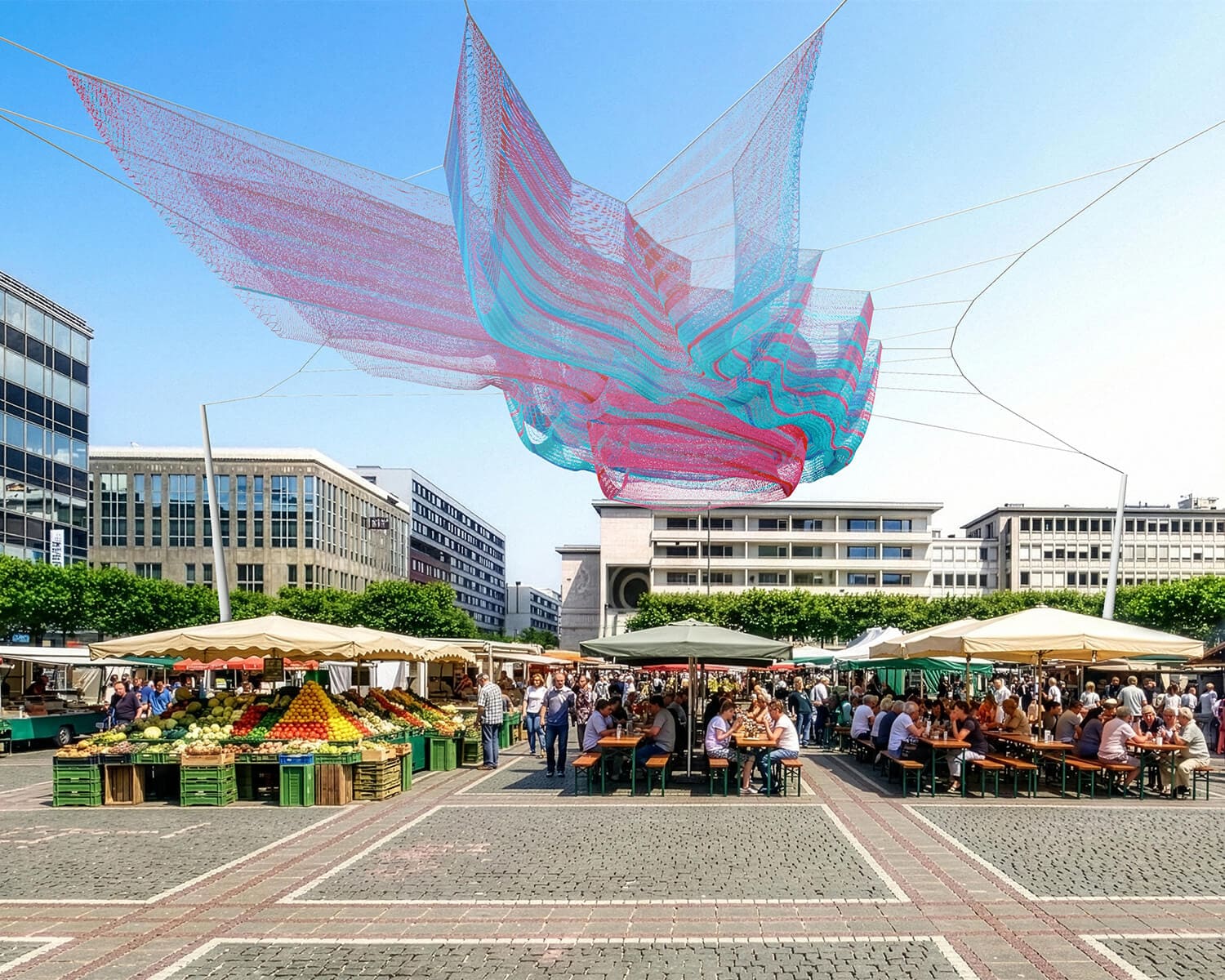
Frankfurt's designation as World Design Capital 2026 rests on a deceptively simple premise: design as a driver for quality of life. The theme, "Design for democracy. Atmospheres for a better life," suggests that spatial interventions can cultivate conditions for civic engagement rather than merely decorate public realm. This is not window dressing. Janet Echelman's A Sky Full of Hope, a twelve-metre-high textile sculpture floating above Konstablerwache square, exemplifies this approach. Monumental yet dematerialized, the installation transforms an urban plaza into a gathering space animated by colour, movement, and shared wonder.
The WDC pavilion, designed by Constructlab, takes material stewardship as its organizing principle. Built from local timber with an inflatable cloud-like roof, the structure is designed for disassembly and itinerant reuse, traveling first to the Rheingau region, then to Darmstadt in September. Constructlab describes the pavilion as "a collection of parts that can be adapted, reused, and transformed over time," positioning temporary architecture not as disposable spectacle but as reconfigurable infrastructure. This is adaptive design in both the technical and conceptual sense: a building that learns from its contexts and evolves accordingly.
The WDC Module Festival, running from August 13 to 16 at Kulturcampus Frankfurt, layers workshops and talks with DJ sets and audiovisual performances, collapsing distinctions between design discourse and pop-culture production. Meanwhile, the German Architecture Museum presents an exhibition on urban heat mitigation strategies, a timely acknowledgment that cities must grapple with thermal extremes as climate patterns shift. The Jewish Museum Frankfurt contributes MISHPOCHA, an immersive exhibition exploring collaboration's creative potential. Together, these programmes position Frankfurt not as a static showcase but as a testing ground for how design might actively shape democratic life.
Textile as Tectonic: Sarah Zapata in Miami
At The Bass Museum of Art in Miami, Sarah Zapata's Against a State of Malevolence deploys weaving traditions as architectural strategy. The Texas-born, Brooklyn-based artist, drawing on her Peruvian heritage and Andean textile practices, transforms gallery spaces into enveloping environments where handwoven surfaces extend into painted walls and floors. This is not decoration applied to architecture; it is textile operating as tectonic system.
Zapata incorporates geoglyph-inspired plinths, echoing the monumental earthworks of ancient Peru, alongside layered fields of blue, saturated reds, and greens. Visitors move through shifts in colour, texture, and scale, experiencing softness and ornament as spatial tools that can be both contemplative and destabilizing. The work blurs boundaries between artwork and architecture, suggesting that craft traditions hold spatial intelligence often overlooked by conventional building practice. In an era where digital fabrication dominates architectural discourse, Zapata's handwork asserts that slowness, ornament, and cultural memory remain viable modes of spatial production.
Helsinki's Network of Exchange
Helsinki Design Week 2026 adopts The Oncoming Other as its thematic anchor, framing chance encounters with unfamiliar perspectives as catalysts for change. The festival treats Helsinki itself as a distributed exhibition, moving through streets, studios, and cultural institutions rather than confining itself to convention halls. Habitare, the week's commercial anchor, functions as a product survey, but the festival's conceptual weight lies elsewhere.
The Architecture & Design Museum Helsinki stages an exhibition examining Aino and Alvar Aalto's holistic approach, linking people, nature, materials, and built form. The Aaltos conceived design not as isolated object-making but as a systemic practice addressing individual and collective wellbeing. This philosophy extended to Artek, the company they co-founded with Maire Gullichsen and Nils-Gustav Hahl. The Making of Modern Living at Artek 2nd Cycle recreates the atmosphere of the brand's first Helsinki store, conceived not merely as retail space but as a cultural platform for art, technology, and new ideas about everyday life.
At Aalto University, Designs for a Cooler Planet shifts from historical reflection to speculative pragmatism, presenting climate-responsive solutions by researchers and students. The exhibition acknowledges that Finnish design's legacy of material restraint and environmental attunement must now address urgent planetary conditions. This is not nostalgia; it is an active reckoning with how modernist principles might inform contemporary environmental practice.
Vignelli's Unified Language in Milan
Triennale Milano's retrospective on Lella and Massimo Vignelli, A Language of Clarity, offers a final opportunity to engage with the couple's disciplined modernism before the exhibition closes. After establishing their practice in Milan, the Vignellis relocated to New York in 1965, importing an Italian conception of design as a unified discipline. Their work spanned New York's subway system, Knoll's graphic identity, furniture, tableware, and interiors, all governed by rigorous typographic and compositional systems.
The exhibition assembles objects, drawings, models, publications, and archival material, tracing how the Vignellis applied consistent principles across vastly different scales and media. This is not eclecticism but systematic thinking: a belief that a coherent visual language can organize everything from wayfinding to domestic space. The retrospective also foregrounds the creative communities that shaped their practice, acknowledging that even the most singular design voices emerge from collaborative networks.
Botanic Fantasy and Digital Moonscapes
Ken Kelleher, working under the moniker Anchorball, populates Ontario's Royal Botanical Gardens with eighteen fibreglass sculptures: female heads crowned in flowers, amorphous blooms, mouse-eared and bunny-like characters rendered in saturated hues. The installations animate a 970-hectare landscape already dense with nature sanctuaries and cultivated gardens. Kelleher envisions these works as constituents of Low Orbit City, an evolving fictional universe, and has created augmented reality layers that visitors can digitally overlay, merging physical and virtual narratives.
In Chicago, Gray gallery presents David Hockney: The Moon Room, a suite of digital paintings the late British artist created on his iPad, capturing a 2020 supermoon and its subsequent landscapes. Hockney deliberately avoided photography, recognizing the moon as a light source that resists photographic capture. Working in real time and later in his Normandy studio, he painted moonlit landscapes using small shapes, diamonds, leaves, circles, to construct trees, bushes, clouds. Printed on paper and mounted on Dibond, the works measure 27 1/8 by 39 1/8 inches. Hockney's approach, foregrounding digital drawing over photographic documentation, suggests that handheld devices can function as legitimate tools for observational painting.
French Talent and Modernist Heritage
Villa Noailles in Hyères, a modernist masterpiece designed by Robert Mallet-Stevens in the 1920s, hosts the twentieth edition of Design Parade, a talent-scouting competition and festival. The anniversary sees ten object designers and ten interior architects honored at the Hyères venue, with Ecuador's Tin Ayala receiving the Grand Prix for product design. Nearby, Chapelle Chalucet in Toulon presents 20 + 10: Génération(s) Design Parade, celebrating the competition's most memorable participants across two decades through some fifty objects by designers including Gregory Granados, Arthur Hoffner, and Alexandre Benjamin Navet.
Villa Noailles simultaneously mounts a retrospective on the 1925 Exposition internationale des arts décoratifs et industriels modernes, the exhibition that announced Art Deco's arrival. This dual programming, juxtaposing emerging talent with historical reflection, positions the institution as both archive and incubator, acknowledging that design's future is inseparable from its past.
Álvaro Siza and the Imperfect City
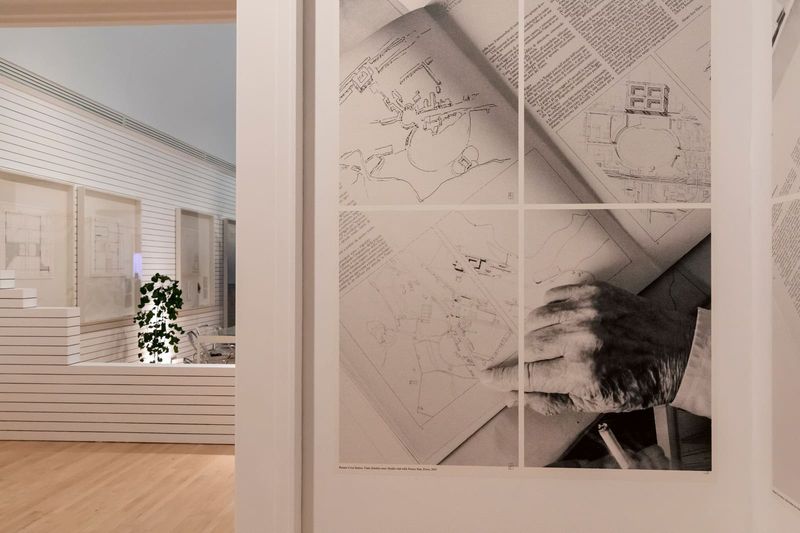
At Montreal's Canadian Centre for Architecture, The fortune of the city is that it has never been perfect examines Álvaro Siza's urban projects through his "experiential way of understanding a place." The Portuguese architect donated his archive to the CCA, and the exhibition draws on drawings, photo collages, models, and sketchbooks, supplemented by photographs from Gabriele Basilico, Nuno Cera, Giovanni Chiaramonte, Alessandra Chemollo, and Balthazar Korab.
The exhibition poses essential questions: How can a city transform without erasing what exists? How does acknowledging time and history influence neighbourhood planning? How do citizens participate in this process? Siza's work, characterized by careful attention to site, history, and social context, offers a model for urban intervention that resists tabula rasa demolition. The title itself, suggesting that imperfection is a city's fortune, reframes incompleteness not as failure but as generative condition. A companion book compiles conversations with Siza in Porto, along with notes and documents, extending the exhibition's inquiry beyond the gallery.
Mid-Century Mexico at Farnsworth House
Opening August 23, Fertile Ground: Crossroads of Design in Mid-Century Mexico occupies Mies van der Rohe's Edith Farnsworth House, part of the iconic building's 75th-anniversary celebration. The exhibition explores Mexico's transformation between the 1930s and 1970s, when architecture, urban planning, industrial design, and traditional craft converged to forge a distinctly modern national identity. Designers, architects, artists, artisans, manufacturers, government institutions, immigrants, and entrepreneurs collectively shaped this vision.
Visitors encounter furniture, ceramics, and architectural drawings that exemplify Mexican tradition and innovation. The pairing is strategic: Mies's radical modernism, with its steel frame and glass enclosure, provides a backdrop for examining how another modernism emerged from different cultural and material conditions. Mexico's mid-century design, often blending pre-Columbian motifs with industrial production, offers a counterpoint to European rationalism, suggesting that modernism was never a singular project but a multiplicity of regionally inflected responses to industrialization and urbanization.
The Cumulative Argument
These nine events, distributed across North America and Europe, collectively argue that architecture and design's relevance hinges on their capacity to address civic, environmental, and cultural urgencies. Frankfurt's democratic design interventions, Helsinki's climate-responsive proposals, and the CCA's inquiry into Siza's urban sensitivity all position spatial practice as a mode of public engagement rather than aesthetic speculation. Meanwhile, retrospectives on the Vignellis and the Aaltos, alongside exhibitions on Mexican modernism and French Art Deco, remind us that historical precedents remain active resources, not inert monuments.
What distinguishes this August programme is its resistance to singular narratives. Zapata's textile tectonics, Kelleher's augmented fantasies, and Hockney's digital moonscapes operate outside conventional architectural discourse yet expand our understanding of how space, material, and perception intersect. The month offers no unified manifesto, only a dispersed set of propositions about how design might navigate between heritage and innovation, individual expression and collective welfare, local specificity and planetary crisis. That multiplicity, far from confusion, is the point.
Save this story. A free account keeps your reading list and the 07:00 email in one place.
CREATE FREE ACCOUNT →SIGN IN