
The City as Palimpsest
There is a recurring tendency in contemporary urbanism to treat the city as a problem awaiting resolution. Master plans promise coherence; large-scale redevelopments offer erasure disguised as renewal. Against this backdrop, the Canadian Centre for Architecture has mounted an exhibition that proposes a different stance entirely. "The fortune of the city is that it has never been perfect" opened in May 2026 and runs through January 10, 2027, presenting the urban work of Portuguese architect Álvaro Siza not as a portfolio of completed objects but as a sustained investigation into how architecture can inhabit time.
Curated by Giovanna Borasi with Laura Aparicio Llorente, the exhibition draws heavily from the Siza archive donated to the CCA. What emerges is not a retrospective in the conventional sense but rather an argument about method, about the patient, iterative work of reading a place before intervening in it. At World Archi Design, we have long tracked the tension between architecture as form-making and architecture as urban repair. This exhibition lands squarely in the latter camp.
Drawing as Research, Not Representation
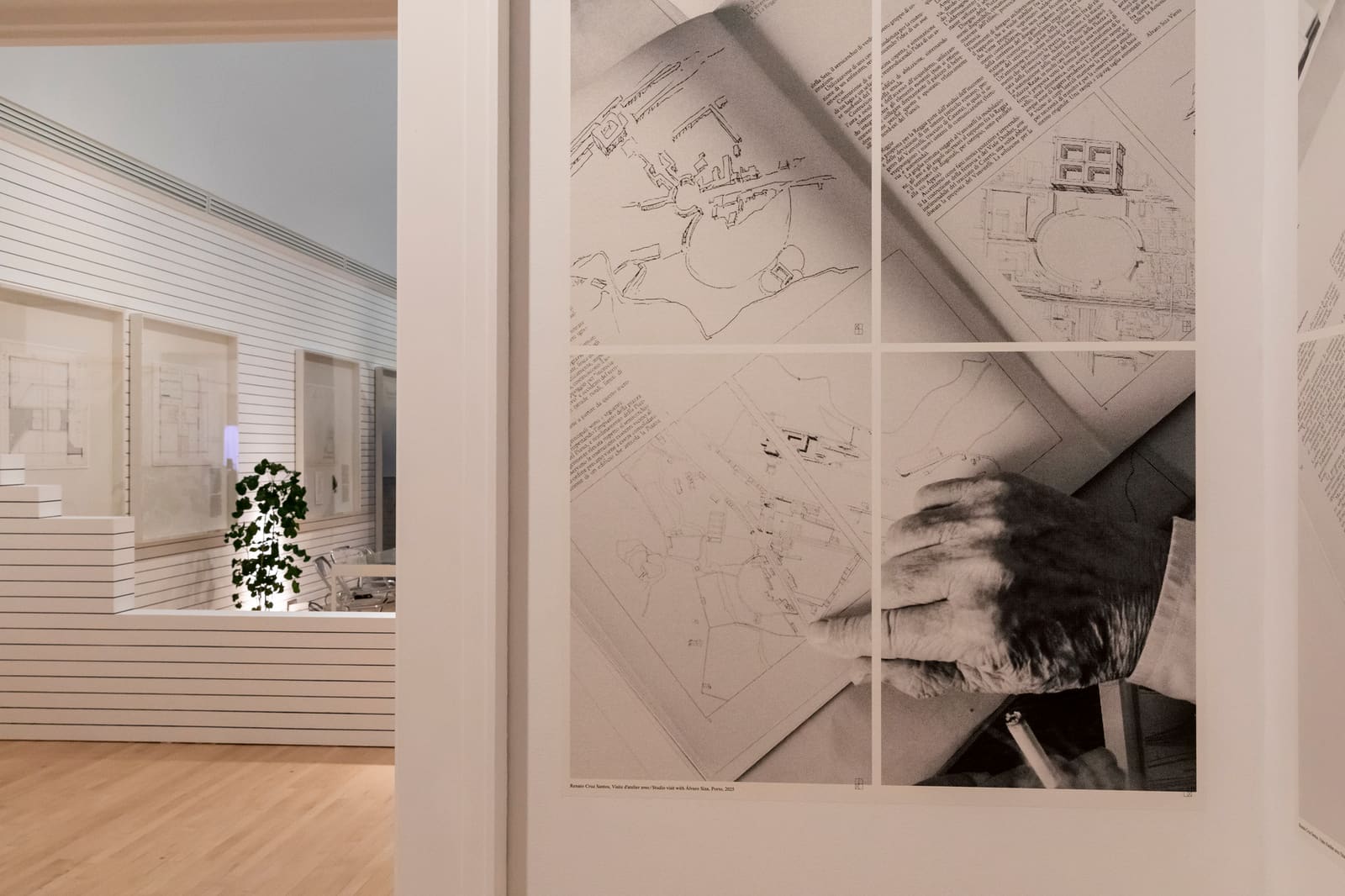
Siza's drawings have always occupied an ambiguous category. They are not purely analytical, nor are they simply preparatory sketches for built work. The exhibition foregrounds original drawings, sketchbooks, architectural models, and photo collages, presenting them as primary documents of a design process rooted in observation. The sketchbooks in particular reveal a practice that begins not with parti or concept but with looking, a kind of graphic note-taking that records topography, adjacency, light, and the worn textures of existing fabric.
This is not the heroic draftsmanship of a Piranesi or the speculative line work of a Lebbeus Woods. It is quieter, more provisional. Siza's drawings track the conditions that already exist, the alignments and discontinuities that any new building will have to negotiate. In one sense, they are acts of deference. In another, they are tactical, identifying where a project might insert itself into the urban grain without rupturing it.
The exhibition includes newly transcribed notes from these sketchbooks, many previously unpublished, identified through a collaborative transcription initiative. The material offers rare insight into how Siza thinks through scale, how he moves between the detail of a threshold and the massing of a block, how he uses drawing not to fix an idea but to test it against the specificity of site.
Projects That Resist the Monumental
The selection of projects spans neighborhoods, public spaces, and urban structures, each chosen for the way it engages historical, social, and physical context. These are not signature buildings dropped into neutral sites. They are works that acknowledge what came before, that accept the city's imperfections as generative constraints rather than obstacles.
Siza's housing projects in particular demonstrate this. Where modernist social housing often imposed typological clarity onto complex sites, Siza's blocks bend, step, and open to accommodate existing streets, retain views, or frame public space. His work in the Schilderswijk neighborhood in The Hague, for instance, negotiates a site fragmented by postwar planning, stitching together disparate scales without flattening difference. The Bonjour Tristesse housing in Berlin, completed in 1984, responds to the particular condition of the IBA initiatives, where infill projects were asked to repair the urban fabric left scarred by war and division.
These projects do not announce themselves. They participate. And that participation requires a different kind of rigor than the production of iconic form. It requires an understanding of adjacency, of how a building meets the sidewalk, of how a courtyard can mediate between public and private without resorting to defensive urbanism.
Situating Siza Within a Broader Discourse
The exhibition does not present Siza in isolation. Material by architects and historians whose work intersected with his research appears throughout, including Aldo Rossi, Gene Summers, James Stirling, Kenneth Frampton, and Jean-Louis Cohen. This contextualization is critical. Siza's urban sensibility emerged alongside the typological inquiries of the Italian Neo-Rationalists, the contextual ambitions of postmodern urbanists, and the critical regionalism articulated by Frampton.
Yet Siza resists easy categorization. He shares Rossi's interest in the architecture of the city, but without the latter's tendency toward abstraction. He engages context as carefully as Robert Venturi, but without the irony. His work is vernacular-adjacent but never pastiche. What the exhibition makes clear is that Siza's method is project-based, not ideological. Each site generates its own logic; each intervention is calibrated to the specific conditions at hand.
Photographs by Gabriele Basilico, Nuno Cera, Giovanni Chiaramonte, Alessandra Chemollo, and Balthazar Korab document completed projects, offering perspectives that underscore the lived dimension of these spaces. Basilico's images in particular, with their forensic attention to the meeting of materials and the play of light on surfaces, reveal how Siza's buildings age into their contexts, how they acquire patina and use.
The City as Source, Not Tabula Rasa
The exhibition's central proposition, articulated by the CCA, is that the city itself constitutes a source of knowledge for future urban development. This is not nostalgia. It is a recognition that the accumulated physical, historical, and social layers of a place contain information, that these layers can inform rather than constrain new work.
Siza's approach does not seek universal solutions. It does not export typologies or replicate formal strategies across sites. Instead, it operates through direct observation, through drawing as a form of research, through careful engagement with what is already there. The appropriate scale and form of intervention emerge from this engagement, not from predetermined concepts or stylistic commitments.
This stance has implications beyond Siza's own practice. In an era of accelerated urbanization, where cities from Lagos to Shanghai are expanding at speeds that preclude patient site analysis, the exhibition offers a counter-model. It suggests that urbanism might begin not with the question of what to build but with the question of what already exists, and how new work might enter into dialogue with it.
An Oral History and Archival Collaboration
The exhibition is accompanied by a publication centered on an oral history recorded with Siza over several days in Porto. Oral histories with architects are notoriously uneven, often veering into anecdote or self-mythology. But when structured around specific projects and supported by archival material, they can reveal the contingencies of practice, the decisions that do not appear in published drawings or critical accounts.
The volume brings together archival documents, newly transcribed notes from sketchbooks, and previously unpublished material. The collaborative transcription initiative that made this possible represents a model for how institutions can activate their archives, turning them from repositories into active sites of research. Siza's handwriting is notoriously difficult to decipher; the initiative involved multiple contributors working to interpret sketches, annotations, and marginal notes that might otherwise remain opaque.
Toward a Longer View
At a moment when architecture culture remains enamored with novelty, with the next material innovation or parametric formal strategy, "The fortune of the city is that it has never been perfect" asks us to slow down. It asks us to consider what it means to build within an already dense field of meaning, to accept imperfection not as failure but as condition.
Siza's work, as presented here, is not about monuments. It is about increments, about the patient accumulation of interventions that, over time, might constitute a more livable city. It is architecture that understands itself as part of a longer conversation, one that began before the architect arrived and will continue after the building is complete.
For those of us who write about architecture, who attempt to identify what matters in the proliferation of new projects, this exhibition offers a useful corrective. It reminds us that the most enduring work is often the least spectacular, that the buildings we return to are not necessarily the ones that photograph well or generate the most discourse upon completion. They are the ones that enter into the life of the city quietly, that become part of the everyday without demanding attention.
The exhibition will remain on view through early 2027. For anyone interested in how architecture negotiates time, in how new work can coexist with old without erasing it, this is essential viewing. Siza's method, refined over six decades, offers no shortcuts. But it offers something rarer: a model for building that respects what came before while remaining open to what might come next.
Save this story. A free account keeps your reading list and the 07:00 email in one place.
CREATE FREE ACCOUNT →SIGN IN