
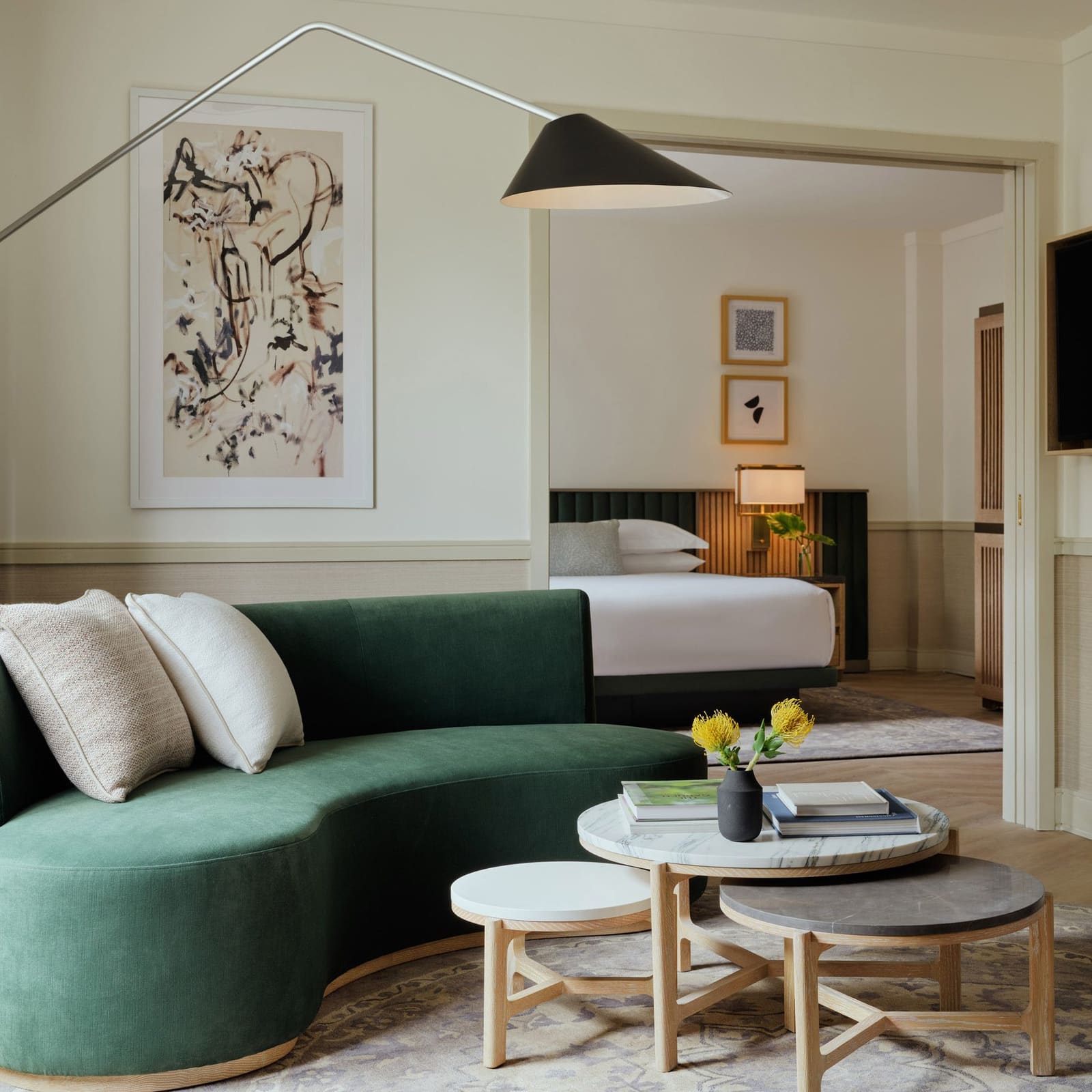
The Typology of Intimacy
Hospitality design has spent the past decade dismantling the grand-lobby paradigm. In its place: projects that mimic the scale, palette, and spatial sequence of private homes. The Kimpton Ashbel, which opened in a 1928 beaux-arts building on Park Avenue, offers a case study in how designers translate residential intimacy to a 200-key program.
Anna and Jonathan Busta, who lead the New York practice behind the interiors, describe the project as a "conceptual townhouse experience." That framing is more than marketing. The building's original envelope, with its limestone facade and setback massing, already belonged to the lineage of Park Avenue residential architecture. The challenge was to extend that language inward, creating public spaces that read as enfilade rooms rather than commercial lobbies, and guestrooms that feel collected rather than standardized.
Material Continuity and Restrained Ornament
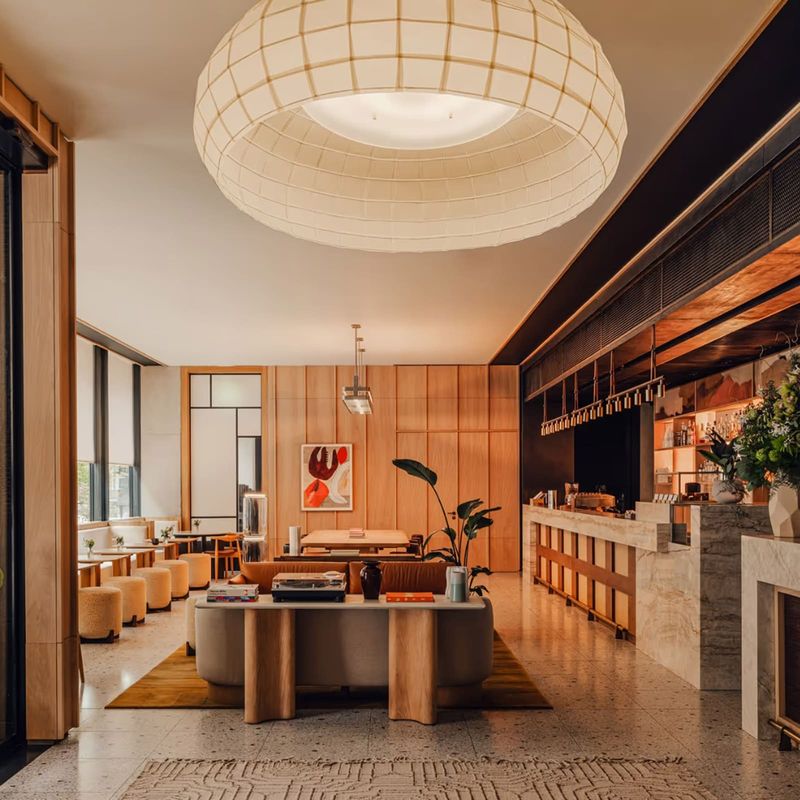
Busta Studio anchored the interior around a limited material palette: hand-brushed blonde limed oak panelling, Bianco Dolomiti marble, and Pietra stone. These surfaces, deployed consistently across lobby, corridors, and guestrooms, establish a tectonic continuity that residential projects take for granted but hotels rarely achieve.
The studio layered in hand-cast bronze detailing, inlaid mosaic work, and white plaster mouldings. The approach recalls the restrained ornament of Delano & Aldrich or Rosario Candela, architects whose 1920s townhouses and apartment buildings defined Park Avenue's aesthetic. There's no exuberance here, no marble-clad atriums or statement chandeliers. Instead, the design relies on proportion, craftsmanship, and the cumulative effect of well-chosen materials.
At street level, custom louvres mediate the threshold between Park Avenue's bustle and the hotel's interior calm. The lobby floor features an inlaid mosaic spelling out the hotel's initials, a gesture that nods to the bespoke entry vestibules common in prewar residential buildings.
Curated Objects and Commissioned Art
One of the hallmarks of residential interiors is the presence of collected objects: artworks acquired over time, furniture inherited or commissioned, decorative pieces that carry narrative weight. Busta Studio replicated this condition by commissioning a suite of artworks specifically for Kimpton Ashbel, spanning graphics, painting, photography, and sculpture.
Anna Busta describes the collection as guided by "a simple but sophisticated aesthetic," deliberately avoiding provocation in favor of visual coherence. The works appear in both public areas and guestrooms, reinforcing the sense that each space has been individually considered. This strategy aligns with precedents like the Hoxton or Ace Hotel, where art programs are site-specific rather than franchise-standardized.
The distinction matters. In residential design, art is integrated into the spatial composition; in most hotels, it's applied as decoration. By commissioning pieces for particular locations within the building, the studio collapses that gap.
Color, Texture, and the Question of Scale
The color palette at Kimpton Ashbel pivots on neutral backgrounds punctuated by jewel tones: emerald, sapphire, amber. These saturated hues appear in arch-back chairs, upholstered headboards, and side stools, providing visual warmth without overwhelming the restrained material base.
Textile choices reinforce the residential reading. Busta Studio specified velvets, linens, naturally tanned leathers, and boucle fabrics, all materials with tactile presence. In guestrooms, this translates to layered softness: upholstered wall panels, linen drapery, velvet seating. The effect is closer to a well-appointed bedroom than a typical hotel room, where hard surfaces and synthetic fabrics dominate for durability.
Hospitality projects face constraints that residential interiors do not. Materials must withstand high traffic, cleaning protocols, and regulatory requirements. The success of Kimpton Ashbel's approach depends on whether those tactile materials can maintain their character under operational conditions. Early projects that pursued similar strategies, like Ian Schrager's Gramercy Park Hotel, often saw their bespoke finishes degrade within a few years.
Precedents and the Return to Domesticity
The townhouse-as-hotel typology has deep roots. London's Georgian terraces have long been adapted into boutique properties; Copenhagen's Hotel d'Angleterre occupies an 18th-century structure originally conceived as interconnected residences. What distinguishes recent iterations is their emphasis on material authenticity and spatial intimacy over period pastiche.
Busta Studio's work at Kimpton Ashbel aligns with projects like A-nrd's Arthouse Glasgow, which occupies a 19th-century townhouse, or David Thulstrup's interiors for Hotel Herman K in Copenhagen, where residential scale and craft-driven detailing anchor the guest experience. These projects reject the maximalism of boutique hotels from the early 2000s, when designers like Christian Liaigre or Jacques Garcia deployed heavy ornament and saturated color to signal luxury.
The current paradigm favors restraint. At World Archi Design, we've observed this shift across markets: from Tokyo's small-scale ryokan-inspired properties to Brooklyn's converted brownstones. The appeal lies in legibility. Guests understand the spatial language of homes; they know how to inhabit them. Hotels that borrow that language reduce cognitive friction, creating environments that feel immediately familiar.
Thresholds and the Choreography of Arrival
One detail worth isolating: the custom louvres at street level. In residential townhouses, the entry sequence is carefully choreographed, mediating the transition from public sidewalk to private interior. Vestibules, foyers, and entry halls create spatial and psychological distance.
Most hotels collapse this sequence. Guests move directly from street to lobby, with only a revolving door as threshold. Busta Studio's louvres reintroduce that buffer, filtering light and views while signaling a shift in atmosphere. It's a small intervention, but one that reinforces the residential conceit.
The mosaic initials in the lobby floor extend this logic. Residential buildings of the 1920s often featured personalized entry mosaics, family crests, or monograms. By embedding the hotel's initials into the threshold, Busta Studio borrows that symbolic gesture, marking the lobby as a place of belonging rather than transit.
Performance and Longevity
The test for any hospitality interior is whether its design ambitions survive operational realities. Residential materials, residential scale, and residential detailing all face challenges in a commercial context. Blonde limed oak panels can show wear; hand-cast bronze can tarnish; velvet upholstery can stain.
Busta Studio's material choices suggest confidence in durability. Limed oak is more forgiving than high-gloss finishes; bronze develops patina rather than damage; velvet, when properly specified, can withstand heavy use. The question is whether maintenance protocols will preserve these surfaces or whether cost pressures will lead to replacements that dilute the original vision.
We've seen this play out in other projects. André Fu's interiors for the Upper House in Hong Kong have maintained their material integrity over a decade; by contrast, many Starwood properties from the same era have undergone multiple renovations, each stripping away craft details in favor of more durable, less distinctive finishes.
A Quiet Argument for Restraint
Kimpton Ashbel represents a particular stance within contemporary hospitality design: that luxury can be quiet, that intimacy scales, and that the spatial and material language of residential architecture translates across typologies. Busta Studio's interiors don't announce themselves. There are no signature gestures, no Instagram-optimized moments. Instead, the project offers cumulative refinement, the kind that reveals itself over time rather than at first glance.
Whether this approach resonates with guests, and whether it proves operationally sustainable, will determine if the townhouse-as-hotel model continues to gain traction. For now, it stands as evidence that beaux-arts bones, when paired with restrained material intervention and spatial discipline, can support a contemporary hospitality program without sacrificing the intimacy that makes residential interiors compelling.
Save this story. A free account keeps your reading list and the 07:00 email in one place.
CREATE FREE ACCOUNT →SIGN IN