
A Palette Problem in Paradise
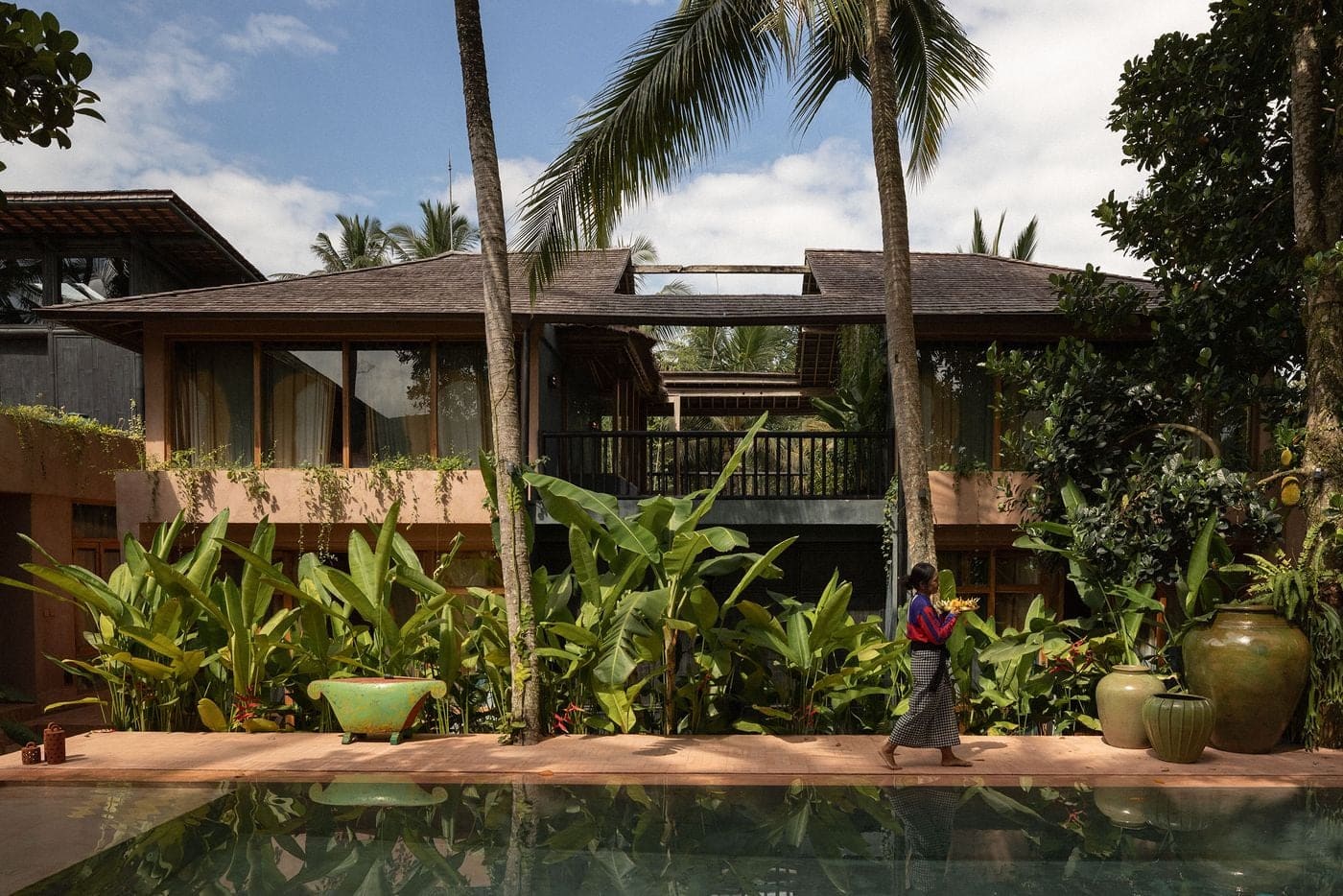
Bali's luxury hospitality sector has perfected a look over the past decade: pale stone, raw timber, woven rattan, and the sort of beige restraint that photographs beautifully but can blur into uniformity. Guests arrive expecting that aesthetic; architects and developers deliver it with assembly-line consistency. Moon Gang, which opened in Ubud in June 2026, operates on different assumptions. Designed by Yasmine Ghoniem of Sydney's YSG Studio for Australian wellness entrepreneur Kirsten Millbank, the five-suite property layers acidic yellows, papaya greens, and lava-glazed tiles over bamboo and terracotta, producing an environment that reads less as tropical zen and more as surrealist collage. It is boutique hospitality willing to risk legibility for personality.
Ghoniem, an Egyptian-Australian designer whose residential projects favour instinct over formula, was handed a dilapidated holiday villa and a mandate to prioritise local fabrication and recycled content. Rather than treat those constraints as limitations, she turned them into the project's organising logic. Virtually every surface, fixture, and piece of furniture was made within Indonesia, often from salvaged or repurposed feedstock. The result is a small hotel that functions as both a catalogue of Indonesian craft capability and an argument against the idea that sustainability must look humble.
Arrival by Scooter
Moon Gang dispenses with the conventional lobby. Guests check in at Mini Moon Gang, a kiosk near Ubud's town centre, then ride pillion on a scooter for three minutes up a narrow, vehicle-free track that winds through rice paddies and jungle canopy. The approach sequence is deliberately cinematic, trading the usual porte-cochère formality for something closer to a pilgrimage. By the time visitors dismount at the property's breeze-block boundary wall, the noise and traffic of central Ubud have receded entirely.
That sense of enclosure is partly topographic, but also architectural. The original concrete structure, though severely degraded, was retained and retrofitted rather than demolished. YSG patched water-damaged walls, replaced rotted timber with new shingles stained in charcoal-indigo, and swapped decaying boundary slats for perforated masonry blocks that recall Indonesian woodblock prints while improving cross-ventilation. Organic portholes were carved through interior walls to frame sightlines toward planted corners; a central archway was lowered to funnel views poolward; structural columns in the lounge were removed to open circulation.
The exterior was resurfaced in a cinnamon-toned render made from recycled earth-based aggregate. Tessellated terracotta finger tiles, laid by hand, unify the pool deck and lounge floor. Against that warm substrate, Ghoniem introduced chromatic punctuation: glazed tiles in saturated blues and greens, citrus-yellow joinery, and dense plantings that spill over walls and balustrades.
Fifteen Artisans, One Vocabulary
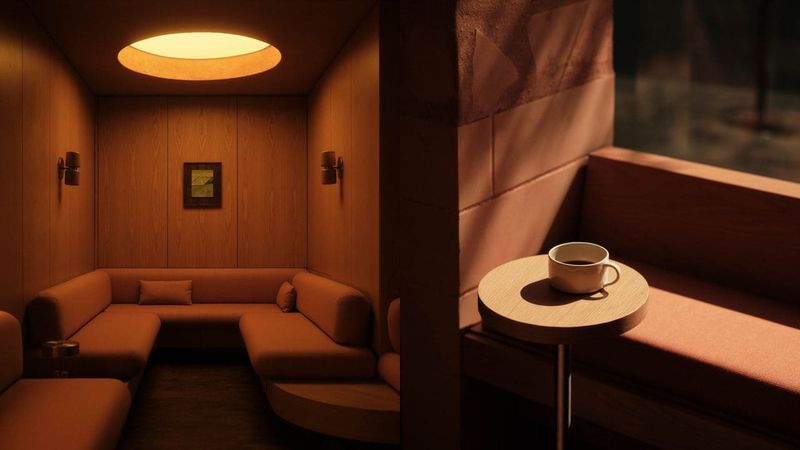
The furniture and lighting programme involved more than fifteen Indonesian fabricators, each working to YSG's drawings but bringing local material knowledge and craft tradition to the execution. Sun loungers at the pool were woven from upcycled plastic waste and feature exaggerated tufted "mohawks" along the headrests. Counters and stools in the listening lounge were cast from recycled bottle caps, yielding a terrazzo-like surface in unexpected colour combinations. Pendant lamps in the suites were constructed from banana-leaf paper dyed in soft gradients and shaped into cloud forms. A rooftop suite, inspired by traditional Japanese bamboo tea huts, was built entirely from bamboo treated with shou sugi ban and punctured by an oversized skylight for nocturnal stargazing.
Japanese references thread through the project in other ways: shoji screens depicting lunar phases, paper lanterns, and charcoal-stained timber furniture. These sit alongside Balinese shrines, newly blessed and painted in custom colours, that serve as both spiritual markers and wayfinding devices. Smaller resin-and-timber versions double as suite signage, blending ritual function with graphic identity.
The art collection, curated with input from creative consultancy Dance Card, was sourced from Indonesian art fairs and local galleries. Commissions include a palm-leaf "dragon" pendant suspended in the lounge (a traditional symbol of fortune) and an outdoor totem combining stained glass, bamboo, metal, and ceramic elements. Wall sculptures by Aral Stud and paintings by Surya Subratha animate individual suites, reinforcing the sense that each room is a distinct spatial proposition rather than a template repeated five times.
Five Suites, Five Personalities
Velvet Mood and Night Fever occupy two levels each, with separate lounges and dual private patios. Midnight Runners includes a freestanding bath, a sitting area, and its own record player stocked with vinyl. Golden Shadow and Sun Dust can be booked separately or combined via a shared terrace to form a 101-square-metre suite suitable for families or small groups. Sun Dust, the rooftop bamboo pavilion, is the most architecturally singular, its deep indigo structure framing views of the surrounding jungle canopy.
Each suite deploys a different material and colour strategy. Acid-yellow tilework appears in one; terracotta finger tiles in another. Plant-dyed curtains in watercolour washes soften hard surfaces. Sculptural lighting, designed by YSG and fabricated by Indonesian studios including Anomolous and AA Practice, provides both ambient illumination and focal points. Amenities range from vintage cassette players to a telescope, encouraging guests to engage with the space rather than simply occupy it.
Wellness as Creative Practice
Moon Gang's Wellness Lab reframes the spa typology as something less prescriptive and more experimental. Treatments developed in collaboration with Indonesian skincare brand Fields of Yarrow combine botanical facials with massage, sauna, meditation, breathwork, and biophilic yoga. Sessions run late into the evening, accommodating guests who prefer post-dinner treatments to morning rituals. The programme also includes outdoor film screenings and silent-disco movement sessions, blurring the boundary between wellness and entertainment.
The most unusual intervention is auditory. Indonesian dance-electro duo Bottlesmoker developed a site-specific soundscape by translating the bioelectrical frequencies of on-site plants into a low-level ambient track that plays throughout the lounge. The result is a gentle, arrhythmic backing score that shifts with the time of day and the health of the vegetation, turning the landscape into a live instrument.
Why Restraint Is Not the Only Answer
Bali's luxury hospitality market has long equated sophistication with understatement. Neutral palettes, minimal ornamentation, and carefully curated vignettes dominate the island's boutique portfolio, reflecting both modernist design principles and the influence of international hotel brands. That formula works, but it also risks homogeneity. When every property aspires to the same visual language, differentiation becomes nearly impossible.
Moon Gang makes a case for a different approach. By prioritising colour, commissioning bespoke fabrication, and treating local artisans as collaborators rather than suppliers, Ghoniem and Millbank have produced a property that feels specific to its place without defaulting to expected tropes. The project demonstrates that sustainability need not look austere, that craft can support contemporary design ambitions, and that boutique hospitality can afford to take formal risks.
The danger of such an authored environment is that it can feel over-determined, leaving little room for guests to project their own interpretations. Moon Gang avoids that trap by building in moments of play: the scooter arrival, the vinyl library, the telescope, the plant-generated soundtrack. These elements invite participation, turning the hotel from a static composition into a platform for curiosity. In a market crowded with competent but predictable retreats, that sense of agency, however modest, makes a difference.
Material Honesty, Chromatic Freedom
One of the project's quieter achievements is its reconciliation of ecological ambition with aesthetic exuberance. Recycled plastic, reclaimed timber, repurposed bottle caps, and salvaged concrete are all legible in the finished work, but they are not fetishised. Ghoniem treats these materials as design opportunities rather than moral badges, deploying them in ways that foreground form and colour over provenance. The sun loungers are striking because of their silhouette and texture, not because they are made from waste. The bottle-cap counters register first as graphic surfaces, only revealing their material composition on closer inspection.
This approach avoids the piety that can afflict sustainable design, where virtue signalling overtakes spatial or aesthetic ambition. Moon Gang is unambiguously committed to material reuse and local fabrication, but it does not require guests to celebrate that commitment. The environmental logic is embedded in the architecture; the experience is one of colour, craft, and spatial surprise.
A Model, Not a Template
Moon Gang will not be replicable at scale. Its bespoke fabrication programme, reliance on local artisans, and relatively small footprint make it a poor candidate for franchise expansion. That specificity is precisely the point. The project demonstrates what becomes possible when a designer and a client are willing to invest time, attention, and trust in local making. It is a model predicated on collaboration rather than procurement, on commissioning rather than specifying, and on treating craft as a living discipline rather than a heritage amenity.
Whether that model can influence Bali's broader hospitality sector remains to be seen. The island's tourism economy depends on volume, and volume typically demands standardisation. But for designers and developers willing to operate at smaller scales, Moon Gang offers a useful provocation: that sustainability, locality, and formal ambition need not be in conflict, and that the tropical boutique hotel typology still has room for experimentation.
Save this story. A free account keeps your reading list and the 07:00 email in one place.
CREATE FREE ACCOUNT →SIGN IN