
A Building With Many Lives
Belgrade's architectural palimpsest rarely follows a single narrative. The city layers neoclassical grandeur atop socialist concrete, brutalist housing beside turn-of-the-century villas, all coexisting without apology. It is precisely this refusal to erase history that makes Esthetic Joys Embassy feel less like an imported concept and more like another stratum in the city's material memory.
The 1927 villa in Dorćol was designed by Branislav Kojić for Edvard and Danica Vlajić Zamboni, a couple known for their intellectual circles in interwar Belgrade. Danica Kojić, Branislav's wife, handled the interiors, a detail worth noting in an era when such credit was rarely formalised. The building later functioned as a milk dispensary under the name Kap mleka, then served as Iran's diplomatic mission through the 1960s and 1970s. Today it accommodates Pavilion Hotel alongside Esthetic Joys Embassy (EJE), a compound programme that includes a dining room, bar and discotheque.
Local studio Supaform was tasked with the interior, and rather than impose a single aesthetic, the team chose to work within the building's accumulated identities. The result is a space that oscillates between multiple references without settling into pastiche.
Yugoslav Optimism Meets Japanese Restraint
Supaform's parti draws heavily from the late 1950s and early 1960s, a period when Yugoslav modernism expressed optimism through aerodynamic forms and modular civic infrastructure. The primary reference is Saša Mächtig's K67 kiosk, designed in 1966 and produced in fibreglass until 1999. The K67 was portable, rounded, and built on a modular logic that allowed it to adapt to different programmes: newsstand, ticket booth, snack bar. It embodied a utopian faith in systems thinking, a belief that good design could be both flexible and egalitarian.
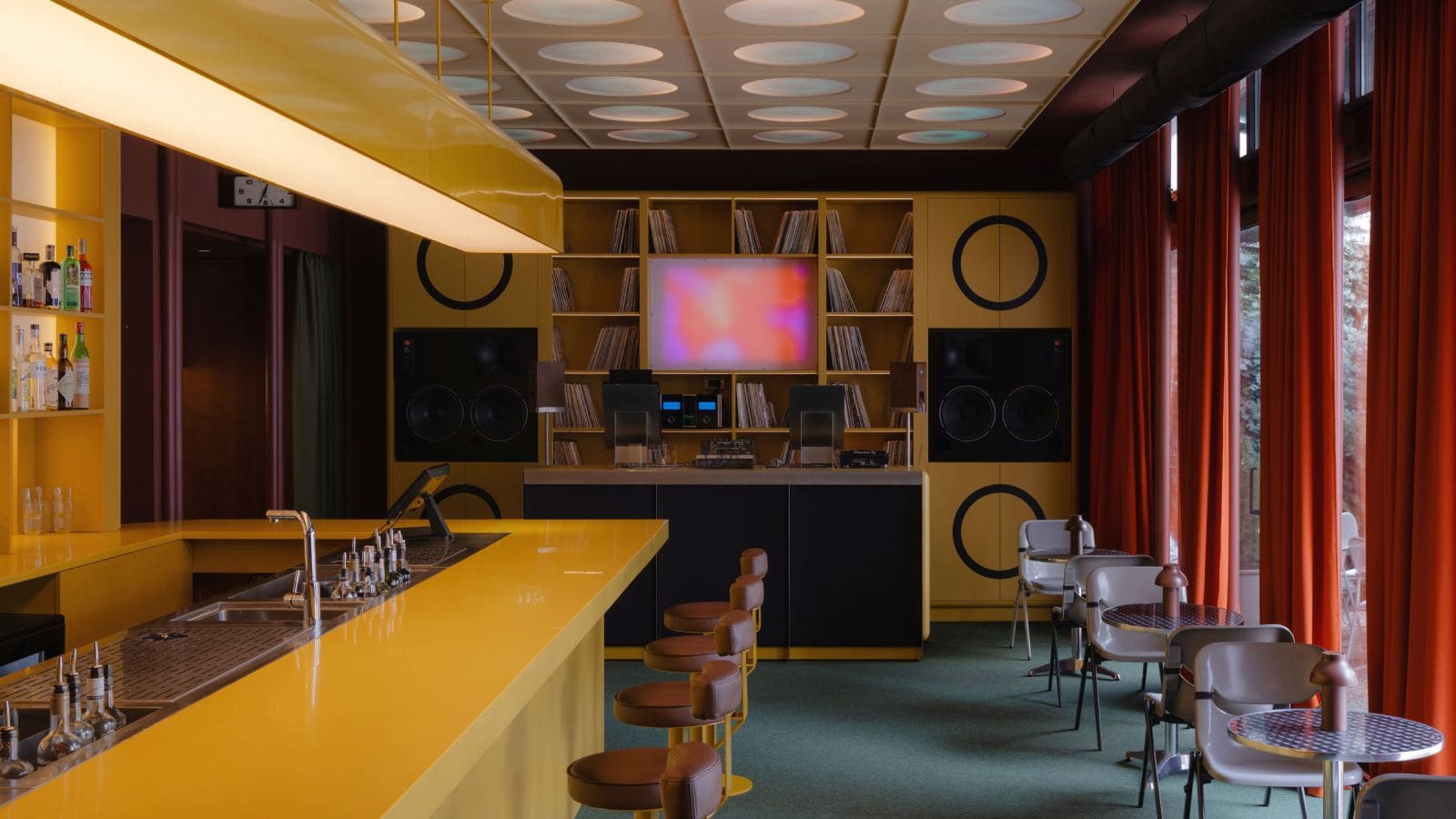
That modularity is echoed throughout EJE, not through literal quotation but through spatial organisation. The interior is divided into zones that can function independently or coalesce depending on the time of day and the density of occupation. A warm, deep yellow pigment unifies the surfaces, while oval ceiling fixtures cast a diffuse glow reminiscent of mid-century Eastern European public interiors. Near the DJ booth, a Dulton Double Face Japanese station clock ticks audibly, a deliberate anachronism that reinforces the hybrid identity of the space.
The banquette seating along the darkly stained wooden walls is upholstered in the final production run of Misha Black's District line moquette, sourced from a London mill before the pattern was discontinued. Black, a British designer and founding member of the Design Research Unit, created the District line for London Transport in the 1970s. Its geometric abstraction and durable weave made it a staple of public seating, and its presence here is both a material nod to civic design and a subtle critique of the disposability that has come to define much contemporary hospitality.
The Listening Bar as Spatial Typology
Japanese listening bars, or kissa, emerged in postwar Japan as spaces where recorded music was treated with the same reverence as live performance. High-fidelity audio equipment, curated vinyl collections, and a culture of attentive silence defined the typology. EJE imports this ethos but reconfigures it for a different social context. Vintage JBL 4435 studio monitors anchor the sound system, and the vinyl collection is presented not as background ambience but as a curatorial statement.
Six booths inspired by the ichiran ramen chain offer an alternative mode of occupation. Curtains close, headphones are provided, and food can be ordered contactlessly. This is not isolation for its own sake but rather a deliberate inversion of the open-plan sociability that dominates most contemporary bars. The booth becomes a private listening chamber within a public space, a micro-environment where the acoustic field is controlled and individual experience is prioritised.
The tension between communal and solitary occupation is one of the more interesting spatial moves here. At World Archi Design, we have tracked the resurgence of booth seating in hospitality design, often as a response to pandemic-era concerns about proximity. But EJE's approach goes further, treating the booth not as a hygiene measure but as a legitimate architectural typology, one that acknowledges the desire for both connection and retreat within the same visit.
Culinary Programme as Cultural Synthesis
Chef Andrey Balakhnov describes the menu as "modern, vibrant, and easy to understand", a formulation that could easily slide into vagueness but is given specificity through technique. The dishes draw on Asian ingredients and methods, layered onto formats that read as familiar to a European palate. Pork ramen is offered as a starting point, and sake tiramisu as a conclusion, both dishes that signal hybridity without theatrics.
The drinks menu adopts a stock exchange conceit, with cocktails named after global currencies. The Chinese Yuan combines vodka, sake, kombu and miso into an umami-forward serve. The Japanese Yen pairs yuzu with sparkling wine. The Korean Won blends gin, strawberry soju, coconut and citrus. The naming system is playful but also gestures toward the globalised flows of capital, ingredients and cultural reference that underpin the space itself.
This is not fusion cuisine in the 1990s sense, where disparate elements were combined for novelty. Instead, it reflects a more contemporary understanding of culinary synthesis, one in which Asian techniques and ingredients are treated as part of a shared repertoire rather than as exotic additions. The menu does not announce its influences with fanfare; it assumes a level of fluency on the part of the diner.
Precedents and Context
EJE sits within a broader trajectory of projects that use historical buildings as armatures for new spatial experiments. Caruso St John's renovation of Nottingham Contemporary repurposed an industrial site without erasing its material history. David Chipperfield's Neues Museum reconstruction in Berlin preserved layers of damage and repair, making the building's biography legible. EJE operates in a similar register, though at a smaller scale and with a more eclectic formal vocabulary.
The use of the K67 kiosk as a conceptual anchor also places the project within ongoing debates about Yugoslav architectural heritage. Much of that built legacy has been neglected, demolished, or misunderstood in the post-socialist period. By referencing Mächtig's work, Supaform participates in a larger effort to reframe Yugoslav modernism not as a relic of a failed system but as a body of design thinking with ongoing relevance.
The Japanese listening bar, meanwhile, has been widely exported in recent years, with examples appearing in London, New York, and Melbourne. EJE's contribution is to resist the formulaic replication that often accompanies such transplantation. Rather than importing the aesthetic wholesale, the project hybridises it with local material culture and spatial history, producing something that feels specific to Belgrade while remaining legible within a global design conversation.
What This Signals
EJE is not revolutionary, nor does it claim to be. It does not propose a new architectural language or a radical rethinking of hospitality space. What it does offer is a model for how adaptive reuse can engage with multiple timelines and geographies without collapsing into nostalgia or eclecticism for its own sake. The space is layered, referential, and unapologetically hybrid, qualities that feel increasingly necessary in a design culture often polarised between purist minimalism and maximalist spectacle.
The project also suggests that the listening bar, as a typology, has more spatial potential than its current iterations often realise. By integrating booth seating, modular zoning, and a culinary programme that matches the complexity of the interior, EJE expands the format beyond the single-use niche it has occupied in many cities. It becomes a place where different modes of occupation can coexist, where the solitary listener and the social drinker are both accommodated without compromise.
Whether this approach will influence other projects in Belgrade or beyond remains to be seen. But it offers a useful counterpoint to the generic internationalism that has flattened much recent hospitality design, proving that specificity, when handled with care, can produce spaces that are both locally grounded and globally resonant.
Save this story. A free account keeps your reading list and the 07:00 email in one place.
CREATE FREE ACCOUNT →SIGN IN