
When Extraction Runs Backward
There is something almost Biblical about the scene: a septuagenarian in white linen, standing in predawn mist among excavators, watching twenty-metre trees lowered into prepared earth. This is not demolition but assembly, not extraction but regeneration, conducted at industrial velocity across 126 hectares an hour from Belo Horizonte. In a region where iron ore mines consume mountains, Bernardo Paz is putting the forest back, one mature specimen at a time.
He has done this before. A decade and a half ago, Paz spent 25 years building Inhotim, the 140-hectare open-air contemporary art museum that became one of the Southern Hemisphere's most ambitious cultural projects. In 2022, he signed it all over: 500 works, 23 galleries, the entire meticulously landscaped apparatus. Now, after liquidating his business holdings for US$300 million, he is building again. The new project, Museu Bernardo Paz, occupies an adjacent parcel of roughly equivalent size. This time, however, he wants the first 20 gallery spaces finished before his own clock runs out.
"What I learned is that I'm going to die," Paz says when asked what decades of shaping landscapes have taught him. That sentence hangs over every architectural decision, every planting schedule, every late-night revision his design teams navigate.
Architecture at the Speed of Conviction
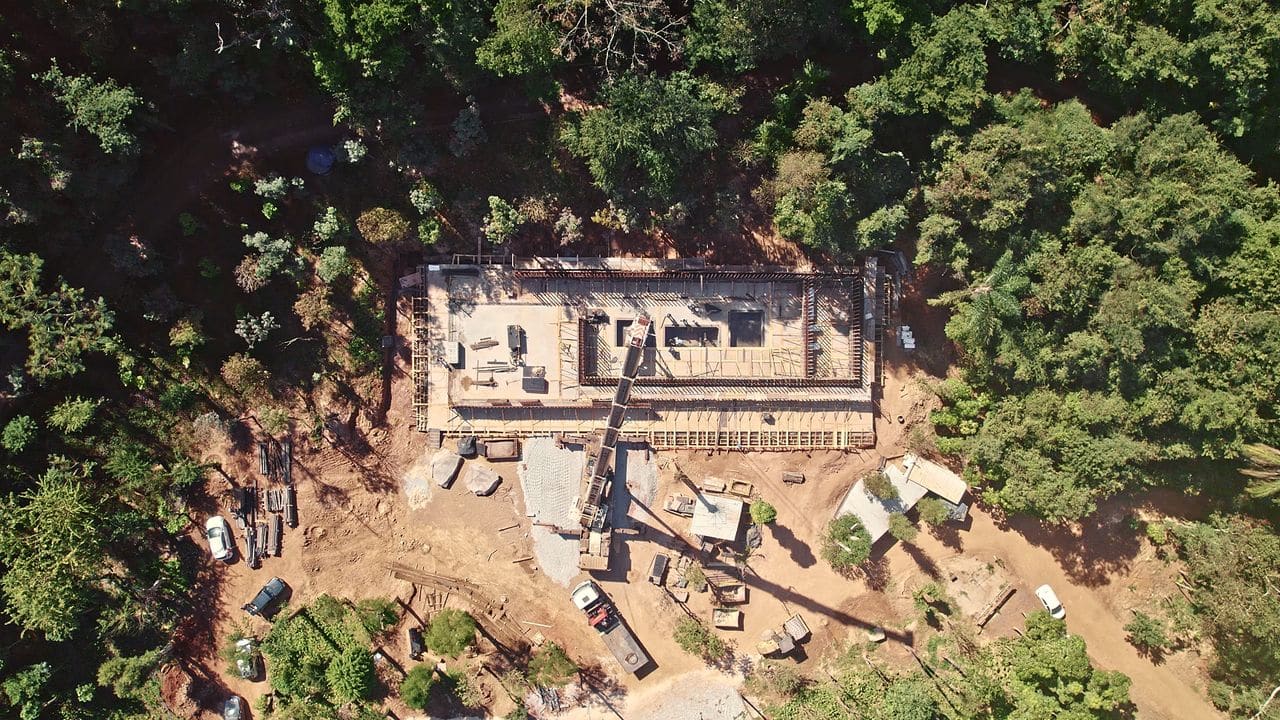
There was no master planner this time, no extended dialogue with collaborators of the stature of Roberto Burle Marx, the legendary landscape architect who helped shape Inhotim. Instead, Paz has been working directly with digger operators since December 2024, when planting began in earnest. Fifteen thousand trees, sourced from Mexico to Uruguay, have been installed. The first phase will include pavilions for Michael Heizer, Anna Maria Maiolino, Sonia Gomes, Pedro Moraleida, Sandra Gamarra, and Laura Belém, alongside large-scale works by Frida Orupabo, Mario Garcia Torres, Torkwase Dyson, and Giuseppe Penone.
Paz describes his method as creating "islands" across the terrain, zones where pavilions can eventually rise. These islands shift constantly because his plans evolve faster than conventional design processes allow. When his niece, architect Maria Paz of PMCKM, was asked to design the museum's reception building, she was given three weeks. "We had renderings, structural engineering, diagrams, plans, elevations," she recalls. "And he said we were taking too long."
Maria Paz works out of San Francisco; her partner Mark Mueckenheim operates from Germany. The studio functions around the clock, a necessity when the client operates on a timeline measured not in fiscal quarters but in remaining years. She is joined by Sol Camacho of Raddar, who recently completed the Pacaembu stadium renovation in São Paulo, and Belo Horizonte-based architect Fernando Maculan. Each has had to reconcile their professional training with a client who possesses infinite will, finite time, and no patience for the conventional rhythms of permitting and deliberation.
Paz's daughter Sofia, a filmmaker, has become the translator between her father's ever-shifting master plan and the architects trying to execute it. As vice president of the new institution, she fields calls when Bernardo decides overnight to relocate a gallery or flatten a hill. "We have to be fast," she says, "but we also have to be careful." At the family house, a giant map plots every gallery location; artistic director Paulo Miyada, recruited from Instituto Tomie Ohtake, updates it constantly. Then Bernardo changes everything, and Sofia's phone rings again.
The Precedent Problem
At World Archi Design, we have long observed how institutional memory complicates second acts. Inhotim taught hard lessons. The Yayoi Kusama pavilion, designed to house one of the artist's Infinity Rooms, was delayed two years by unforeseen drilling complications. Now, before any structure rises at Museu Bernardo Paz, the ground is surveyed for water and load-bearing capacity. It is project management as preventive diplomacy, learning from past mistakes without ever naming them aloud.
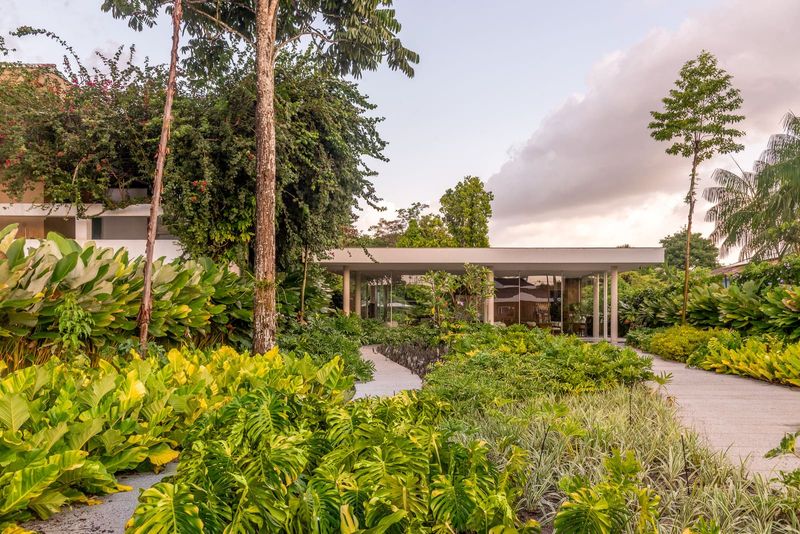
Maria Paz's Kusama pavilion at Inhotim was conceived as near-invisibility, a shelter that would be overtaken by foliage, its primary volume dedicated not to the artwork but to the queue. "It was meant to be almost part of the garden," she explains. That aesthetic carries forward into the new museum, where landscape moves faster than construction. Her reception building for Museu Bernardo Paz compresses all enclosed program into a central core, throwing four sides open to the forest. Water ponds substitute for walls. "It's not conditioned," she says. "It's just a shelter."
The design acknowledges that Inhotim's original reception proved too small, too enclosed. Her answer is larger and more porous simultaneously, a building that defers to its surroundings even as it announces the institution. The structure was originally sited to the left of the entrance baobabs, massive African specimens shipped south from northern Brazil. Then Paz moved it to the right. Plans for other pavilions rest on ground that may or may not be levelled, to elevations nobody has yet determined. "You have to constantly adapt and change," Maria Paz says. "You're constantly challenging your creativity."
The Town and the Tailings
If Maria Paz's work is about yielding to the forest, Sol Camacho's first project addresses a wound that cannot be architecturally healed but must be acknowledged. In 2019, the collapse of a Vale tailings dam killed 270 people and buried the valley near Brumadinho in toxic mud. The Brumadinho Memorial opened recently as a space for collective mourning, but the town's trauma remains acute. Some residents initially directed anger at Paz, a former mining magnate, guilty by association though the dam was never his. "It left a scar in the community that is hard to talk about," Camacho says.
Compensation money arrived, sedating as much as it healed. Paz wants to forge stronger links to Brumadinho, and Camacho's response is Casa Comun, a modest ten-by-ten-metre community centre in an existing structure, adapted rather than demolished. She began not with drawings but with round-tables, gathering thirty to forty residents to collect wishes: computer labs, reading rooms, sports programs. Her team translated these into a harder question: what can art bring to daily life?
The wager is that when an artist comes to live and work in the neighbourhood for two months, barriers dissolve. Casa Comun is scheduled to begin operating in April 2027, its program built up over a year or two before any new construction. It is the antithesis of Bernardo's steel-frame velocity, research first, patience as a design principle. Camacho notices the effect this particular project has on her client. "It feels like we can have a conversation, travel, talk, come back, think," she says, then catches herself, aware that even here, the clock is ticking.
Curatorial Abundance and Institutional Memory
Allan Schwartzman, chief curatorial advisor for the new museum and a co-founder of Inhotim, describes "a creative abundance at Museu Bernardo Paz, a distinctive and radical sense of discovery, that will be astonishing in both scope and imaginative force." The intention, he notes, is to move visitors through the land in ways that present a different relationship of pavilions to landscape, visitors eventually passing smoothly between the two institutions without simply replicating what Inhotim accomplished.
That ambition raises a question the architecture must answer: how do you build a sequel that honours its predecessor without becoming a footnote? Inhotim invited the community in with free Sundays, jobs, education for workers' children. It was not enough, Sofia's generation now acknowledges, because the traffic ran one way. "We need to go to Brumadinho," Camacho insists. "If we want to impact everyday life, we need to meet them where they live."
The first 25 years at Inhotim demonstrated what a private patron with vision and resources could achieve in a country where public funding for the arts remains scarce. The next chapter will test whether that model can be made more porous, more reciprocal, more attuned to the social fabric surrounding it. Casa Comun is a small gesture against a tragedy of enormous scale, but it signals a shift in thinking: art as a way of understanding, not merely a destination for pilgrimage.
The Speed of Impermanence
Across the site, construction crews work at a pace that would alarm most architects. Foundations pour while drawings are still being revised. Trees arrive before their final positions are confirmed. It is a method that inverts the usual sequence of design, where documentation precedes fabrication. Here, fabrication and documentation proceed in parallel, with Sofia Paz serving as the buffer between her father's certainty and the architects' need for something resembling a stable plan.
The urgency is not entirely about mortality. Paz is, by all medical accounts, in excellent health. "The man will kill us all before he dies," Sofia jokes. But the fear of running out of time propels him forward, and that urgency has become the project's defining material constraint. Time, not budget or terrain or permitting, is the resource in shortest supply.
What emerges from this pressure is an architecture of deferral, buildings designed to be overtaken by their surroundings, structures that whisper where the landscape shouts. Maria Paz's pavilions compress program, open walls, dissolve boundaries. Camacho's Casa Comun adapts rather than replaces, listens before it builds. Even Maculan's work, less discussed but equally present, follows the logic of minimal intervention, maximum adaptability.
This is not the tectonic heroism of high modernism, where architecture asserts its geometry against the landscape. It is something closer to the vernacular of impermanence, buildings that acknowledge they are temporary interventions in a forest that will outlive them. The irony is that this architecture of modesty is being built at breakneck speed, as if humility itself were an emergency.
What Remains
At five in the morning, in the mist that closes over newly turned earth, Bernardo Paz watches another tree lowered into place. He has already given away one utopia. Now he is building another, faster, with less time to second-guess, less patience for the slow accretion of consensus that typically governs institutional projects of this scale. His architects work in shifts across time zones. His daughter translates his vision into instructions that change before the day ends. His community outreach begins not with a gallery but with a modest house in a town still grieving.
Whether Museu Bernardo Paz will achieve the stature of Inhotim remains to be seen. What is already clear is that it represents a different model of patronage, one where urgency produces not carelessness but a kind of radical pragmatism. The buildings yield to the landscape because there is no time to dominate it. The community engagement begins early because there is no time to repair mistakes later. The planting happens at industrial scale because waiting for saplings to mature is a luxury Paz no longer possesses.
In a discipline that typically measures projects in decades, this is architecture conducted at the speed of human finitude. It is a reminder that all building is, in the end, a race against time, and that the most honest architecture might be that which admits as much from the start.
Save this story. A free account keeps your reading list and the 07:00 email in one place.
CREATE FREE ACCOUNT →SIGN IN