
A Building That Refused to Be Forgotten
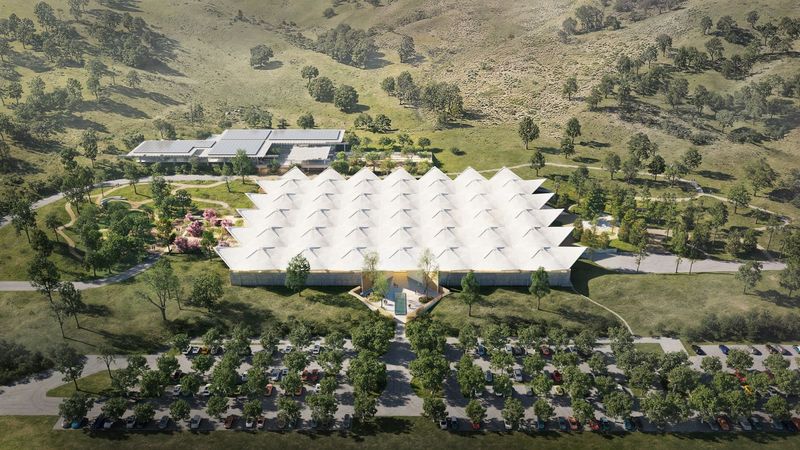
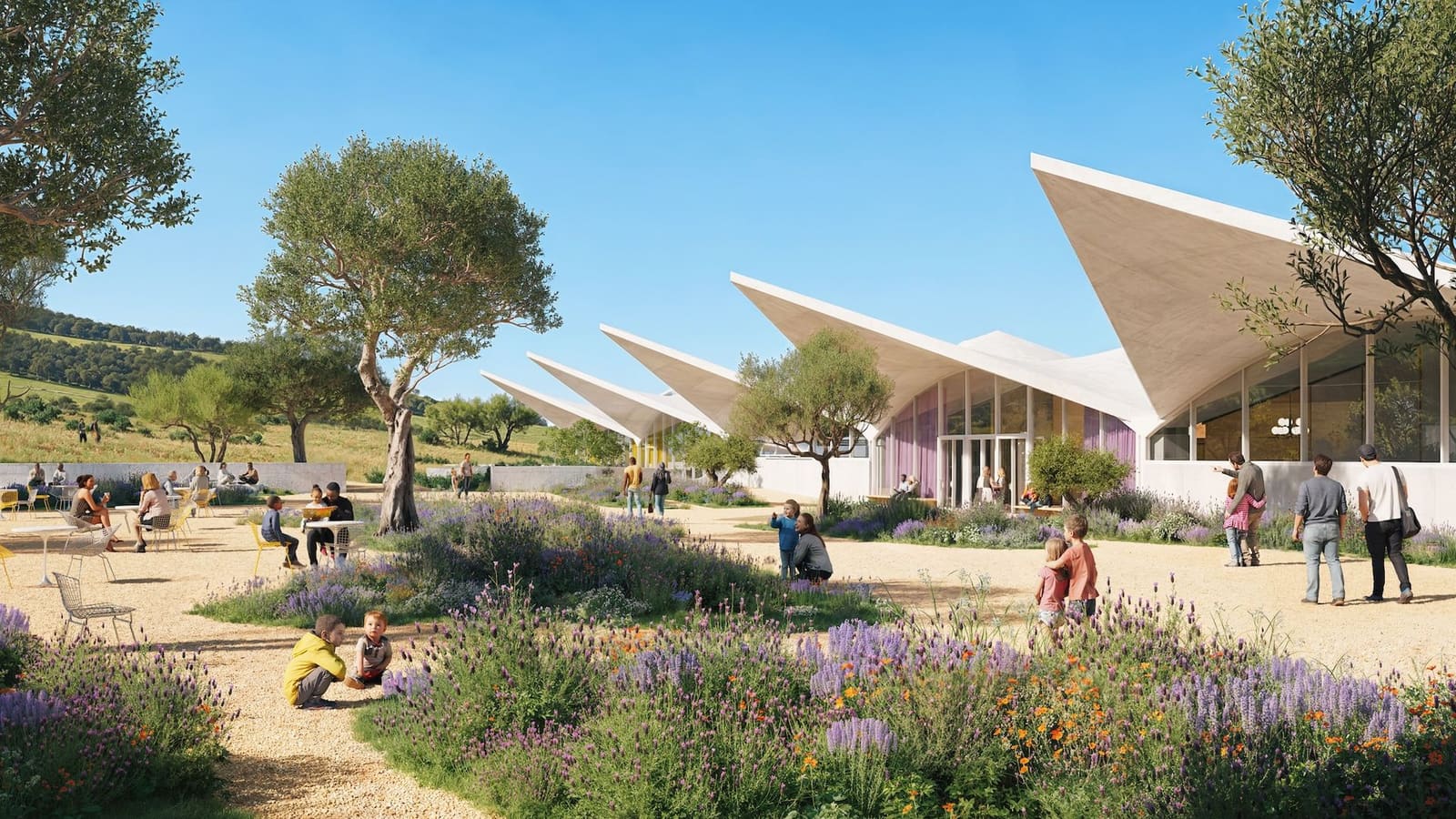
There are structures that outlive their original purpose so gracefully they seem to be waiting for something better. The former McGraw-Hill warehouse in Novato, California, with its origami-like concrete roof folding across 185,000 square feet, is one such building. Designed in 1965 by Polish architect Jan Lubicz-Nycz alongside modernist John Savage Bolles, the structure spent decades as a Birkenstock distribution centre before the footwear company vacated in 2020. Now, Herzog & de Meuron has been commissioned to convert this midcentury shell into The Eames Institute of Infinite Curiosity, a sprawling 88.5-acre campus devoted to the design legacy of Charles and Ray Eames.
The choice of site is not incidental. The warehouse itself is a study in structural economy, its folded-plate roof a feat of concrete engineering that reads, from a distance, as a range of white peaks against the Marin County hillside. That tectonic clarity, the legibility of construction logic, aligns precisely with the Eames ethos: design as problem-solving made visible, beauty emerging from constraint rather than ornament. At World Archi Design, we have long tracked how adaptive reuse projects succeed or fail based on whether the original building possesses enough spatial generosity to absorb new programmes. This warehouse, with its column-free spans and dramatic roof geometry, offers exactly that latitude.
Preservation as Reinterpretation
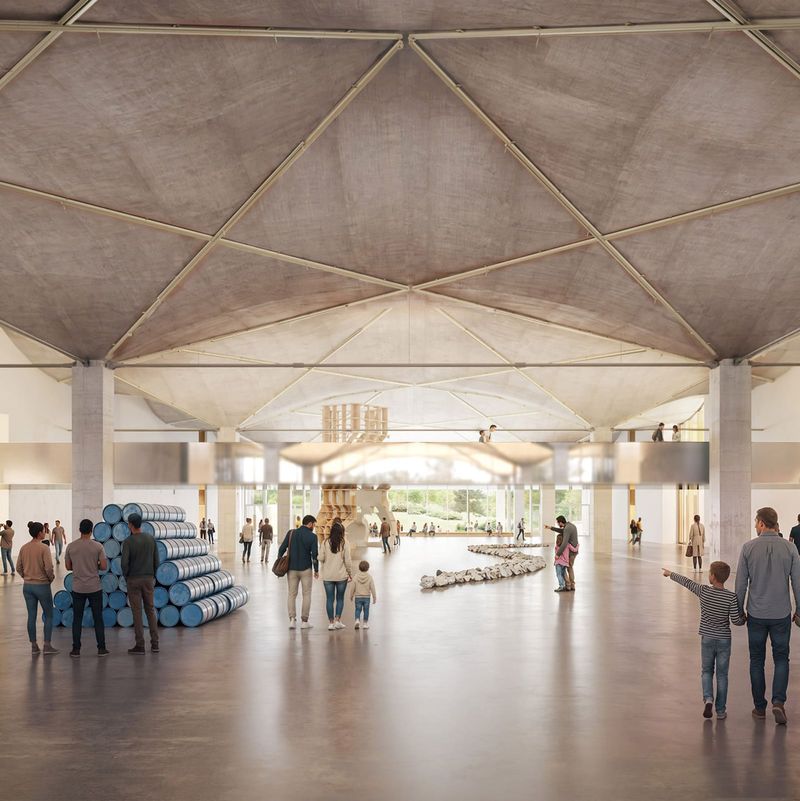
Herzog & de Meuron, working with San Francisco practice EHDD, will retain the envelope and structural frame while reimagining the interior as contemporary exhibition space. The design proposes warm timber cladding within the concrete shell, creating a textural counterpoint to the raw industrial bones. Column-free galleries will allow fluid circulation and flexible curation, a necessity given the breadth of the Eames archive, from furniture prototypes to experimental films.
The programme extends beyond display. A café, museum shop, theatre, and maker spaces will occupy the main structure, while a neighbouring former office building will host residencies, lectures, and workshops. This layering of functions reflects a broader shift in museum typology: away from the hermetic white cube and towards the civic commons, where making and learning happen alongside viewing.
The approach here is not one of erasure or pastiche. Herzog & de Meuron has built a practice on revealing the tension between old and new, as seen in their Tate Modern conversion of Bankside Power Station or their extension of the Kunstmuseum Basel. In Novato, the strategy appears to be one of calibrated contrast: preserving the concrete roof as datum while inserting warmer, more intimate volumes beneath. It is a tectonic conversation rather than a monologue.
Landscape as Pedagogy
Field Operations, the landscape architecture firm behind New York's High Line and Freshkills Park, will shape the 88.5-acre grounds. The design includes gardens, groves, play areas, and water features, planted with herbs, olive trees, and other species native to Northern California's Mediterranean climate. This is not decorative landscaping but an extension of the Institute's pedagogical mission: the Eameses were famously attentive to natural systems, from the grain of wood to the structure of soap bubbles.
The landscape strategy also addresses access and equity. Public cultural institutions in suburban or exurban contexts often struggle with car dependency and limited transit infrastructure. Marin County is no exception. Field Operations' design will need to negotiate the tension between creating a destination landscape and ensuring the campus does not become an enclave accessible only to those with private vehicles. The renderings suggest generous pedestrian circulation and outdoor gathering spaces, but the success of the project will hinge on how it connects to broader transit networks and community programming.
The Archive as Living Resource
Llisa Demetrios, granddaughter of Charles and Ray Eames and co-founder of the Institute, has described the museum as a continuation of her grandparents' belief that design is grounded in curiosity and intention. The Institute will house the most comprehensive collection of Eames materials anywhere, including furniture, textiles, films, toys, and ephemera. But the ambition is not merely archival. The maker spaces and residency programmes signal an intention to treat the collection as a living resource, a prompt for contemporary practice rather than a relic under glass.
This raises a familiar question for design museums: how to balance preservation with activation. The Vitra Design Museum in Weil am Rhein, which holds another significant Eames collection, has wrestled with this for decades, oscillating between scholarly retrospectives and speculative design commissions. The Eames Institute's programming will need to define its own position, likely somewhere between the two. The involvement of Herzog & de Meuron, a firm known for rigorous materiality and spatial clarity, suggests a preference for substance over spectacle.
Precedent and Context
Adaptive reuse of industrial buildings for cultural programmes is well-trodden ground. The typology includes successes like Renzo Piano's conversion of the Fiat Lingotto factory in Turin and cautionary tales where the original structure is so heavily altered it becomes scenographic backdrop. The Novato warehouse offers a middle path: the roof is distinctive enough to anchor the project's identity, but the interior is open enough to accommodate transformation without violence.
The timeline is ambitious. Groundbreaking is anticipated in 2028, with public opening in 2030, according to Institute officials. That schedule will depend on securing permits, funding, and navigating California's environmental review processes, all of which can extend timelines significantly. The project also arrives at a moment when construction costs and labour shortages are reshaping feasibility studies across the United States. Herzog & de Meuron's experience with large-scale cultural projects, from Elbphilharmonie Hamburg to M+ in Hong Kong, will be tested by the particular constraints of the Northern California context.
Why This Matters Now
The Eames Institute arrives at a moment when the midcentury modern canon is being re-examined, not only for its formal achievements but for its blind spots: questions of authorship, labour, and access. Charles and Ray Eames worked within a network of collaborators, fabricators, and manufacturers whose contributions were often elided in favour of singular genius narratives. A museum that foregrounds process, making, and collaboration has the opportunity to complicate that legacy in productive ways.
There is also a broader question about what design museums are for in 2030. If the past decade has seen a proliferation of immersive experiences and Instagram-optimised installations, the Eames Institute's emphasis on curiosity and inquiry suggests a different model: slower, more iterative, grounded in material knowledge rather than spectacle. Whether that vision can compete for attention in a saturated cultural landscape remains to be seen.
For now, the warehouse waits. Its folded concrete roof, engineered for efficiency and built to last, has outlived publishing companies and footwear distributors. Soon it will shelter a different kind of work: the work of looking closely, asking questions, and finding beauty in how things are made. If the Eameses taught us anything, it is that good design begins with attention. Herzog & de Meuron's task is to build a place where that attention can be sustained.
Save this story. A free account keeps your reading list and the 07:00 email in one place.
CREATE FREE ACCOUNT →SIGN IN