
Beyond the Brutalist Canon
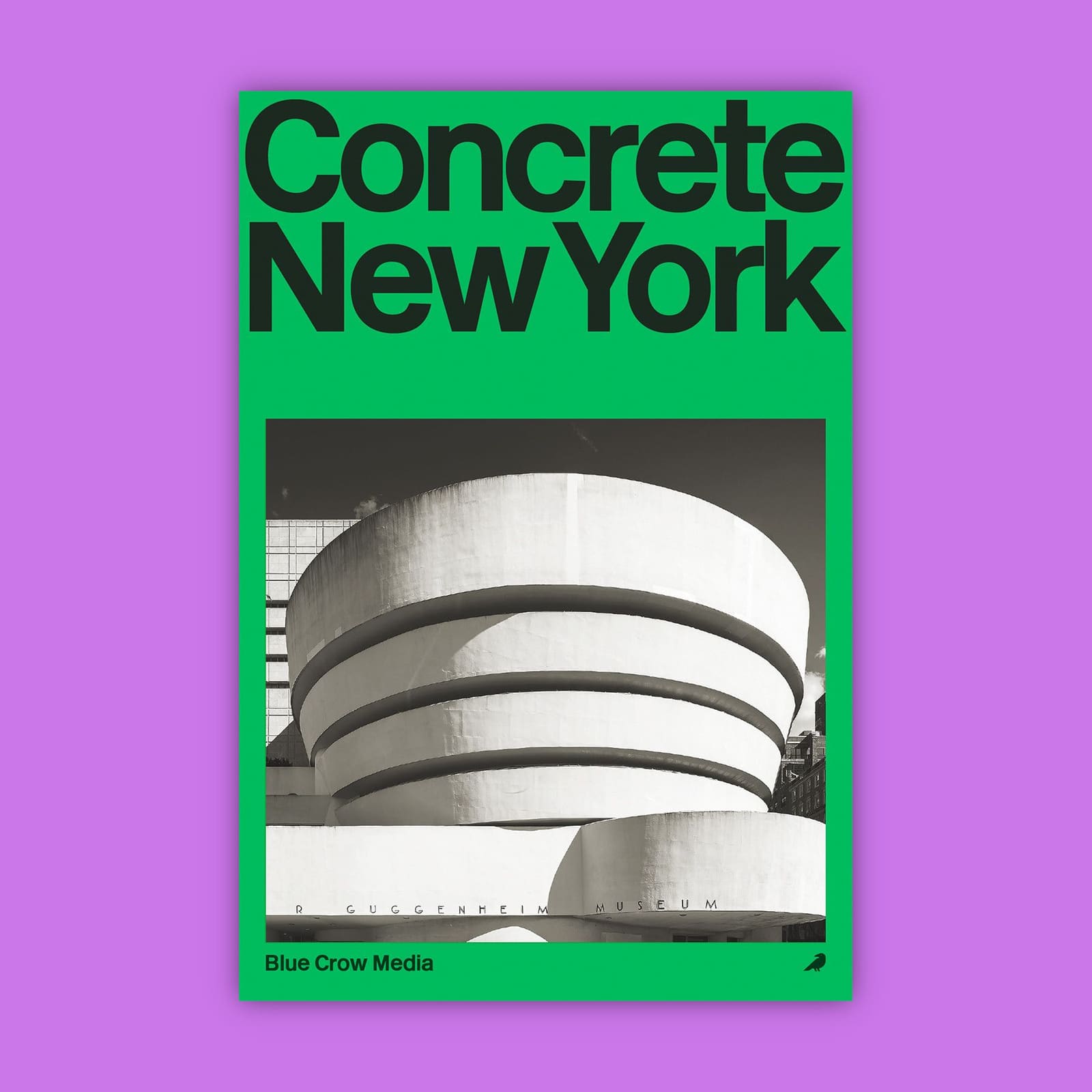
New York rarely registers as a concrete city in the popular imagination. The skyline reads as steel and glass, the brownstone neighbourhoods as brick and limestone, the iconic skyscrapers as art deco ornament or curtain-wall minimalism. Yet concrete, in all its tectonic variety, has been fundamental to the city's built environment for over a century. Blue Crow Media's Concrete New York makes that case with quiet authority, joining the publisher's expanding series of material-focused guides that now spans London, Berlin, Paris, and a broader volume on Asia.
What distinguishes this volume is its refusal to treat concrete as synonymous with brutalism. Author Allison C. Meier and photographer Jason R. Woods have assembled more than fifty structures that demonstrate the material's formal range, from the sculptural exuberance of Frank Lloyd Wright's Guggenheim to the structural poetry of Pier Luigi Nervi's George Washington Bridge Bus Station. The selection acknowledges that concrete's role in New York was never monolithic; it was a medium for modernist expression, engineering innovation, and occasionally, social optimism.
Structural Expression and Mid-Century Ambition
Nervi's bus station, completed between 1960 and 1963, remains one of the most compelling arguments for concrete as an expressive material. The Italian engineer's use of pre-cast concrete ribs creates a muscular interior that celebrates load and span without resorting to ornament. It is architecture as structural diagram, a tectonic clarity that influenced a generation of engineers and architects who saw concrete not as a cheap substitute for stone but as a material with its own formal logic.
Marcel Breuer's Begrisch Hall at Bronx Community College, finished in 1961, offers a different approach: the massing is bold and monumental, but the concrete surfaces are textured and articulated, softening the building's presence on campus. Breuer, a Bauhaus émigré who helped define American institutional architecture in the post-war decades, understood that concrete could be both modern and humane, a lesson that much later brutalism forgot.
The guide also highlights William N. Breger Associates' Tribeca Synagogue, completed in 1967. Its ribbon wall, a sinuous concrete surface that mediates between interior and street, anticipates the parametric fluidity that would dominate architectural discourse decades later. It is a proto-Zaha moment, proof that formal experimentation with concrete was not confined to Europe or to secular commissions.
Continuity Across Eras
One of the book's strengths is its temporal breadth. Paul Rudolph's Tracey Towers, a 1972 housing complex in the Bronx, appears alongside Studio Gang's recent work, creating an implicit conversation about how concrete has been deployed in different economic and cultural contexts. Rudolph's towers, with their corduroy texture and vertical emphasis, were part of a broader ambition to reimagine public housing through architectural innovation. That ambition was largely abandoned in the decades that followed, making the building's inclusion here both a historical document and a reminder of roads not taken.
David Adjaye and Steven Holl represent the contemporary moment, demonstrating that concrete remains a viable material for architects interested in material honesty and spatial experimentation. Adjaye's work, often characterised by its careful attention to surface and light, uses concrete to anchor buildings in place, while Holl's phenomenological approach treats the material as a medium for shadow, reflection, and atmospheric effect. Both architects engage with concrete's weight and permanence, qualities that feel increasingly relevant in an era of lightweight assemblies and digital fabrication.
Photography as Argument
Jason R. Woods' black-and-white photography throughout the volume is not merely illustrative; it is a critical tool. By stripping away colour, the images foreground texture, shadow, and form, qualities intrinsic to concrete's architectural character. The monochrome palette also imposes a visual unity on a disparate collection of buildings, suggesting that these structures, built across seven decades and in wildly different contexts, share a common material language.
Woods captures both the monumental and the intimate: the soaring vaults of Harrison and Abramovitz's New York Hall of Science, renovated by Ennead Architects in 2015, and the quieter details of less-celebrated buildings. The photography argues, implicitly, that concrete's value lies not in spectacle but in its capacity for varied expression, from the delicate to the dramatic.
A Guide with Precedent
Blue Crow Media has built a niche by producing guides that are neither academic monographs nor tourist handbooks. They occupy a middle ground, accessible to general readers but informed by serious curatorial judgement. Concrete New York fits that model, offering enough context to orient newcomers while rewarding those already familiar with the city's architectural history. The book also functions as a companion to the publisher's earlier Concrete New York Map, a cartographic project that situates these buildings within the city's broader geography.
The guide is part of a three-volume Architectural City Guides set, suggesting that Blue Crow Media sees these publications as a series rather than standalone volumes. That seriality matters; it implies a sustained editorial vision and a commitment to exploring how a single material can shape urban identity across different cities and cultures.
What the Guide Leaves Out
No guide is exhaustive, and Concrete New York makes choices that reveal its priorities. The selection skews towards mid-century modernism and contemporary practice, with relatively little attention to the interwar period or to vernacular uses of concrete in industrial and infrastructural contexts. Bridges, tunnels, and the vast concrete substrate of the city's transit system are largely absent, as are the more utilitarian applications of the material in housing and commercial construction.
This is not a criticism so much as an observation about scope. The guide is interested in concrete as an architectural medium, not as a ubiquitous building material. That focus allows for a more coherent narrative, even if it means certain chapters of the city's concrete history remain untold.
Concrete as Cultural Memory
At World Archi Design, we have been tracking how material-focused guides reshape public understanding of architectural history. By organising a city's built environment around a single material, these publications reveal connections that conventional chronologies or typological surveys might miss. Concrete New York suggests that concrete has been a constant in the city's architectural evolution, even when it has not been the most visible or celebrated material.
The guide also arrives at a moment when concrete's environmental impact is under intense scrutiny. The material's carbon footprint, driven by cement production, has made it a target for sustainability advocates and a subject of innovation in low-carbon alternatives. Concrete New York does not engage with these debates directly, but its documentation of concrete's aesthetic and structural achievements provides context for ongoing conversations about the material's future. Understanding what concrete has made possible is a necessary step in determining what it should do next.
Save this story. A free account keeps your reading list and the 07:00 email in one place.
CREATE FREE ACCOUNT →SIGN IN