
A Parallel to the Plate
The conversation around ultra-processed food has reshaped how we think about nutrition. Ingredients lists on cereal boxes now read like chemistry textbooks, prompting consumers to seek whole grains, fermented goods, and produce that looks like it came from soil rather than a lab. A similar reckoning is underway in the built environment. Across the projects we've covered this year, a question recurs: what exactly are we wrapping around ourselves when we step inside?
The answer, more often than not, involves a catalog of synthetic compounds. Polymers line our walls, adhesives bind our cabinetry, sealants fill our joints, and composite panels clad our facades. Gina Ciganik, chief executive of Habitable, frames the issue bluntly: we inhabit a plastic world. With projections pointing toward 2.5 trillion square feet of new construction by 2060, according to Habitable, the material palette chosen in the next decade will define indoor air quality, durability, and environmental load for generations.
The Health Imperative
Joseph Allen, who directs Harvard University's Healthy Buildings Program, describes buildings as one of the greatest public health opportunities of this century. The claim rests on a simple premise: we spend the majority of our lives indoors, and the materials surrounding us off-gas volatile organic compounds, trap moisture, harbor particulates, and shape thermal comfort. Carrie Denning Jackson, head of innovation and technology at developer Jamestown and founder of Places as Medicine, argues that creating healthier spaces ranks among the most impactful interventions available for families and children.
The shift in thinking parallels the food movement. Just as consumers began scrutinizing ingredient lists, designers are now interrogating spec sheets. Composite joinery, for instance, consists of wood pulp bound with adhesives and sealants, notes Olga Turner-Baker, managing director of design consultancy Ekkist. The result is a material that may look like timber but behaves chemically like a synthetic, emitting compounds that accumulate in poorly ventilated interiors.
Materiality as Identity
For Robert Douge, co-founder of Arya Douge, the turn toward natural materials is not solely a health play. It is an assertion of individuality in an era of algorithmic reproduction. A porcelain tile, no matter how convincing the print, remains a factory product replicable ad infinitum. A slab of marble drawn from a specific quarry, by contrast, carries geological idiosyncrasies that no other piece can claim. The veining, the inclusions, the way light refracts through calcite crystals are all singular.
Arya Douge collaborates with Studio Ore, a tapware supplier specializing in unpatinated finishes. The fittings are left to oxidize naturally, developing a patina shaped by water chemistry, hand oils, and ambient humidity. Six months into use, each tap becomes a one-off, a record of habitation rather than a static object.
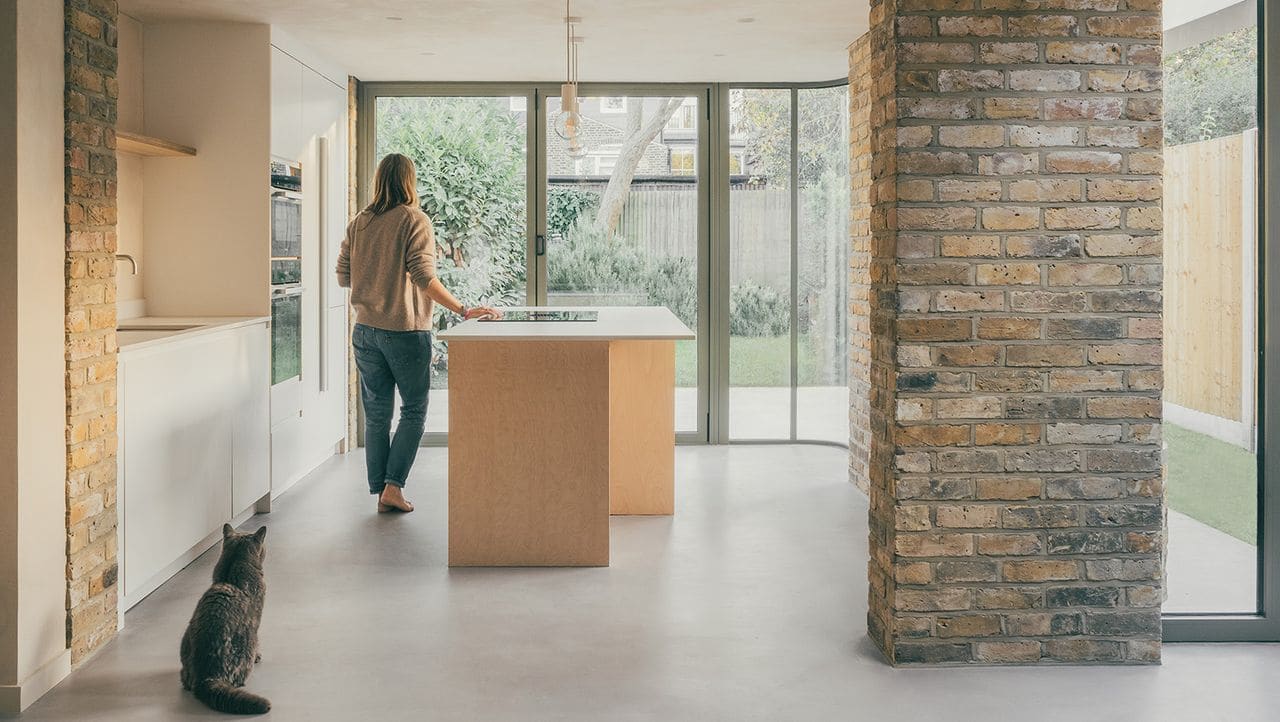
This philosophy informed the renovation of a Victorian terrace in north-west London, where homeowners Emma Trachtenberg and Edward Pearse Wheatley sourced reclaimed materials and bespoke finishes. An original butcher's block, scarred by decades of use, was repurposed as a kitchen island. Bathroom tiles were hand-poured, ensuring variation in tone and texture. The aesthetic rejects the airbrushed perfection that dominates digital renders in favor of surfaces that register time.
Embracing Impermanence
Sam McNally, co-founder of Echlin London, pushes clients to reconsider their relationship with wear. Marble, often dismissed for its propensity to stain, is better understood as a living surface. The first mark provokes anxiety, but subsequent blemishes accumulate into a narrative. A wine spill, a citrus splash, the daily prep of meals become part of the material's biography. McNally likens it to a leather wallet: the object improves with age, not in spite of it, but because of it.
At The Dairy, a residential project in Notting Hill that converted a 19th-century working dairy into eight homes, Echlin specified leathered Taj Mahal quartzite rather than polished stone. The finish offers durability without sacrificing the tactile irregularity of natural material. The choice reflects a broader strategy: allow materials to weather rather than seal them beneath synthetic coatings. Heavy lacquers and high-gloss finishes, McNally observes, introduce the very chemicals that health-focused design seeks to eliminate.
Tectonic Honesty
Pensaer, a practice centered on craft and making, approaches materiality through the lens of aging. Synthetic layers, applied to mimic patina or protect against weathering, often degrade faster than the substrates they cover. Paula Morgan, head of studio, advocates for raw materials at touch points. At Ashbourne Grove, a residence in East Dulwich, internal clay render was applied alongside existing brickwork. Clay naturally regulates humidity, absorbing moisture when air is damp and releasing it when conditions dry. At Casino Avenue in Southwark, the practice installed a salvaged stone countertop, valuing the material's provenance and texture over factory uniformity.
The approach aligns with vernacular traditions, where materials were selected for local availability and inherent performance rather than visual novelty. Lime plaster, hemp insulation, and mass timber all possess antimicrobial properties and breathability, allowing buildings to exhale rather than trap indoor pollutants.
Precedent in Healthcare
White Arkitekter applied this logic in a context where material scrutiny is paramount: healthcare. At the New Velindre Cancer Centre in Wales, the practice employed mass timber as the structural core and finished patient areas with hemp-lime render. Christian Dimbleby, head of sustainability at the firm, notes that both materials are naturally antibacterial and breathable, allowing toxins to dissipate rather than accumulate. The design challenged regulatory standards written for synthetic materials, requiring the team to demonstrate that traditional, unprocessed finishes meet infection control requirements.
The Sara Cultural Centre, also by White Arkitekter, extends this material strategy into civic architecture, using timber to shape acoustics and thermal comfort while reducing embodied carbon. The projects signal a shift: natural materials are no longer niche or nostalgic but viable alternatives in typologies long dominated by engineered products.
The Cost of Change
Denning Jackson acknowledges the obstacles. Natural materials are routinely value-engineered out of projects due to higher upfront costs. Durability data for some materials remains incomplete. Cork flooring, used in one Jamestown project, began bubbling shortly after installation, requiring remediation and installer education. Experimentation carries risk, but it also drives innovation. The industry is slowly building a knowledge base around installation techniques, maintenance protocols, and lifecycle performance for materials that have been sidelined for decades.
The Sara Cultural Centre and Velindre projects demonstrate that public and institutional clients are willing to absorb these risks when the health and environmental benefits are articulated clearly. As precedents accumulate, the cost premium narrows and supply chains adapt.
A Material Shift
We possess the technical capacity to fabricate flawless replicas at scale. Porcelain can mimic marble, vinyl can imitate wood, and composites can replicate stone. But the question architects are now asking is whether perfection, in the industrial sense, aligns with human well-being. Materials that age, stain, and patina may be harder to maintain and more expensive to source, but they also register inhabitation. They breathe, they evolve, and they anchor us in the physical world at a moment when much of life unfolds on screens.
The movement toward less-processed architecture is not a rejection of modernity but a recalibration of priorities. It values longevity over novelty, health over convenience, and character over consistency. As more practices adopt these principles, the built environment may begin to resemble the world it sits within: imperfect, variable, and alive.
Save this story. A free account keeps your reading list and the 07:00 email in one place.
CREATE FREE ACCOUNT →SIGN IN