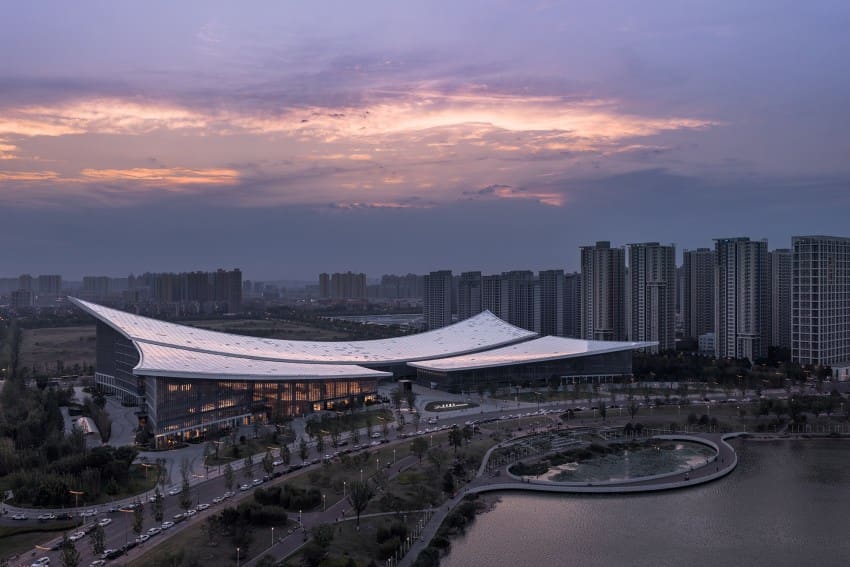
When the Fifth Facade Becomes the First Program
What happens when a library's most active public space is not its lobby, but its roof? At Chang'an Academy and Xi'an Public Library, HONG Designworks has inverted the conventional hierarchy of architectural surfaces, treating the building's upper plane not as a technical necessity but as a programmed landscape. The 70,016.90-square-meter complex, sited along the Ba River in Xi'an, organizes its interior around the traditional functions of reading and circulation, yet the project's most provocative gesture lies overhead: a continuous roofscape conceived as civic ground.
We've seen this strategy before, from Piano's California Academy of Sciences to SANAA's Rolex Learning Center, but Chang'an Academy operates within a different cultural and urban context. Xi'an, with its layered histories and its position as the eastern terminus of the Silk Road, demands architecture that negotiates between monumentality and accessibility. The broad roof plane here becomes a mediating device, an inhabited threshold that registers both the scale of the river corridor and the intimacy of individual occupation.
Massing and the River Section
The complex sits in direct relation to the Ba River, a waterway that has shaped Xi'an's development for millennia. HONG Designworks positions the building not as an object in a park, but as a datum that extends the river's horizontal reading into the built fabric. The massing is low and expansive, resisting the vertical impulse that often characterizes contemporary cultural institutions. This horizontal emphasis allows the roof to function as a continuation of the landscape rather than a termination of the building envelope.
The section reveals the logic: interior spaces are carved beneath the roof plane, with reading rooms, circulation zones, and support functions organized in a series of stratified layers. Natural light enters through carefully calibrated apertures, creating zones of varying luminosity that correspond to different modes of reading and study. The interplay between the roof's public topography and the library's interior volumes produces a building that operates on multiple levels simultaneously, serving both as a destination and as a passage.
Material Continuity and Tectonic Expression
The materiality of Chang'an Academy reinforces its conceptual ambitions. The roof surface employs materials that read as landscape rather than building, blurring the distinction between constructed and natural ground. This choice is not merely aesthetic; it signals a shift in how the building wants to be occupied. Rather than cordoning off the roof as a technical zone accessible only to maintenance staff, the design invites the public to claim it as a space for gathering, observation, and movement.
Internally, the library employs a restrained palette that prioritizes clarity and orientation. Circulation paths are legible, reading zones are differentiated through shifts in ceiling height and light quality, and the overall spatial sequence guides visitors through the collection without prescribing a single route. The tectonic expression is straightforward, avoiding the gestural flourishes that can overwhelm library interiors. This restraint allows the act of reading, and the social life that surrounds it, to remain the focus.
Precedents and Divergences
Chang'an Academy inevitably invites comparison to other projects that have explored the roof as public terrain. SANAA's Rolex Learning Center in Lausanne, completed in 2010, proposed a continuous interior landscape where floor and ceiling undulate in tandem, creating a single, fluid space. Moshe Safdie's Jewel Changi Airport in Singapore, though not a library, similarly treats the roof as a cultivated landscape, albeit one enclosed within a glass envelope.
Where Chang'an Academy diverges is in its relationship to context. The Rolex Learning Center operates within the campus environment of EPFL, where the building functions as a node in a network of academic structures. Jewel Changi is an interior garden, hermetically sealed from Singapore's climate. Chang'an Academy, by contrast, engages directly with the Ba River corridor and the urban fabric of Xi'an. The roof here is not an abstract gesture but a specific response to site, climate, and the cultural expectation that public buildings should offer more than enclosed program.
Reading, Circulation, and the Library Interior
Inside, the library is organized around two fundamental activities: reading and circulation. These are not treated as separate systems but as intertwined modes of occupation. Reading rooms are distributed across the complex, each calibrated for different types of use. Some spaces are designed for concentrated individual study, with controlled lighting and acoustic separation. Others accommodate collaborative work, with flexible furniture and higher ambient noise levels.
Circulation becomes a form of spatial narrative. As visitors move through the building, they encounter shifting views, both into the collection and outward toward the river. These moments of visual connection serve to orient users within the larger complex and to reinforce the relationship between interior program and exterior context. The organization is legible without being didactic, allowing for intuitive navigation while rewarding more sustained exploration.
Adaptive Reuse and Urban Continuity
While Chang'an Academy is a new construction, its conceptual framework has resonances with adaptive reuse strategies that prioritize urban continuity. By treating the roof as public ground, the project extends the city's horizontal plane across the building, maintaining permeability even as it introduces a substantial new volume into the district. This approach contrasts with more insular institutional models, where the building becomes a fortified enclave, accessible only through controlled entry points.
The strategy has implications for how we think about cultural infrastructure in rapidly urbanizing contexts. As cities like Xi'an continue to densify, the pressure on public space intensifies. Projects that can serve multiple functions, operating simultaneously as buildings and as urban surfaces, offer a productive model. Chang'an Academy demonstrates that a library can be both a repository of knowledge and a platform for civic life, without compromising the specificity of either function.
Context and Continuity
Xi'an's architectural history is one of accumulation and transformation. The city's Tang Dynasty heritage coexists with Soviet-era infrastructure and contemporary development. In this layered environment, new cultural buildings must negotiate between monumentality and integration. Chang'an Academy achieves this balance not through stylistic mimicry but through strategic massing and programmatic generosity. The building is large, but its horizontality and its accessible roof prevent it from reading as an isolated monument.
The Ba River provides both a physical and a conceptual edge. As a natural feature that has shaped settlement patterns for centuries, the river offers a datum against which the building can be measured. HONG Designworks uses this relationship to ground the project, ensuring that the library reads as part of a larger hydrological and urban system rather than as an autonomous object.
Looking Forward
Chang'an Academy and Xi'an Public Library arrives at a moment when the role of the library is undergoing redefinition. Digital access to information has shifted the library's function from storage to social infrastructure. The spaces that matter now are not only the stacks but the communal areas where people gather, study, and interact. By prioritizing the roof as a civic amenity, HONG Designworks acknowledges this shift, proposing that the library's value lies as much in its capacity to host public life as in its collection.
The project also raises questions about scalability and replicability. Can the roofscape model function in denser urban contexts, where vertical access becomes a constraint? How does the strategy perform in climates less temperate than Xi'an's? These are not criticisms but invitations for further experimentation. Chang'an Academy offers a compelling prototype, one that other cultural institutions might adapt, critique, or build upon as the typology continues to evolve.
Save this story. A free account keeps your reading list and the 07:00 email in one place.
CREATE FREE ACCOUNT →SIGN IN