
A Room That Refuses to Sit Still
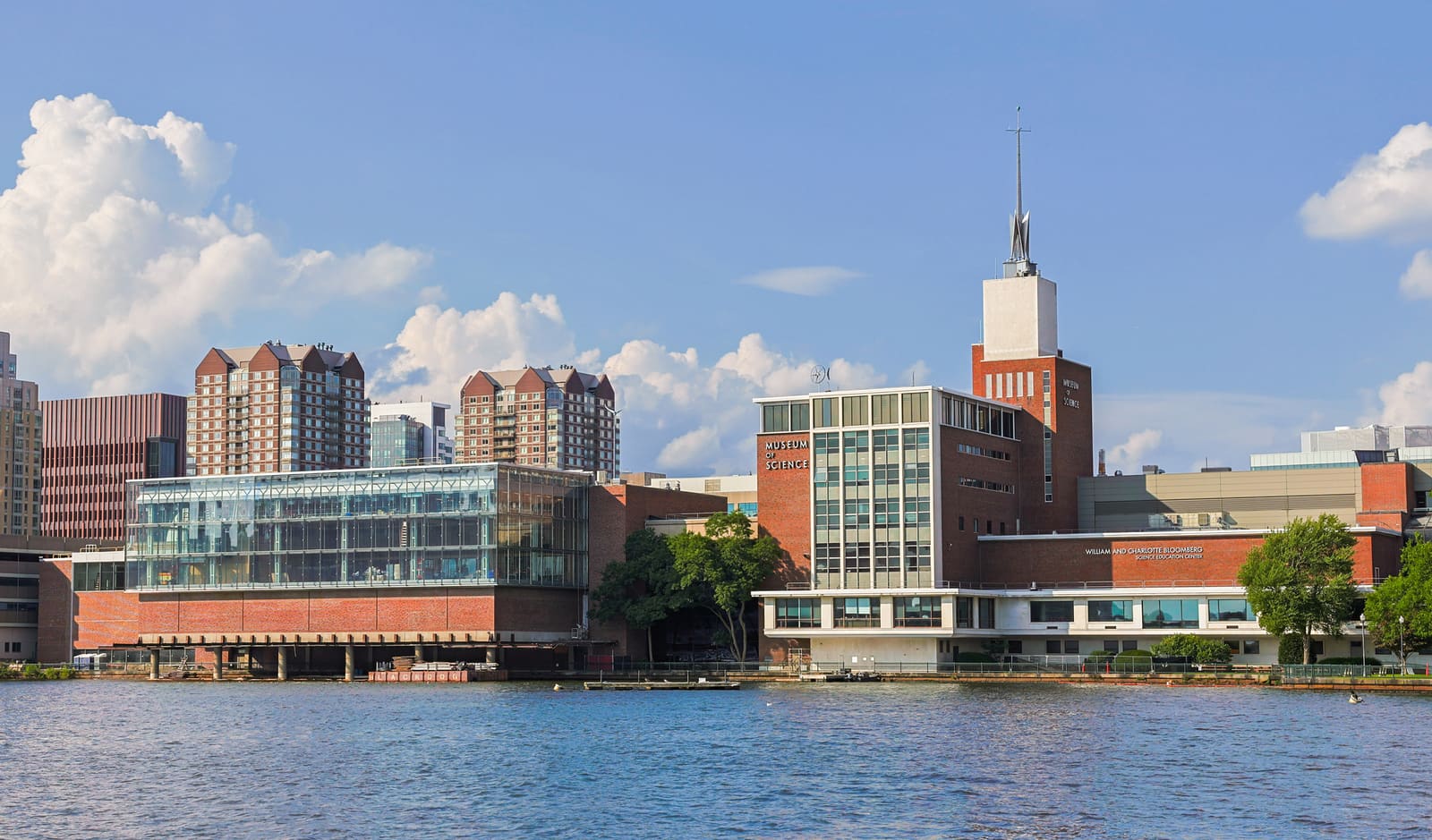
The question isn't whether a building can do multiple things. Most do. The question is whether those transformations feel natural or forced, whether the architecture merely accommodates change or actively enables it. William Rawn Associates has spent decades exploring that threshold, from concert halls to libraries, and their latest work at Boston's Museum of Science pushes the inquiry further. The William and Charlotte Bloomberg Public Science Common, set to open this October, is less a fixed room than a spatial kit of parts, a 10,000-square-foot volume overlooking the Charles River that refuses to settle into a single identity.
The brief was straightforward but demanding: create a venue that could host morning school programs, afternoon roundtables, and evening performances without feeling like it was designed for none of them. The response is a building that treats adaptability not as a feature but as its organizing principle. Movable walls partition the main hall into smaller discussion rooms. Retractable seating disappears to open the floor for standing audiences or reconfigures for theater-style presentations. The architecture provides the framework; the program dictates the form.
At World Archi Design, we've been tracking the resurgence of civic buildings designed explicitly for dialogue, spaces that position themselves as neutral ground for contested topics. The Bloomberg Public Science Common joins that lineage, but with a technological ambition that sets it apart. This isn't a lecture hall with updated AV equipment. It's a space conceived from the start to function as both physical venue and broadcast studio, capable of reaching audiences far beyond Boston while maintaining intimacy for those inside.
Immersive Media as Architectural Material
Walk into the center of the Common and you're surrounded by imagery. Ars Electronica's Deep Space system projects ultra-high-resolution visuals across the floor and walls, erasing the boundary between surface and screen. Six movable LED video walls, each independently positionable, can cluster for cinematic impact or spread out to frame multiple streams of content simultaneously. The spatial audio system, developed by d&b Soundscape, treats sound as a three-dimensional medium, placing voices and ambient noise with precision around the room.
The effect is less spectacle than immersion. Topics like climate modeling or artificial intelligence often resist traditional presentation formats; they require viewers to understand systems, not just facts. The Deep Space environment allows real-time data visualization to unfold at architectural scale, turning abstract datasets into navigable terrain. A climate simulation can spread across the floor. Astronomical imagery from ongoing space missions can wrap the walls. The technology doesn't illustrate the science so much as create a spatial condition for understanding it.
William Rawn Associates has form here. Their Seiji Ozawa Hall at Tanglewood, completed in 1994, explored how a music venue could open to its landscape, dissolving the boundary between interior performance and exterior environment. The Cambridge Public Library renovation emphasized flexibility and public access, reimagining the library as civic infrastructure rather than repository. The Bloomberg Common extends that logic into the realm of scientific discourse, treating media technology as a core architectural element rather than an add-on.
The Politics of Transparency
The building's glazed envelope offers unobstructed views toward the Charles River and Boston's skyline, a deliberate gesture of openness. Transparency in civic buildings carries symbolic weight; it signals accessibility, accountability, a willingness to be seen. But transparency also demands that the interior hold up under scrutiny. The Common's design embraces that exposure, organizing the space so that activities inside remain visible from outside, even when the walls are reconfigured or seating deployed.
This isn't accidental. Museums of science occupy a peculiar position in contemporary culture. They are educational institutions, certainly, but also sites where public understanding of contentious issues, climate change, public health, genetics, gets negotiated. The architecture of such spaces can either reinforce authority or distribute it. By making the venue adaptable and visible, William Rawn Associates avoids the monumental posture of older science museums, those marble-clad temples to certainty. The Bloomberg Common feels provisional, open to revision, a quality that mirrors the iterative nature of scientific inquiry itself.
There's a precedent worth noting. The Sendstelle für Rundfunktechnik in Munich, designed by Sauerbruch Hutton, used transparency and color to demystify broadcast infrastructure, turning technical operations into public spectacle. The Bloomberg Common operates similarly, but inverts the relationship: here, the public becomes the broadcaster. Blackmagic 4K cameras and livestreaming infrastructure enable real-time transmission of events, turning local conversations into global ones. The architecture supports this dual function, designing spaces that work equally well for an audience of fifty in the room and fifty thousand online.
Program as Protagonist
The building opens October 10, with a celebratory event following on October 28. Daily programming will include museum visitors, but the venue is also slated to host scientists, creators, and public figures for special presentations. Robotics demonstrations, genetics discussions, climate science briefings, the lineup reflects the breadth of contemporary scientific research and its increasing overlap with public policy.
What matters here is the architecture's refusal to dictate how those programs unfold. Unlike a traditional auditorium, which assumes a fixed relationship between speaker and audience, the Common allows that relationship to shift. A morning session might arrange seating in the round for peer-to-peer dialogue. An afternoon program could deploy the full performance stage for a keynote. An evening event might clear the floor entirely, turning the space into a reception area or exhibition hall. The building doesn't impose a hierarchy; it offers options.
This approach aligns with a broader shift in institutional design. Across the projects we've covered this year, from the Lola Mora Cultural Center in Argentina to the forthcoming Guggenheim Abu Dhabi, cultural institutions are moving away from fixed typologies toward hybrid models that accommodate multiple publics and programs. The Bloomberg Common is a particularly clear example, a building that treats program not as a fixed input but as a variable to be designed around.
Why Boston, Why Now
The Museum of Science itself dates back to 1830, making it one of the oldest science institutions in the United States. Its location, straddling the Charles River between Boston and Cambridge, places it at the intersection of academic research and public education. The Bloomberg Common reinforces that position, creating a venue explicitly designed to bridge the gap between specialized knowledge and general understanding.
Timing matters. Public trust in scientific institutions has become a contested issue, shaped by debates over climate policy, public health interventions, and emerging technologies. The Bloomberg Common enters this landscape as a space designed not to assert authority but to facilitate conversation. Its flexibility, transparency, and media infrastructure position it as a platform rather than a podium, a place where scientific discourse can unfold in public view and on multiple scales simultaneously.
William Rawn Associates has built a career on this kind of thoughtful restraint, designing buildings that serve their users without overwhelming them. The Bloomberg Common continues that trajectory, offering a model for how civic architecture can support public dialogue without prescribing its outcome. The building doesn't solve the problem of scientific communication; it creates the conditions for that problem to be addressed, one conversation at a time.
Save this story. A free account keeps your reading list and the 07:00 email in one place.
CREATE FREE ACCOUNT →SIGN IN