
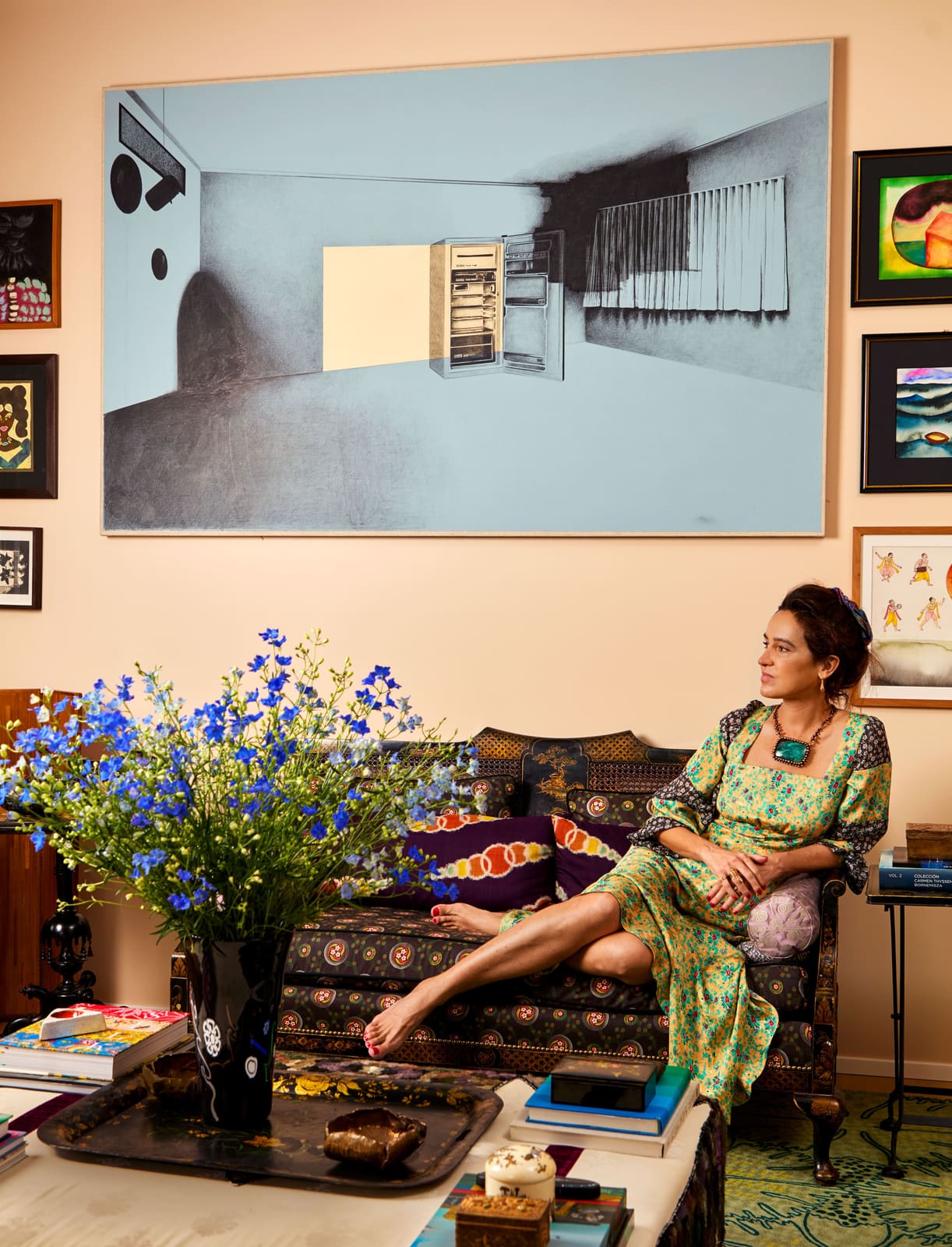
A Home That Refuses Minimalism
There is a particular kind of domestic space that emerges when someone who makes things for a living is also constitutionally incapable of passing by something beautiful. Coco Brandolini d'Adda's Milan apartment exemplifies this condition. The founder of d'AddA, an artisanal fashion label launched in 2022, lives with her husband Matteo Colombo and their three daughters in a residence that has grown organically over two decades, absorbing rooms, objects, and textiles the way a city accretes neighborhoods.
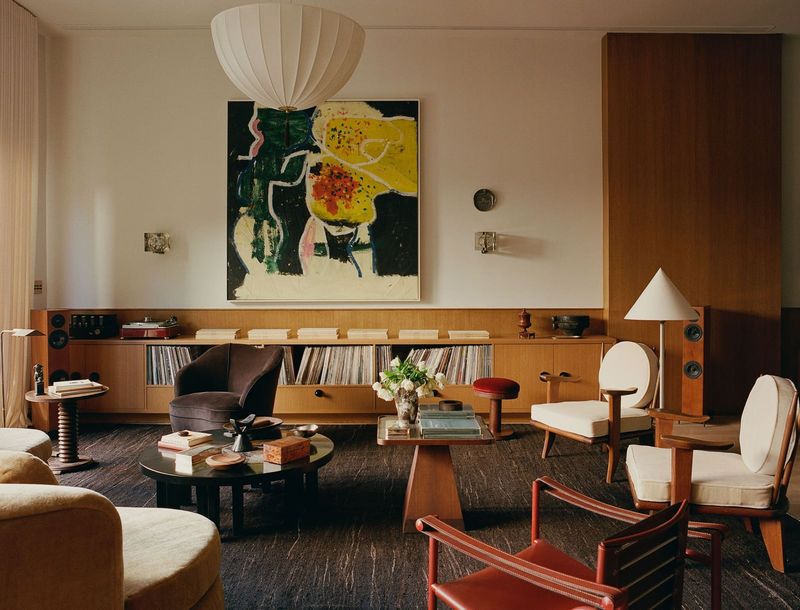
Stand in the living room and you confront not a single cabinet of curiosities but several. A faded red French cabinet holds Murano glass from her grandfather's Venetian collection, a work by Alighiero Boetti acquired after she moved to Milan, and a small brass-and-bronze bird by Gabriella Crespi. The latter piece prompts reflection on craft hierarchies. Crespi, who died in 2020, spent decades producing furniture and objects that merged Italian metalworking traditions with sculptural ambition, operating in a design world that rarely made space for women at the highest commercial tiers. Brandolini d'Adda's choice to foreground that work speaks to a collecting instinct rooted in material quality and maker biography rather than market cachet alone.
Nearby, a glass-topped chest commissioned from Dimorestudio serves as display infrastructure for jewel boxes and, unexpectedly, two antique spoons, one of them Fabergé. The impulse to design custom furniture around small objects rather than the reverse is instructive. It suggests a household organized not by spatial logic or decorative scheme but by the primacy of the artifact. The room accommodates the collection; the collection does not bend to the room.
Expansion as Creative Necessity
The apartment began as a modest three-bedroom unit. Over time, as daughters Nina, Lea, and Cora arrived, spatial pressure mounted. When the adjacent apartment became available, the family absorbed it, an act that might read as typical bourgeois expansion except for what Brandolini d'Adda chose to do with the additional square footage. One daughter gained her own bedroom, yes, but the former living room became a dining space large enough to seat fourteen, and crucially, the old bedrooms converted into an in-house atelier for d'AddA.
This reallocation reveals priorities. The studio, operational since 2022, allows Brandolini d'Adda to work in pajamas before her team arrives, a detail that underscores the blurred boundary between domestic life and creative production. At World Archi Design, we have long tracked how designers and architects structure their own environments, and the pattern that emerges consistently is this: the home becomes workshop, and the workshop bleeds back into lived space. Brandolini d'Adda's setup is less about work-life balance than work-life integration, a condition enabled by the apartment's hybrid programming.
The renovation was overseen by Leonora Hamill, a London-based AD100 designer who has known Brandolini d'Adda since childhood. Hamill's task was not to impose order but to accommodate proliferation. She notes that Brandolini d'Adda possesses more objects than any other client, yet the space avoids reading as cluttered because each item occupies a position determined by intention rather than convenience. This is the difference between hoarding and curating, a line Brandolini d'Adda herself acknowledges with humor. The self-aware collector stops when rooms run out; the hoarder does not.
Textiles as Architecture
Stacked atop library shelves are bolts of bright silk, deliberately left visible rather than stored away. Guests invariably ask about them, which Brandolini d'Adda welcomes. One swatch, shimmering and hand-loomed, came from a Buddhist monk encountered during travel through Bhutan. The memory of acquisition remains vivid, and the textile itself functions as both material resource and mnemonic device.
This approach to textiles treats them not as decorative accent but as spatial element. Vintage fabrics reupholster family heirlooms; Moroccan embroidered panels cover a custom ottoman; an antique Chinese silk tablecloth dresses the dining table. In the studio, a slipper chair wears vintage textiles sourced from travels to Uzbekistan and beyond. The effect is accretive rather than designed in the conventional sense. Brandolini d'Adda does not select a palette and then source fabrics to match. She acquires fabrics she loves and then builds environments around them.
The precedent here is less mid-century modernism, which privileged restraint and the honest expression of industrial materials, than it is the layered, eclectic interiors of figures like Renzo Mongiardino, the legendary Italian decorator hired by Brandolini d'Adda's grandmother, Countess Cristiana Brandolini d'Adda, for a private residence in Paris. Mongiardino's interiors were theatrical, densely patterned, historically referential, and unapologetically maximalist. They assumed that more could be more if handled with sufficient rigor. Brandolini d'Adda's apartment operates in that tradition, though with a lighter touch and a willingness to mix high and low, flea market and family heirloom, without hierarchy.
The Furniture Mix: Ponti, Buffa, and the Street
The apartment contains Gio Ponti furniture, a Paolo Buffa table, and a lamp found on the street. This range is not eclectic for its own sake but reflects a collecting philosophy that privileges form and function over provenance. Ponti's work, characterized by geometric clarity and a keen sense of proportion, anchors the living room. A Ponti desk, topped with a painting by Salvatore Emblema, demonstrates how mid-century Italian design can coexist with contemporary art without either losing ground.
Buffa, a lesser-known contemporary of Ponti, produced furniture marked by sculptural curves and luxe materials, often walnut and brass. His pieces read as more traditionally decorative than Ponti's, which makes their inclusion here a useful counterbalance. The apartment does not commit to a single design language. It samples across decades and sensibilities, unified not by style but by the collector's eye.
And then there is the street lamp, positioned without apology next to glassware from Laguna~B, a Venetian studio run by Brandolini d'Adda's cousin Marcantonio Brandolini d'Adda. The juxtaposition is deliberate. It asserts that an object's value resides in its form and utility, not its backstory. This is a democratic approach to collecting, one that refuses to fetishize pedigree while still honoring craft.
Art as Domestic Infrastructure
The walls and surfaces hold works by Francesco Clemente, Andrea Bowers, Massimo Vitali, and Ernesto Caivano, among others. A circular sculpture by Eve Rothschild hangs above a late-17th-century Italian cabinet in the entrance. In the primary bedroom, a wall displays work by Benjamin Degen. These are not trophy acquisitions but pieces integrated into the daily rhythm of the household. Brandolini d'Adda's daughters' artworks appear in the primary bath, a gesture that flattens the hierarchy between professional and amateur, adult and child.
This treatment of art mirrors the broader logic of the apartment: objects are not sequestered in formal display zones but distributed throughout lived space. A 19th-century Italian secretary holds collections of small boxes and ephemera. A kitchen wall features a Massimo Vitali photograph flanked by Neapolitan and Hungarian baskets and a vintage Russian tray. The composition is painterly, but the materials are everyday. The effect is to make art feel accessible rather than precious, part of the domestic fabric rather than separate from it.
Craft Lineage and the Launch of d'AddA
Brandolini d'Adda's professional trajectory shaped her collecting habits and vice versa. She spent eight years with Oscar de la Renta, whom she credits as mentor and inspiration. Subsequent stints with Alberta Ferretti, Tomas Maier at Bottega Veneta, and a decade with Domenico Dolce building Dolce & Gabbana's Alta Moda operation exposed her to high craft at scale. The quality, fit, and construction techniques she absorbed during those years inform both her fashion work and her approach to objects.
When Dolce encouraged her to launch her own label, he advised her to focus exclusively on what she wanted to wear and to embrace her family story rather than distance herself from it. The counsel was strategic but also liberating. For years, Brandolini d'Adda resisted trading on her lineage. Her grandmother's legendary eye, her mother Georgina's years with Valentino, the Brandolini name itself, all felt like inherited advantages she preferred not to leverage. Maturity and confidence shifted that calculus. Heritage became not burden but resource, a narrative thread that connected her work to a longer continuum of taste and craft.
The apartment functions as physical manifestation of that acceptance. Family heirlooms sit alongside flea-market finds and contemporary design without tension. A 1940s Russian tea service shares shelf space with a small screen by Lilou Marquand, a Paris-based craft legend in her nineties. Plates discovered on holiday in Greece mix with a 1930s Clarice Cliff Bizarre tea set in the Gayday pattern. The collection refuses chronological or stylistic purity. It is, instead, a record of curiosity sustained over decades.
The Atmosphere Principle
Brandolini d'Adda insists that atmosphere matters more than space. In the original apartment, she hosted thirty or forty people without a dining table. Guests did not seem to mind. The expanded apartment offers more room, but the underlying principle remains. A home succeeds not because it is large or spare or perfectly composed but because it reflects the people who live in it.
This is an unfashionable position in an era that often equates good design with restraint, with the elimination of clutter and the reduction of possessions to a carefully edited few. Brandolini d'Adda's apartment argues for the opposite: that a space can hold many things, many histories, many textures, and still cohere if the collector's instinct is strong enough. It is not a home that could be replicated by following a mood board or a shopping list. It is the product of sustained attention, travel, inheritance, and a willingness to live surrounded by objects that demand care and acknowledgment.
In this sense, the apartment is less a static interior than an ongoing project, one that will continue to accumulate and evolve as long as Brandolini d'Adda keeps finding things she cannot leave behind. The question she poses, half-joking, about whether she is a hoarder is rhetorical. She knows the difference. A hoarder accumulates without discernment. A collector builds a world.
Save this story. A free account keeps your reading list and the 07:00 email in one place.
CREATE FREE ACCOUNT →SIGN IN