
A General in the Courtyard
In 1973, Michele De Lucchi arrived at Triennale Milano dressed as a Napoleonic general. He was a student at the University of Florence, caught in the ferment of Italy's youth movements, and his costume was not merely theatrical. It was argument rendered in gold braid and epaulettes: designers, he insisted, are not neutral facilitators. They are architects of behavior, shapers of social life, and the objects they place in the world carry ideological weight. That provocation, staged in the courtyard of Giovanni Muzio's Palazzo dell'Arte, now reads like a preview of the role De Lucchi accepted earlier this year. As Creative Director under President Vincenzo Trione, alongside Manuela Lucà-Dazio overseeing architecture and Andrea Villani on contemporary art, he returns to the institution not as a provocateur but as a steward of its future. Yet the tension he performed five decades ago remains unresolved: how does an institution dedicated to change avoid calcifying into ritual?
The Bridge That Remembers Its Own Reversibility
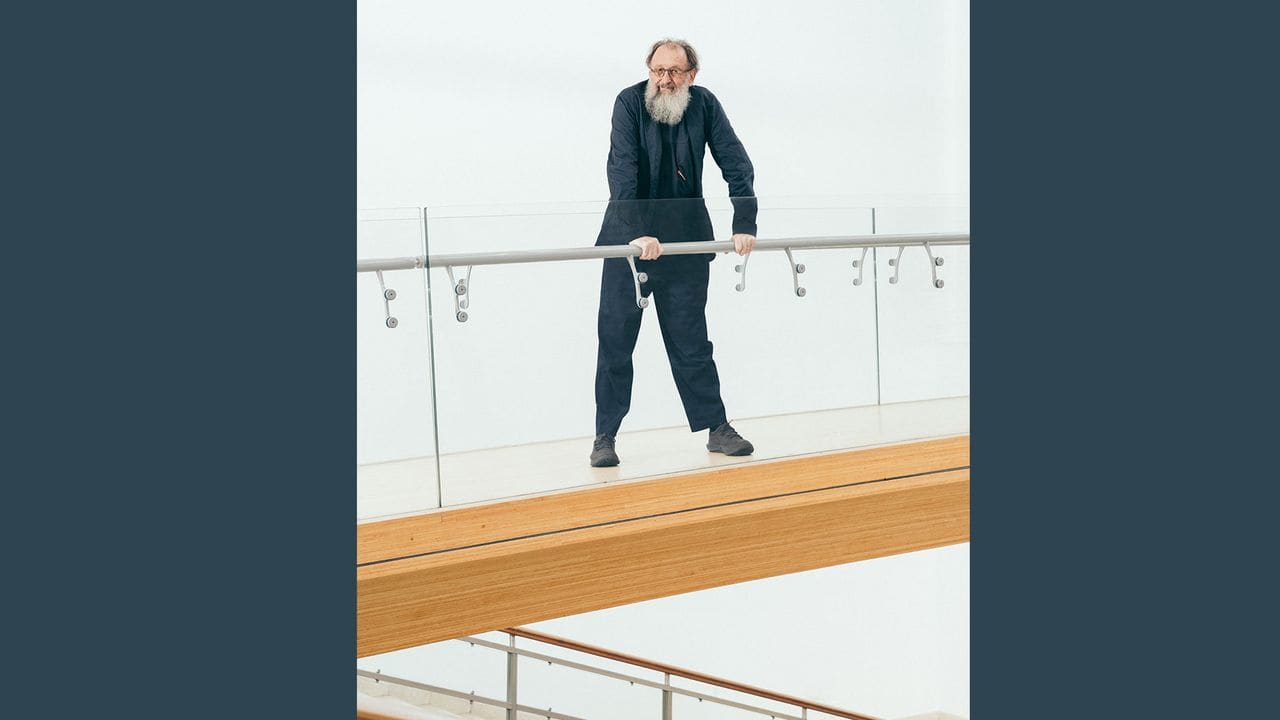
De Lucchi's relationship with the Triennale has been physical as well as conceptual. Among his architectural interventions in the building, the most striking is a bridge spanning the grand ceremonial staircase, connecting the upper floor to the Design Museum. It is a bold insertion into Muzio's 1933 structure, yet engineered with an unusual humility. The bridge rests on two independent iron portals, touching nothing of the original fabric. A single piece of stone, visible from the bridge itself, marks where the staircase was interrupted, a deliberate reminder that the intervention could be undone without leaving a scar. This reversibility is more than technical courtesy. It embodies a philosophy De Lucchi now brings to his curatorial mandate: institutions must take root, but they must also remain alert to the possibility of their own obsolescence. The bridge is confident in its utility and modest about its permanence, a rare combination in contemporary architecture.
Decorative Arts, Industrial Design, and the Slippage Between Terms
The Triennale was founded as a showcase for decorative arts, a term that once meant the ornamental labor artisans applied to functional objects. That definition has migrated across decades, absorbing the vocabularies of Art Nouveau, rationalism, industrial prefabrication, and eventually the broader category of design itself. De Lucchi does not treat this semantic drift as confusion. He frames it as the institution's central asset. The Triennale is not a museum of art, nor a trade fair, nor a school. It occupies the space where disciplines converge, where architecture, fashion, performance, and industrial production share a common preoccupation: the act of designing, of projecting intention into the material world. What distinguishes it from other institutions, he argues, is its Milanese rootedness. Milan has always been a city that looks outward, but the Triennale's authenticity lies in its refusal to become generic. It is international in aspiration and local in sensibility, a combination that has allowed it to remain relevant through waves of ideological and aesthetic upheaval.
The Tension Between Institution and Improvisation
De Lucchi speaks often of opposites that must coexist without resolution. The most pressing of these is the pairing of institutional stability and cultural improvisation. Institutions exist to establish foundations, to build slowly and take root. Yet the contemporary moment demands agility, shallow roots, the capacity to pivot. He does not propose a synthesis so much as a productive friction. The Triennale, he insists, must maintain its program of planned exhibitions and its triennial cycle, but it must also leave room for spontaneity. The themes that matter most, sustainability chief among them, cannot wait three years for a scheduled platform. They require immediate, improvisational engagement. This is not a call for chaos. It is a recognition that cultural vitality depends on rhythm, on the interplay between what is planned and what emerges in response to the present. At World Archi Design, we have long tracked institutions that attempt this balance, and the record is mixed. The ones that succeed are those willing to accept that some of their most important work will not fit neatly into the brochure.
Building Sustainability in the Collective Imagination
One of De Lucchi's central proposals is that sustainability is not primarily a technical problem. Designing the most energy-efficient building or the most recyclable object is futile if the broader culture remains committed to consumption as a form of identity. The real work, he argues, is imaginative. It requires reshaping the mental images people hold of a desirable future. If those images continue to valorize excess, no amount of green technology will matter. This is a sharper critique than it may initially appear. It implicates not only consumers but the entire apparatus of architectural visualization: the renderings, the lifestyle photography, the aspirational interiors that circulate through magazines and social feeds. If those images continue to depict worlds that are ecologically unattainable, they function as propaganda for a way of life that must end. The Triennale, in De Lucchi's vision, has a responsibility to circulate different images, to populate the collective imagination with futures that are both desirable and possible.
The Artisan as Catalyst for Innovation
De Lucchi is careful to avoid romanticizing craft. He does not position artisans as noble alternatives to industrial production, nor does he advocate for a return to preindustrial methods. Instead, he describes Italian craftsmanship as structurally intertwined with the country's design industry. Major furniture manufacturers depend on a network of carpenters, metalworkers, upholsterers, and textile producers who work in small batches and iterate rapidly. These artisans are not preserving tradition for its own sake. They are engines of experimentation, driven by a simple fact: they get bored. Repetition fatigues them, and in response they invent new techniques, new finishes, new ways of solving familiar problems. This restlessness is a form of innovation that operates below the level of branded design, invisible to most consumers but essential to the system. De Lucchi suggests that this artisanal fabric, which Italy has maintained partly through economic necessity, is now a strategic advantage. It allows for a kind of material intelligence that cannot be replicated in purely industrial contexts. The Triennale, he argues, should foreground this network, not as nostalgia but as infrastructure.
Seven Maxims and the Return to Humanism
To accompany his new role, De Lucchi produced a series of illustrated aphorisms: "Design is a human's most human manifestation"; "Design is collective responsibility"; "Design gives shape to our time." These maxims read less as marketing copy than as attempts to reanchor design in a humanist tradition that has been eroded by decades of market logic. They insist that design is not neutral, not merely responsive to client briefs or consumer preferences. It is an active force, a way of inscribing values into the built environment. This is the same argument he made in 1973, dressed as a general. The difference now is institutional backing. The provocation has become policy.
What Comes Next
De Lucchi has not outlined a detailed exhibition calendar, and that may be intentional. The improvisational element he champions cannot be scripted in advance. What is clear is that the Triennale under his direction will prioritize themes that cannot be postponed: truth in an era of epistemic collapse, connection in fragmented societies, recyclability as both material practice and conceptual model. These are not neat curatorial packages. They are urgent, messy, and resistant to resolution. Whether the institution can hold space for that kind of inquiry without collapsing into incoherence remains to be seen. But the ambition is correct. At a moment when much of the design world has retreated into aestheticized problem-solving, the Triennale is positioning itself as a site for deeper, more uncomfortable questions. That alone makes it worth watching.
Save this story. A free account keeps your reading list and the 07:00 email in one place.
CREATE FREE ACCOUNT →SIGN IN