
From Finish to Framework
There's a conceptual leap happening in the ceramic tile industry, one that moves the conversation away from palette and pattern toward something more fundamental: the role of surfacing in how buildings actually work. When over 600 manufacturers converge in Bologna this September for Cersaie - the International Exhibition of Ceramic Tile and Bathroom Furnishings - the fair's organizing principle will center not on aesthetics alone, but on what it calls "a space for architectural design." That phrasing signals a shift. Tile is no longer the last decision in a design sequence, applied after the real architecture has been resolved. Instead, it's being positioned as part of the building's performance logic - integral to durability, hygiene, thermal behavior, and environmental footprint.
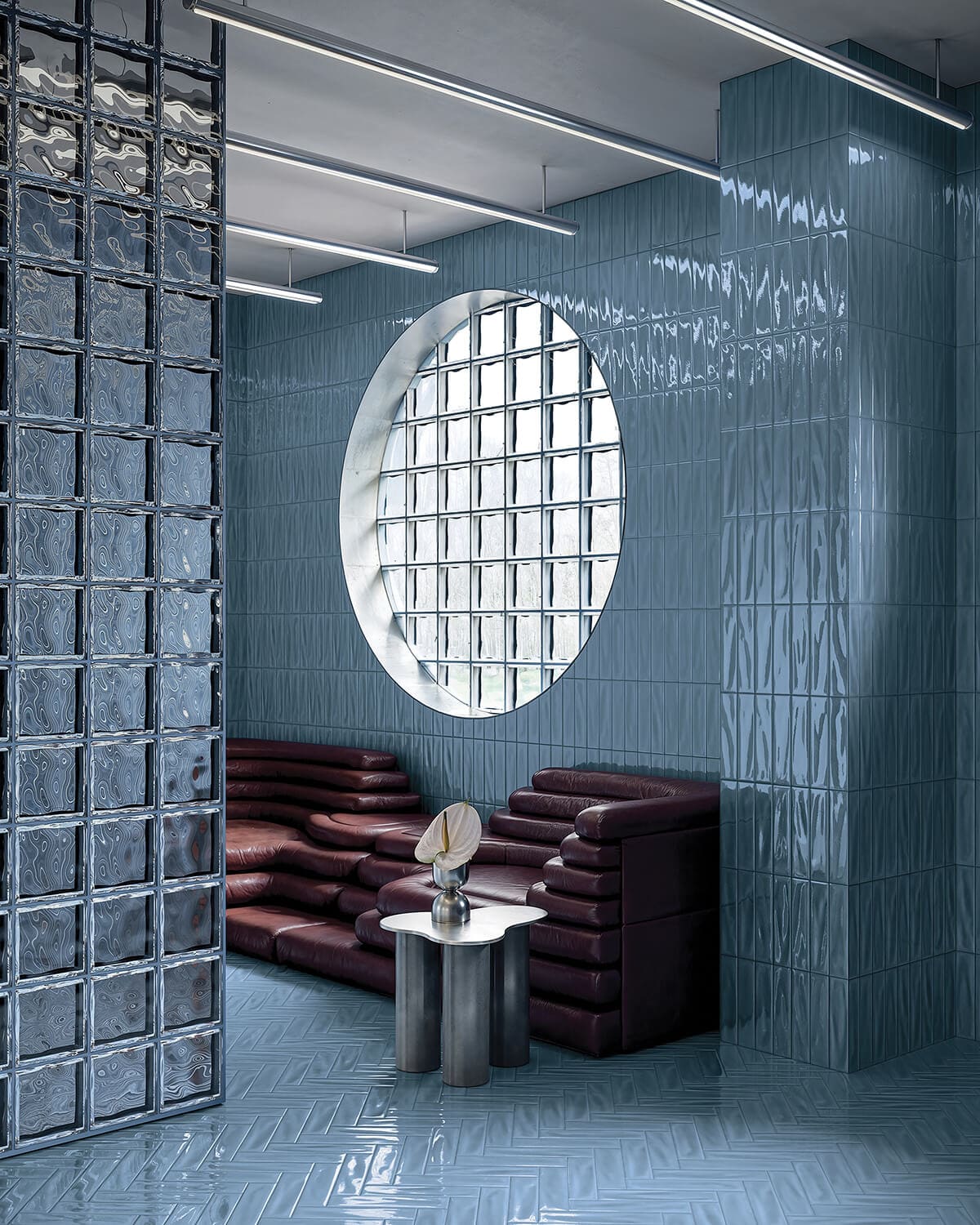
This isn't marketing rhetoric. Across the projects we've covered this year, we've seen porcelain slabs replacing stone cladding on ventilated facades, ceramic pavers forming the hardscape of urban plazas, and tile drenching entire interiors to create monolithic spatial envelopes. The material's technical versatility has quietly expanded beyond the typical residential bathroom. What Italian manufacturers are offering now is a toolkit that spans scales - from mosaic insets measured in centimeters to ultra-thin slabs that stretch across countertops, cabinetry, even cooktops. The breadth of application is less about fashion and more about ceramic's intrinsic properties: resistance to moisture, UV stability, ease of maintenance, and a lifespan that outlasts most other surface materials by decades.
Why Infrastructure Language Matters
Cersaie's 2026 theme - positioning ceramic within infrastructure - reflects a broader reckoning in architecture about material longevity and life-cycle impact. Pritzker laureate Alejandro Aravena will deliver the keynote address on September 24, and his inclusion is telling. Aravena's work with Elemental has long foregrounded social housing, incremental construction, and buildings designed to evolve over time. His practice doesn't treat finishes as secondary; it treats them as part of the building's adaptive capacity. Annabelle Selldorf, whose museums and cultural projects prioritize restrained materiality and precision detailing, will also speak. A panel discussion on large-scale infrastructure projects rounds out the program, underscoring the fair's intent to situate ceramic not in the realm of interior decoration, but in the domain of urban systems and public works.
This rhetorical repositioning aligns with what manufacturers have been doing technically for years. Porcelain's compressive strength rivals that of natural stone, and its water absorption rate - often below 0.5 percent - makes it suitable for exterior applications in freeze-thaw climates. Ventilated facade systems using ceramic panels have been deployed across Europe for decades, valued for their thermal performance and low maintenance. What's changed is the industry's willingness to articulate these attributes in architectural terms rather than trade-show superlatives.
The Expansion of Use Cases
At World Archi Design, we've been tracking the proliferation of ceramic beyond traditional tiling applications. Countertops fabricated from sintered porcelain now compete directly with engineered stone and solid surface materials, offering comparable aesthetics without the silica dust hazards associated with quartz fabrication. Integrated washbasins and vanities - where the sink and counter are a single monolithic piece - eliminate seams and simplify installation. Shower drainage systems embedded within ceramic floor assemblies allow for curbless, barrier-free wet rooms. Bathtubs clad in tile create continuity with surrounding surfaces, blurring the boundary between fixture and architecture.
The technical advances enabling these applications are rooted in digital fabrication. Large-format slabs, some measuring up to 1.6 by 3.2 meters, are produced using inkjet printing technologies that can replicate the veining of Calacatta marble or the patina of weathered bronze with near-photographic fidelity. Three-dimensional relief patterns add tactility, while metallic glazes introduce reflectivity that shifts with lighting conditions. The result is a material palette that can mimic almost anything - stone, wood, metal, concrete - while retaining ceramic's inherent performance advantages.
Cersaie's Tiling Town, a 400-square-meter dedicated space for hands-on learning, will host live installation demonstrations focused on extra-large slabs, three-dimensional volumes, and mosaics. The inclusion of an international tiling lab signals recognition that specification alone isn't enough; the craft of installation - how joints are aligned, how substrates are prepared, how adhesives are selected - determines whether a ceramic assembly performs as intended over its lifespan.
Sustainability Without the Asterisk
Italian manufacturers have invested heavily in closed-loop manufacturing processes. Many facilities now recycle 100 percent of production waste - grinding rejected tiles back into raw material - and recirculate water used in cooling and cleaning. Energy consumption has dropped through the adoption of combined heat and power systems and waste heat recovery. These aren't incremental improvements; they represent structural changes in how ceramic is produced.
The material itself carries environmental advantages that are often undersold. Ceramic tile contains no polyvinyl chloride, no phthalates, no volatile organic compounds. Its raw ingredients - clay, feldspar, silica - are abundant and geologically stable. Unlike vinyl or laminate flooring, ceramic doesn't off-gas. Unlike carpet, it doesn't harbor allergens or require chemical treatments for stain resistance. Its durability means replacement cycles measured in decades, not years. And when a building is eventually demolished, ceramic can be crushed and used as aggregate - a form of downcycling, but one that avoids landfill entirely.
Third-party certifications - Environmental Product Declarations, LEED credits, Greenguard Gold, Declare labels - provide the documentation needed for projects pursuing green building standards. But the deeper sustainability argument is about longevity. A material that lasts 50 years without degradation, that requires only water for cleaning, that resists UV fading and moisture damage, is inherently more sustainable than one requiring periodic refinishing or replacement.
Aesthetic Range and Sensory Design
None of this would matter if ceramic looked institutional. But the aesthetic range on display at Cersaie - judging from preview images released by exhibitors - suggests the opposite. Cerasarda's Porto Rotondo Azzurro Smeraldino series evokes the coastal palette of Sardinia, using soft blues and mineral textures. Ceramica Bardelli's Acquatic Creatures collection treats tile as a canvas for illustrative work, with hand-drawn marine motifs that recall the tradition of Portuguese azulejos. Atlas Concorde's Marvel T line reinterprets classic marble typologies - Statuario, Calacatta, Breccia - in porcelain, offering the look of quarried stone without the weight or maintenance burden.
Fondovalle's Starlit collection introduces metallic finishes that shift from matte to reflective depending on viewing angle, a technique borrowed from automotive paint technology. ABK Stone's Breccia Medici captures the fractured, sedimentary quality of Italian breccia, complete with fossil inclusions and color variation. Del Conca's Travertino Moka Vein Cut mimics the linear striations of vein-cut travertine, a finish traditionally achieved by sawing perpendicular to the stone's bedding plane.
These aren't imitations for the sake of cost savings. They're design choices that prioritize performance - resistance to staining, ease of repair, consistency of supply - while retaining the visual complexity of natural materials. In high-traffic environments, porcelain's scratch resistance and color stability outperform most stone. In wet environments, its impermeability eliminates the need for sealants. The aesthetic mimicry is sophisticated enough that, in many cases, the substitution goes unnoticed.
Precedent and Parallel
The use of ceramic as a primary architectural material has deep roots. Carlo Scarpa's Olivetti Showroom in Venice, completed in 1958, employed Venetian terrazzo and custom mosaic work not as ornament but as tectonic strategy - defining thresholds, articulating joints, creating spatial hierarchy. More recently, Herzog & de Meuron's VitraHaus used oversized ceramic panels on exterior facades, exploiting the material's dimensional stability and weather resistance. In Japan, studios like Kengo Kuma & Associates have integrated ceramic tile into both interior and exterior assemblies, valuing its compatibility with traditional craft techniques and its capacity for fine-grain modulation of light and texture.
What distinguishes the current moment is scale and accessibility. Technologies that were once bespoke - large-format slabs, digital printing, three-dimensional relief - are now industrialized and available at relatively modest cost. The barrier to specifying ceramic in non-traditional applications has dropped. Architects no longer need to justify the material choice on purely aesthetic grounds; the technical case is robust enough to stand alone.
What the Fair Reveals
Cersaie functions as both trade show and knowledge exchange. With over 100,000 visitors expected from more than 160 countries, the fair draws not just architects and designers but contractors, developers, and distributors - the full supply chain. That breadth matters because ceramic's expanded role in architecture depends on coordination across disciplines. A ventilated facade system requires collaboration between architect, structural engineer, facade consultant, and installer. An integrated bathroom vanity requires coordination between plumber, tile setter, and cabinetmaker. The fair's structure - combining product exhibitions, technical seminars, and live demonstrations - acknowledges that material innovation alone isn't sufficient. Adoption requires education, standardization, and trust.
The inclusion of panels on large-scale infrastructure projects suggests that the industry is looking beyond the single-family home or boutique hotel. Public transit stations, schools, hospitals, and housing blocks represent opportunities for ceramic to prove its value at urban scale. These are environments where durability, hygiene, and low maintenance aren't nice-to-haves - they're essential. If ceramic can meet those demands while offering design flexibility, the material's role in architecture shifts from niche to normative.
Looking Forward
September's fair will likely reveal trends in color, texture, and format - metallic finishes, nature-inspired palettes, mural-like compositions. But the more significant reveal will be how manufacturers articulate ceramic's place within the broader discourse on sustainable building, material longevity, and architectural performance. The move from surface to system isn't just conceptual; it's operational. It reflects a material industry that has invested in production efficiency, environmental responsibility, and technical innovation - and is now prepared to make the case that ceramic belongs in the same conversation as mass timber, low-carbon concrete, and regenerative design.
Whether that case holds up depends less on what's launched in Bologna and more on how the material performs in buildings over the next decade. But the shift in framing - from finish to infrastructure - is already underway.
Save this story. A free account keeps your reading list and the 07:00 email in one place.
CREATE FREE ACCOUNT →SIGN IN