
Efficiency as Ethical Framework
There exists a strain of contemporary practice in which efficiency is neither cost-cutting euphemism nor stylistic posture but rather an ethical position. Diana Salvador's work in Ecuador occupies this territory. Her buildings emerge from an obsessive concern with constructive logic: how materials behave, how components assemble, how structures perform across time and climate. For Salvador, the tectonic is inseparable from the ecological. Every screw, every joint, every thermal gap becomes a site of decision-making.
This is not the effortless minimalism often celebrated in glossy surveys. Salvador describes her approach as survival, particularly for women navigating a profession still structured around patriarchal assumptions of labor and authority. Her insistence on self-reliance stems less from ideology than necessity. She has built a practice predicated on absolute control over workflow, from initial sketches through fabrication to on-site assembly. The result is architecture that reads as intimate, almost handmade, despite its industrial precision.
A Triangle House in Subtropical Context
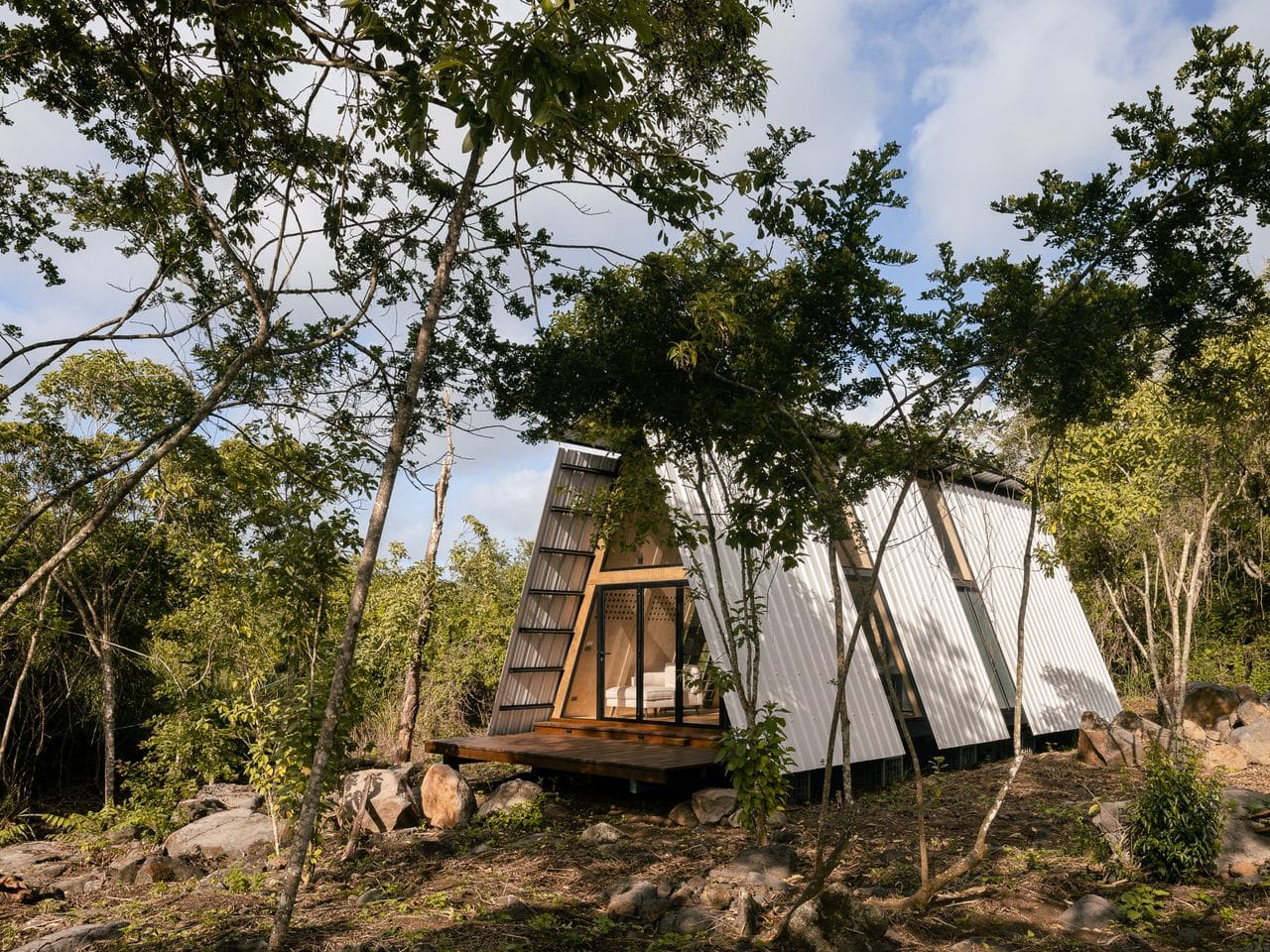
Casa Sula sits within the dense subtropical vegetation of Santa Cruz Island in the Galápagos, an archipelago whose fragility demands restraint. The house takes the form of a contemporary A-frame, a typology that has seen renewed interest among architects seeking to maximize volume while minimizing footprint. Here, the triangle is not nostalgic gesture but structural logic: the pitched roof sheds rain efficiently while the compact massing reduces material waste.
Salvador fabricated the entire structure in Quito over a two-month period. The house comprises roughly 2,000 individual components, wood, metal, aluminium, and glass, each custom-milled to precise tolerances. These pieces were then transported by sea to the island, where a small crew assembled the building in 25 days. The speed of construction matters in an environment where prolonged site disturbance can have cascading ecological consequences.
The assembly relied on over 17,000 screws, a detail Salvador's studio emphasizes not as boast but as data point. Screws, unlike adhesives or welds, permit disassembly. They encode reversibility into the structure, a principle central to low-impact building. If the house must one day be removed, it can be taken apart and its materials reused elsewhere. This is prefabrication understood not as expedience but as stewardship.
Passive Strategies and Bioclimatic Performance
The Galápagos climate poses specific challenges: high humidity, intense solar exposure, salt-laden air. Salvador addressed these through passive design rather than mechanical systems. The exterior envelope consists of two layers with a ventilated cavity between them. Air circulates through this interstitial space, carrying heat away from the inner skin and moderating interior temperatures without air conditioning.
This double-skin strategy has precedents in tropical modernism, from Le Corbusier's brise-soleil experiments to Glenn Murcutt's corrugated pavilions in Australia. What distinguishes Salvador's application is its integration with prefabrication. The air gap is not an afterthought but engineered into the component system from the outset. Each panel arrives on-site with its thermal performance predetermined, tested in Quito before shipment.
The house also employs strategic fenestration to capture prevailing breezes while limiting solar gain. Windows are positioned to create cross-ventilation, drawing cooler air from shaded zones and exhausting warm air through high openings. These are techniques older than modernism itself, vernacular strategies that Salvador has codified within an industrialized building process.
Prefabrication as Ecological Practice
Salvador positions Casa Sula as her second experiment with prefabricated construction, a lineage she intends to expand. Prefabrication in architecture often signals efficiency in the narrow sense: faster timelines, lower labor costs, tighter quality control. Salvador's interest extends further. By centralizing fabrication in a controlled workshop environment, she reduces on-site waste, limits transportation of raw materials to sensitive locations, and shortens the period of construction disturbance.
This approach challenges the conventional romance of architecture as site-specific craft. There is no hand-mixing of concrete, no local stone quarried from nearby hillsides. Instead, the building arrives as a kit of parts, its relationship to place mediated through performance rather than material provenance. The house responds to the Galápagos not by mimicking its forms but by minimizing its impact, a distinction that reflects shifting priorities within ecological design.
The project also raises questions about scalability. Prefabrication demands investment in tooling, precision equipment, skilled labor capable of working to tight tolerances. These are resources not evenly distributed across geographies or economies. Salvador's model depends on Quito's manufacturing infrastructure, access to CNC milling, laser cutting, powder coating. Whether such systems can be replicated in contexts with less industrial capacity remains an open question.
Women, Labor, and Architectural Autonomy
Salvador frames her practice explicitly in terms of gender and professional survival. Architecture remains a field where women are statistically underrepresented in leadership roles, particularly in Latin America. Her emphasis on self-reliance, her desire to build with her own hands, speaks to a broader frustration with structures of delegation and authority that exclude or marginalize.
This is not simply biography but methodology. Salvador's workflow minimizes reliance on large construction firms, subcontractor hierarchies, and the patronage networks that often determine who gets to build. By mastering fabrication herself, she circumvents gatekeepers. The architecture becomes more direct, less mediated by the conventions of professional practice.
There is precedent for this in figures like Eileen Gray, who learned lacquerwork and upholstery to control every aspect of her interiors, or Anne Tyng, who pursued structural engineering to gain authority within Louis Kahn's office. Salvador's path is contemporary, routed through digital fabrication and parametric modeling, but the impulse is continuous: technical mastery as a form of autonomy.
Recognition and Trajectory
Salvador received the National Award in Minimal Architecture at the Pan-American Architecture Biennial of Quito in 2020 and was named a finalist for the UIA 2030 Awards in Paris two years later. These honors position her within a cohort of young practitioners rethinking architecture's relationship to resource consumption and environmental impact. Her work shares affinities with studios like Lacaton & Vassal in France, who advocate for economy of means, or Rural Urban Framework in Hong Kong, who prioritize community participation and low-tech solutions.
Yet Salvador's context is distinct. Ecuador's construction industry operates under different regulatory frameworks, material availabilities, and economic pressures than those in Europe or East Asia. Her practice must negotiate these specificities while engaging with global conversations around sustainability. The tension between local constraint and international discourse animates much of her work.
The Name and the Bird
Casa Sula takes its name from a bird species endemic to the Galápagos. The gesture is more than poetic. Naming a building after a local species signals awareness of ecological interdependence, a reminder that construction always occurs within a web of existing life. The sula, commonly known as the booby, is a seabird whose populations have fluctuated in response to climate patterns and human activity. To invoke its name is to acknowledge the precarity of the archipelago's ecosystems and the responsibility architects bear when intervening in such places.
This kind of nominal homage risks sentimentality, but Salvador's rigor elsewhere in the project earns it. The house does not merely gesture toward nature; it operationalizes respect through material choices, construction speed, and reversible assembly. The name becomes shorthand for a set of commitments embedded in the building's DNA.
Forward Momentum
Salvador has stated her intention to pursue further projects using prefabricated systems. The logic is cumulative: each building refines the component library, improves fabrication processes, and expands the range of what such systems can achieve. This is architecture as iterative research, closer in spirit to product design than to the bespoke commissions that still dominate high-end practice.
Whether this model can address housing at scale, beyond one-off residences for clients able to afford custom prefabrication, remains uncertain. Salvador's work to date operates in the luxury market, however modest its formal language. The real test will be whether her methods can be adapted to social housing, disaster relief, or other contexts where speed and economy are not aesthetic choices but necessities.
For now, Casa Sula stands as a proof of concept: a small building in a vulnerable landscape, assembled quickly, performing passively, and harboring the possibility of eventual disassembly. It is architecture that aspires to leave no scar, a quiet ambition in an era of mounting climate anxiety.
Save this story. A free account keeps your reading list and the 07:00 email in one place.
CREATE FREE ACCOUNT →SIGN IN