
Mining the Archive for Pattern
Pattern libraries are the unsung heroes of heritage houses. While couture garments and runway moments capture headlines, the decorative motifs that populate textiles, accessories, and home objects often carry a quieter, longer life. Cordelia de Castellane, who oversees the artistic direction of Dior Maison, has spent years navigating the French brand's vast holdings, which number in the thousands and stretch back to the founding year of 1947. Her latest excavation surfaced a motif that first appeared on home goods in the mid-1970s and flourished through the following two decades: the Godron, a fluted decoration built from rows of rounded, segmented forms.
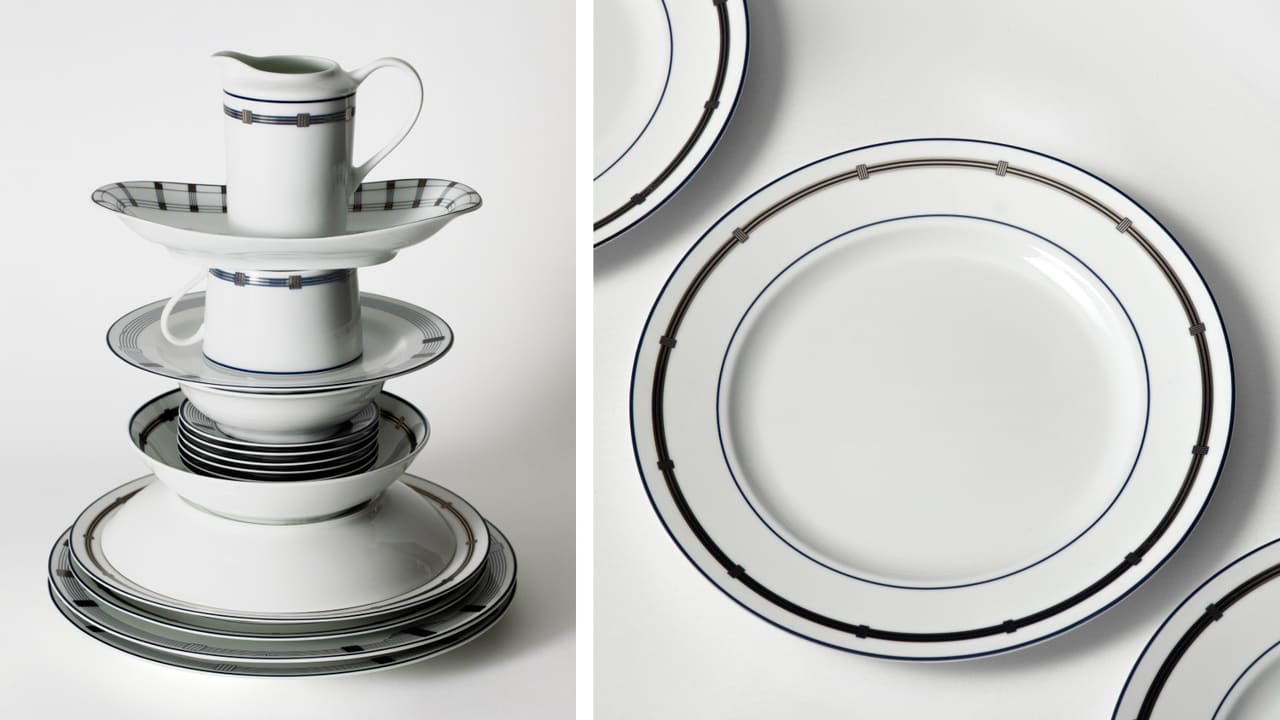
The pattern itself is straightforward. Thin blue stripes run parallel, interrupted at intervals by hatched rectangles rendered in white, navy, and metallic gold. The effect is rhythmic without being fussy, a quality that has allowed it to migrate across decades and typologies. Now reinterpreted for a collection of Limoges porcelain, the Godron takes on new domestic roles, from egg cups to oval platters, each piece balancing the formality of French porcelain craft with the graphic clarity of its surface treatment.
Limoges as Canvas
Limoges porcelain has been synonymous with French luxury tableware since the late eighteenth century, when kaolin deposits were discovered near the town in central France. The material's fine grain and translucency make it an ideal substrate for detailed surface work, whether hand-painted florals or, in this case, geometric patterning that recalls both art deco rigor and the textile sensibility that has always underpinned Dior's visual language.
De Castellane's collection spans a wide functional range. Decorative plates and trays feature the blue stripes arranged into stepped pyramids, a nod to the Mesoamerican-inspired forms that populated art deco architecture and ornamentation a century ago. On tea cup saucers, the stripes curl into concentric circles, a shift in orientation that creates visual variety without abandoning the underlying grid. A butter dish wears the pattern like a band around its lid, while a relish dish organizes the stripes into parallel tracks that echo the compartmentalized layout of the vessel itself.
The collection is designed to function across contexts. Everyday breakfasts and formal dinners both find a place within the range, a duality that reflects broader shifts in how contemporary households approach tableware. The rigid division between "fine china" and "daily use" has softened, particularly among design-conscious consumers who value coherence over hierarchy.
Beyond the Table
Dior Maison has extended the Godron motif beyond porcelain, applying it to trays, vases, picture frames, and trinket dishes. This move toward a coordinated decorative system is not new; European luxury houses have long understood that pattern can function as a form of branding, a visual signature that travels across categories. What distinguishes this iteration is the restraint. The palette remains limited, the forms are uncomplicated, and the motif itself is deployed with enough variation to avoid monotony.
Textiles form a parallel strand of the collection. Towels, placemats, napkins, beachwear, and bathrobes all carry the Godron in different scales and applications. On towels, a single line of the pattern crosses an elegant blue border, a gesture that feels more like punctuation than decoration. The placemat and napkin set translates the motif into a framing device, suitable for both indoor and outdoor settings. The beachwear and bathrobes push the pattern into softer, more casual territory, extending the reach of the collection into spaces where porcelain would never venture.
This cross-category approach is deliberate. De Castellane has spoken in the past about the importance of creating environments rather than isolated objects, a philosophy that aligns with the way many design-forward consumers now curate their homes. The ability to carry a single visual language from the dining table to the bathroom to the beach suggests a level of commitment that goes beyond the occasional accent piece.
Pairing with Dior Greenhouse
The Godron collection arrives alongside another recent launch from de Castellane: Dior Greenhouse, her first furniture collection for the house. That line features clover-shaped rattan pieces inspired by the winter garden of Christian Dior's childhood home in Granville, on the Normandy coast. The two collections are not identical in mood, rattan carries a warmth and informality that Limoges porcelain does not, but they share a commitment to historical reference filtered through contemporary use.
Rattan and porcelain have long coexisted in French domestic interiors, particularly in spaces that blur the line between indoors and outdoors. The winter garden, or jardin d'hiver, was a nineteenth-century typology that brought tropical plants and wicker furniture into glass-enclosed rooms attached to bourgeois homes. De Castellane's pairing of the two collections evokes that tradition without replicating it, a move that acknowledges history while refusing to be bound by it.
The clover motif in the rattan pieces and the geometric precision of the Godron create a productive tension. One is organic, curvilinear, tied to the natural world; the other is industrial, linear, rooted in the machine-age aesthetics of early twentieth-century design. Together, they suggest a layered approach to interior composition, one that values contrast as much as harmony.
Art Deco's Enduring Pull
Art deco emerged from the 1925 Exposition Internationale des Arts Décoratifs et Industriels Modernes in Paris, an event that sought to position France as the center of modern decorative arts in the wake of World War I. The style's defining characteristics, geometric abstraction, luxurious materials, streamlined forms, and references to ancient and non-Western cultures, resonated across continents and persisted well beyond the interwar period.
The Godron motif taps into several of these threads. Its fluted structure recalls the vertical emphasis of art deco skyscrapers, from New York's Chrysler Building to the stepped facades of Miami Beach hotels. The hatched rectangles and metallic accents evoke the era's fascination with machine precision and industrial materials. And the blue-and-white palette, while not strictly period-specific, aligns with the movement's fondness for high-contrast color schemes that emphasized clarity and boldness.
What makes the current revival interesting is its timing. Art deco has cycled in and out of favor for decades, often resurfacing during moments of economic uncertainty or cultural nostalgia for perceived glamour and order. The 2020s have seen a renewed interest in the style, visible in everything from hotel interiors to fashion runways to, as here, luxury tableware. Whether this reflects a genuine reappraisal of the movement's aesthetic contributions or simply the exhaustion of other historical reference points remains an open question.
The Economics of Archive-Driven Design
For heritage brands, the archive serves a dual function. It is both a repository of creative material and a form of intellectual property, a stockpile of motifs, silhouettes, and techniques that can be reissued, reinterpreted, or simply referenced to reinforce brand identity. De Castellane's work with the Godron motif exemplifies this approach. By reaching into the 1980s and 1990s, decades that are currently enjoying a cultural resurgence, she taps into both nostalgia and novelty, offering something that feels both familiar and fresh.
This strategy also carries commercial advantages. Archive-driven collections allow brands to leverage existing design assets without the risk and expense of developing entirely new visual languages. They appeal to longtime customers who recognize the references and to newer audiences who encounter the motifs for the first time. And they reinforce the narrative of continuity and craftsmanship that underpins luxury positioning.
At the same time, the approach has limitations. Reliance on the archive can lead to creative stagnation if not balanced with original development. The challenge for any artistic director working within a heritage framework is to navigate between reverence and reinvention, to honor the past without becoming trapped by it. De Castellane's decision to pair the Godron collection with the forward-looking Dior Greenhouse line suggests an awareness of this tension, an effort to anchor new work in historical reference while pushing the brand's design vocabulary into less familiar territory.
Everyday Luxury and the Shift in Domestic Ritual
The Godron collection's dual emphasis on everyday use and grand occasions reflects broader shifts in how luxury is understood and consumed. The aspirational model that dominated the late twentieth century, in which fine objects were reserved for special events and carefully protected, has given way to a more integrated approach. Contemporary luxury consumers increasingly prioritize quality and design in daily life, preferring objects that can withstand regular use while maintaining aesthetic and material integrity.
This shift has implications for design. Tableware must now balance durability with refinement, accessibility with distinction. Limoges porcelain, despite its historical association with formal dining, is robust enough for dishwasher use, a practical consideration that matters to households without full-time domestic staff. The Godron pattern, with its high-contrast graphics, reads clearly across different lighting conditions and table settings, from candlelit dinners to bright breakfast nooks.
The extension of the motif into beachwear and bathrobes further underscores this democratization of luxury. These are not heirloom objects meant to be passed down through generations; they are consumables, items that will wear out and be replaced. Yet they carry the same design attention and material quality as the porcelain, a signal that luxury is no longer confined to the display cabinet but can inhabit every corner of domestic life.
Save this story. A free account keeps your reading list and the 07:00 email in one place.
CREATE FREE ACCOUNT →SIGN IN