
When Absence Becomes the Subject
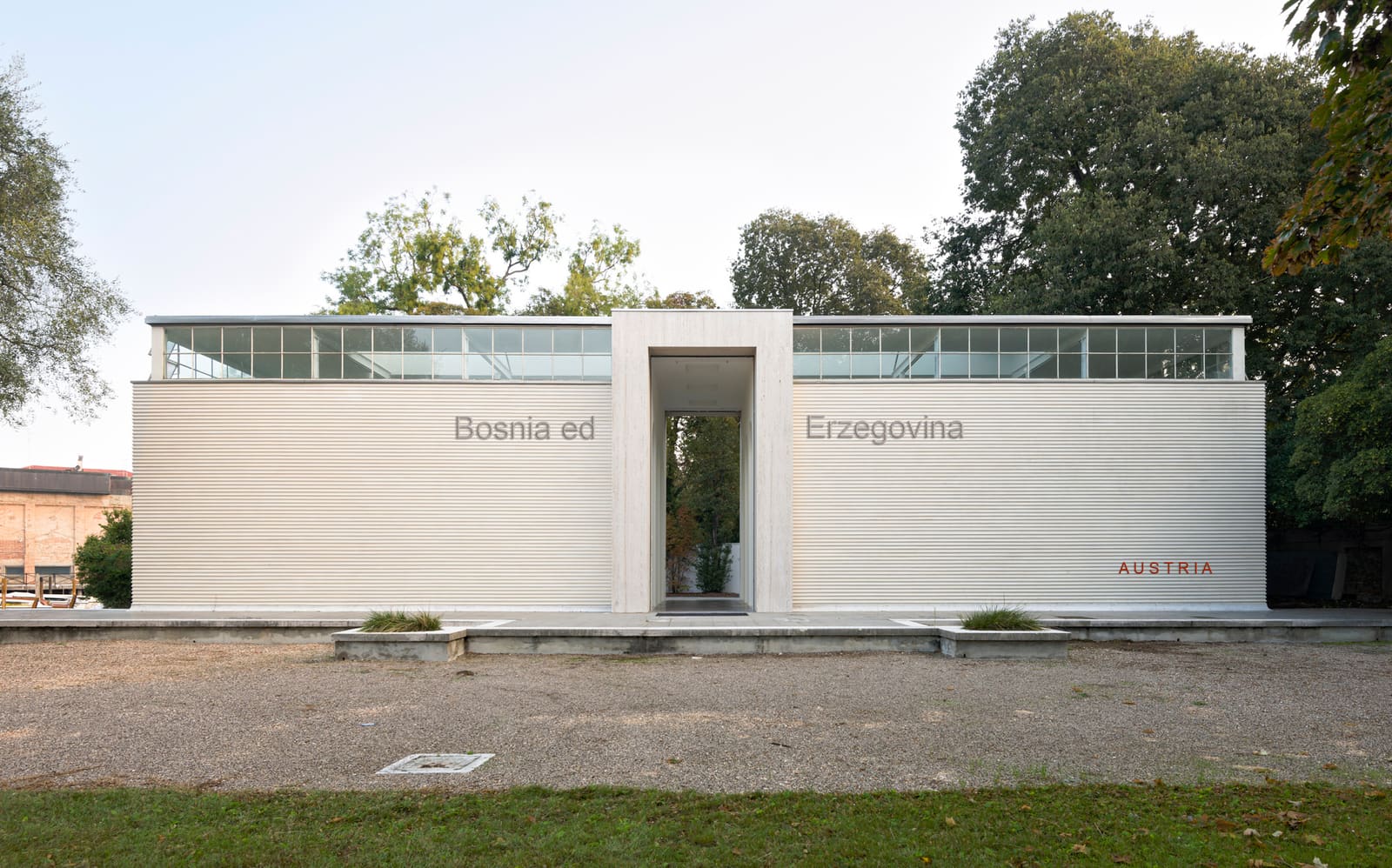
National pavilions at the Venice Architecture Biennale have long carried the weight of cultural diplomacy, their architecture frozen in the geopolitics of their construction era. But what happens when a nation has no pavilion at all? Austria's proposal for the 2027 edition turns this absence into the conceptual anchor of its contribution, offering to temporarily grant its Giardini pavilion to Bosnia and Herzegovina through what it terms a cooperative concession.
The project, titled Koncesija / Konzession / Concession(e), was selected through Austria's open competition and will be curated by architects Adna Babahmetović and Ajna Babahmetović alongside curator Sebastian Höglinger. Rather than presenting a singular national narrative, the pavilion reimagines itself as a shared platform, one that makes visible the structural inequalities embedded in the Biennale's geography.
At World Archi Design, we've been tracking how cultural institutions negotiate questions of access and representation. This proposal does not simply invite collaboration; it performs a spatial relinquishment, turning the pavilion itself into the medium of critique.
The Giardini's Selective History
The Giardini's permanent pavilions date primarily from the late nineteenth and early twentieth centuries, when national representation at Venice was shaped by colonial power, European alliances, and the aesthetic ideologies of nation-building. Austria's pavilion, like many others, embodies a specific historical moment. Bosnia and Herzegovina, by contrast, has never had a permanent structure in the Giardini, a circumstance that reflects both the region's complex twentieth-century history and the Biennale's own institutional inertia.
The absence is not incidental. The Giardini's layout is a physical record of who was invited to the table when the rules were written. By proposing a concession, Austria acknowledges that the pavilion system is not neutral. It is an architecture of inclusion and exclusion, one that can be temporarily reconfigured but never fully escaped.
This approach recalls the 2015 Nordic Pavilion intervention, when Finland, Norway, and Sweden shared their space with the Sámi people, though the Austrian proposal extends further by ceding curatorial control entirely. The pavilion becomes not a gesture of hospitality but a temporary transfer of sovereignty.
Concession as Curatorial Method
The term "concession" carries layered meanings. In diplomatic language, it denotes a formal grant of rights or territory. In commercial contexts, it describes a temporary license to operate within another's domain. The curators deploy this ambiguity deliberately, framing the pavilion as both a legal instrument and a spatial proposition.
What distinguishes this project from other collaborative pavilions is its explicit focus on the mechanics of representation. The pavilion does not simply exhibit Bosnian architecture; it examines the conditions under which national narratives are constructed and displayed. The concession is not a metaphor but a functional arrangement, one that foregrounds the bureaucratic and spatial negotiations required to make such a gesture possible.
Sebastian Höglinger and the Babahmetović architects bring both professional rigor and personal stakes to the project. Their curatorial framework treats the pavilion as a case study in architectural diplomacy, where the physical structure becomes secondary to the protocols that govern its use. The project's trilingual title underscores this multiplicity, refusing to privilege any single linguistic or cultural framework.
Representation and Its Discontents
National pavilions have always been contested spaces. Critics have long argued that they perpetuate outdated models of cultural identity, reducing complex architectural discourse to national branding exercises. Yet they remain the Biennale's most visible and politically charged sites, their architecture inseparable from the histories they embody.
Bosnia and Herzegovina's absence from the Giardini is a reminder that representation is never guaranteed. The country's post-Yugoslav trajectory, marked by war, partition, and contested statehood, complicates any straightforward claim to national identity. A pavilion, if one were to exist, would need to navigate these fractures, balancing multiple narratives within a singular architectural frame.
The Austrian proposal does not resolve these tensions. Instead, it makes them legible, using the pavilion as a device to surface questions that typically remain unspoken. Who gets to speak at Venice? What does it mean to represent a nation through architecture? And what forms of collaboration are possible within a system designed for competition?
Precedents and Parallels
Austria's gesture is not without precedent, though it operates at a different scale than previous collaborative efforts. The 2018 Architecture Biennale saw several national pavilions explore themes of displacement and migration, with Switzerland and the Vatican both addressing questions of refuge and belonging. Yet those projects retained their national frameworks, using the pavilion to comment on global issues rather than relinquishing the space itself.
A closer parallel might be found in the art world, where institutions have increasingly grappled with questions of restitution and shared authority. The Austrian proposal borrows from this discourse, applying it to the physical and symbolic architecture of the Biennale. The concession is temporary, a six-month grant rather than a permanent transfer, but its implications extend beyond the exhibition's duration.
The project also invites comparison to adaptive reuse practices, where existing structures are repurposed for new functions. Here, the pavilion's architecture remains unchanged, but its purpose is fundamentally reimagined. The concession operates as a form of institutional reuse, one that tests the flexibility of the Biennale's curatorial and diplomatic frameworks.
Beyond the Exhibition Cycle
Whether the concession will influence the Biennale's broader structure remains to be seen. The proposal does not call for the construction of a permanent Bosnian pavilion, nor does it demand systemic reform of the Giardini's allocation process. Instead, it operates within the existing system, using the tools available to expose its limitations.
This pragmatic approach may be the project's most significant contribution. Rather than issuing manifestos or proposing utopian alternatives, the curators work within the constraints of institutional architecture, demonstrating what is possible when national representation is treated as negotiable rather than fixed.
The 2027 Biennale will test whether this model can be sustained beyond a single exhibition cycle. If successful, the concession could establish a precedent for other nations to follow, transforming the pavilion system from a static geography into a dynamic network of temporary alliances and shared platforms. If not, it will remain a singular gesture, a footnote in the Biennale's long history of architectural experimentation.
What is certain is that the project places questions of access and representation at the center of Venice's architectural conversation. In doing so, it reminds us that the most important architecture at the Biennale may not be the buildings we see, but the systems that determine who gets to build in the first place.
Photo: Georg Petermichl
Save this story. A free account keeps your reading list and the 07:00 email in one place.
CREATE FREE ACCOUNT →SIGN IN