
The Crate as Totem
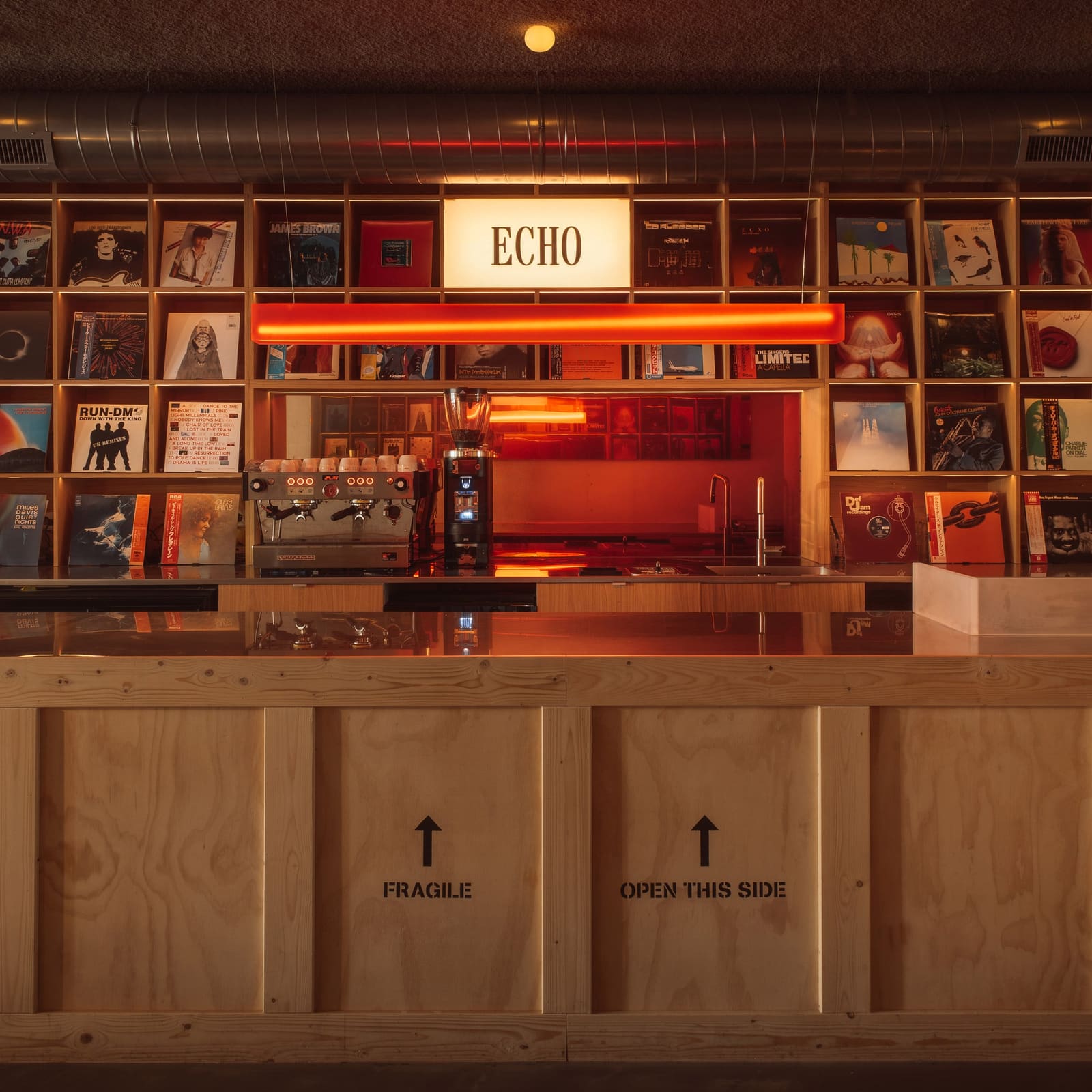
When most designers conceive a listening bar, they reach for velvet, dimmed lighting, and the hushed vocabulary of the audiophile shrine. Cloud, the architecture and design studio led by Paul Cournet, chose instead to build Echo's central bar from wooden shipping crates manufactured by Baleart Handlers, a company that makes bespoke containers for transporting fine art. The gesture is more than clever branding. Rotterdam's identity has long been intertwined with its port, the largest in Europe, and the crate becomes a material shorthand for both the city's industrial backbone and its treatment of culture as cargo worth protecting. Printed on the crate's sides are the words "handled with care", which now functions as the bar's tagline. The decision to foreground this utilitarian object, rather than conceal it beneath polished veneer, signals Echo's broader ambition: to adapt the contemplative ethos of Tokyo's listening bars to Rotterdam's grittier, more protean creative energy.
A Flexible Vessel for Sound
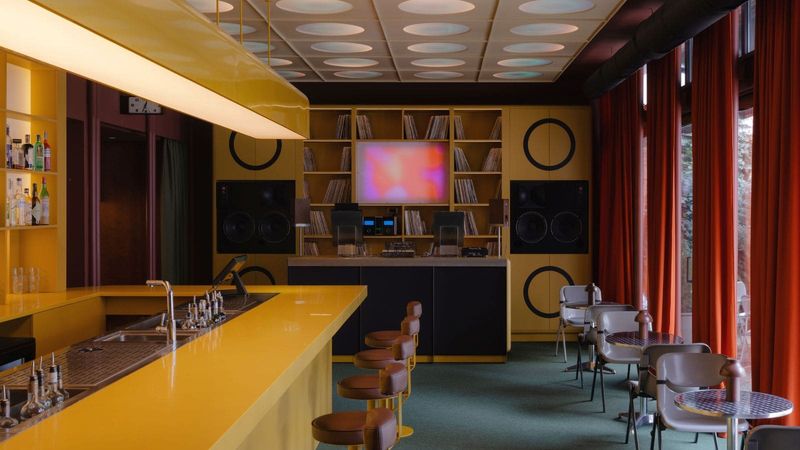
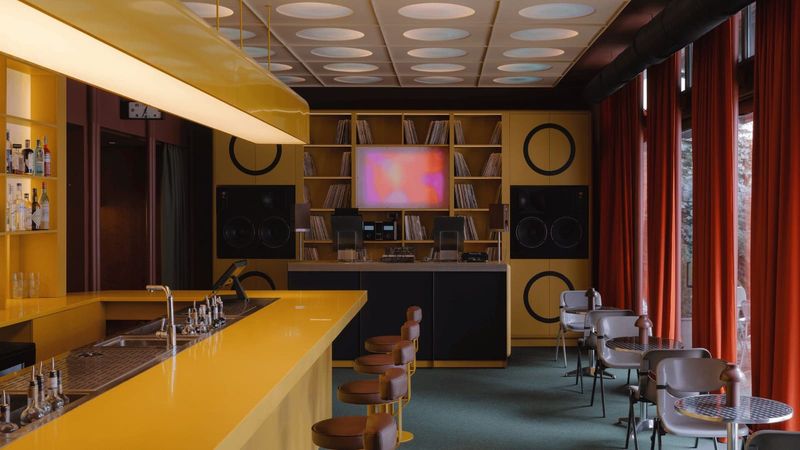
Echo occupies the ground floor of Groot Handelsgebouw, a post-war office block that faces Rotterdam Centraal station. The building's exposed concrete and orthogonal massing typify the city's brutalist inheritance, a vocabulary born from reconstruction after wartime devastation. Cournet's intervention does not attempt to soften this tectonic language. Instead, Cloud layers refined elements atop the raw substrate: ombré mirrors by Sabine Marcelis, who is also Cournet's partner, wash the walls in gradients of red and gold, while a linear resin lamp by Marcelis hovers above the bar. The mirrors, signature works in Marcelis's oeuvre, function as both ornament and optical device, multiplying the space and introducing chromatic warmth without compromising the concrete's austerity.
The programme is intentionally fluid. By day, Echo operates as a coffee shop; by night, it transforms into a bar. The venue can accommodate listening sessions for twenty to forty attendees, seated dinners for up to forty guests, or exhibitions. Modular shelving by Polish brand Tylko extends across the walls, creating storage for vinyl and integrating a bespoke sound system developed in collaboration with Form Follows Frequency. The speakers and subwoofers, launched earlier in 2026, slot precisely into Tylko's shelving units, a detail that emerged from Cournet's prior work on the furniture company's Berlin showroom. Two sculptural speaker towers flank the bar, anchoring the acoustic architecture.
Precedent and Adaptation
The listening bar as a typology has its roots in Japan, where establishments devoted to the communal experience of recorded music flourished in the mid-twentieth century. These venues privilege fidelity and attention, often featuring meticulously curated sound systems and strict protocols around conversation. Recent years have seen the format proliferate beyond Tokyo, with openings including Bar Bardo in Milan and Upstairs at Hausu in London. Echo represents the first such space in Rotterdam, but its designers, creative director Jeff Hoogendijk, DJ and producer Khalil Ryahi, and Cournet, have resisted a purist transplantation of the Japanese model. The retail offering, the morphing programme, and the deliberate use of local fabricators and materials all suggest a venue calibrated to Rotterdam's particular cultural metabolism.
The city's music history runs deep. In the 1990s and 2000s, Rotterdam became synonymous with gabber and hardcore techno, genres characterised by high tempos and industrial sonics. While Echo's programming leans toward a broader palette, the venue has invited local record stores to contribute to its event schedule since opening in early September 2026, embedding itself within existing networks rather than positioning itself as an imported novelty.
Material Tension and Acoustic Refinement
Cournet has described the interplay between the building's concrete shell and the interior's more polished elements as a productive tension. The sound system, engineered for clarity and spatial distribution, contrasts with the raw surfaces that might otherwise deaden or scatter frequencies unpredictably. This juxtaposition, between the unfinished and the exacting, mirrors a broader trend in contemporary hospitality design: the embrace of imperfection as a foil for moments of technical precision. The concrete, rather than feeling cold or indifferent, registers as softer when set against Marcelis's refractive surfaces and the geometric speakers.
The Tylko shelving, in particular, performs double duty. It provides the necessary infrastructure for a vinyl-centric venue while also serving as the structural matrix for the sound system. This integration recalls earlier experiments in furniture-as-architecture, where storage, display, and technical equipment collapse into a single articulated element. The shelving's modularity allows the space to reconfigure as programming demands shift, a pragmatic consideration for a venue that aspires to be more than a single-use room.
A Local Proposition
At World Archi Design, we have tracked the resurgence of listening bars with interest, noting how each iteration negotiates the tension between reverence and accessibility. Echo's success, if it endures, will likely rest on its refusal to perform Tokyo's listening bar culture as pastiche. The shipping-crate bar, the Marcelis mirrors, the Tylko shelving, and the collaboration with Form Follows Frequency all root the project in Rotterdam's material and social landscape. The space does not ask visitors to be silent or still, but it does ask them to pay attention, to treat music and hospitality as disciplines worthy of care.
The venue's tagline, lifted from the crate's shipping instructions, encapsulates this ethos. "Handled with care" implies fragility, but also value. In a city rebuilt from rubble, where infrastructure and culture have always been co-dependent, Echo proposes that the listening bar need not be a hermetic retreat. It can be a workshop, a gallery, a dinner venue, a coffee shop, and still, when the lights dim and the speakers engage, a place where sound takes precedence. Whether Rotterdam's music community will sustain this model remains to be seen, but the early response suggests that the city was ready for a venue that honours its industrial past while carving out space for quieter, more deliberate forms of cultural production.
Save this story. A free account keeps your reading list and the 07:00 email in one place.
CREATE FREE ACCOUNT →SIGN IN