
The Visibility Paradox
We find ourselves in an unusual moment. Craftsmanship commands more attention in architectural discourse than perhaps any time in recent decades. Walk through a major exhibition or flip through the glossy pages of design annuals and you will encounter rammed earth walls, hand-carved stone screens, woven bamboo structures, and lime plaster finishes celebrated as markers of environmental conscience and cultural authenticity. Yet step outside those documented projects and the picture shifts dramatically. The vast majority of construction - the apartment towers, office complexes, and housing developments that constitute the built environment - proceeds through industrialized methods that rarely engage skilled artisans.
This contradiction deserves scrutiny. Craft has become most visible precisely when it has become least common. The question is not why traditional building techniques are returning, but why they now appear predominantly in projects where budgets, timelines, and clients can absorb the complexity they demand.
Beyond Cultural Nostalgia
The conventional narrative frames this shift as inevitable modernization, a story in which traditional knowledge disappears because superior technologies replace it. That explanation proves inadequate when examined closely. Artisans have not ceased to exist. Their knowledge has not evaporated. Instead, skilled making has been economically repositioned within construction markets that increasingly struggle to accommodate it.
Across regions where building traditions stretch back centuries - India, parts of Southeast Asia, portions of Latin America - the knowledge base for handmade construction remains intact. Masons, carpenters, stone workers, and earth builders continue practicing techniques passed through generations. What has changed are the opportunities to deploy that expertise consistently. Craftsmanship survives where project economics permit it, which increasingly means bespoke commissions rather than ordinary building.
The distinction matters. If we misdiagnose the problem as cultural loss, we pursue preservation campaigns and documentation initiatives while the underlying economic structures that marginalize skilled labor remain untouched. The challenge is not preserving knowledge that already exists but creating construction systems capable of employing it.
The Procurement Question
Contemporary construction operates through procurement frameworks optimized for speed, standardization, and measurable efficiency. Competitive tendering rewards lowest cost. Subcontracting fragments labor into temporary arrangements. Project timelines compress to minimize financing costs. These systems function well for industrial production but create friction when skilled making enters the equation.
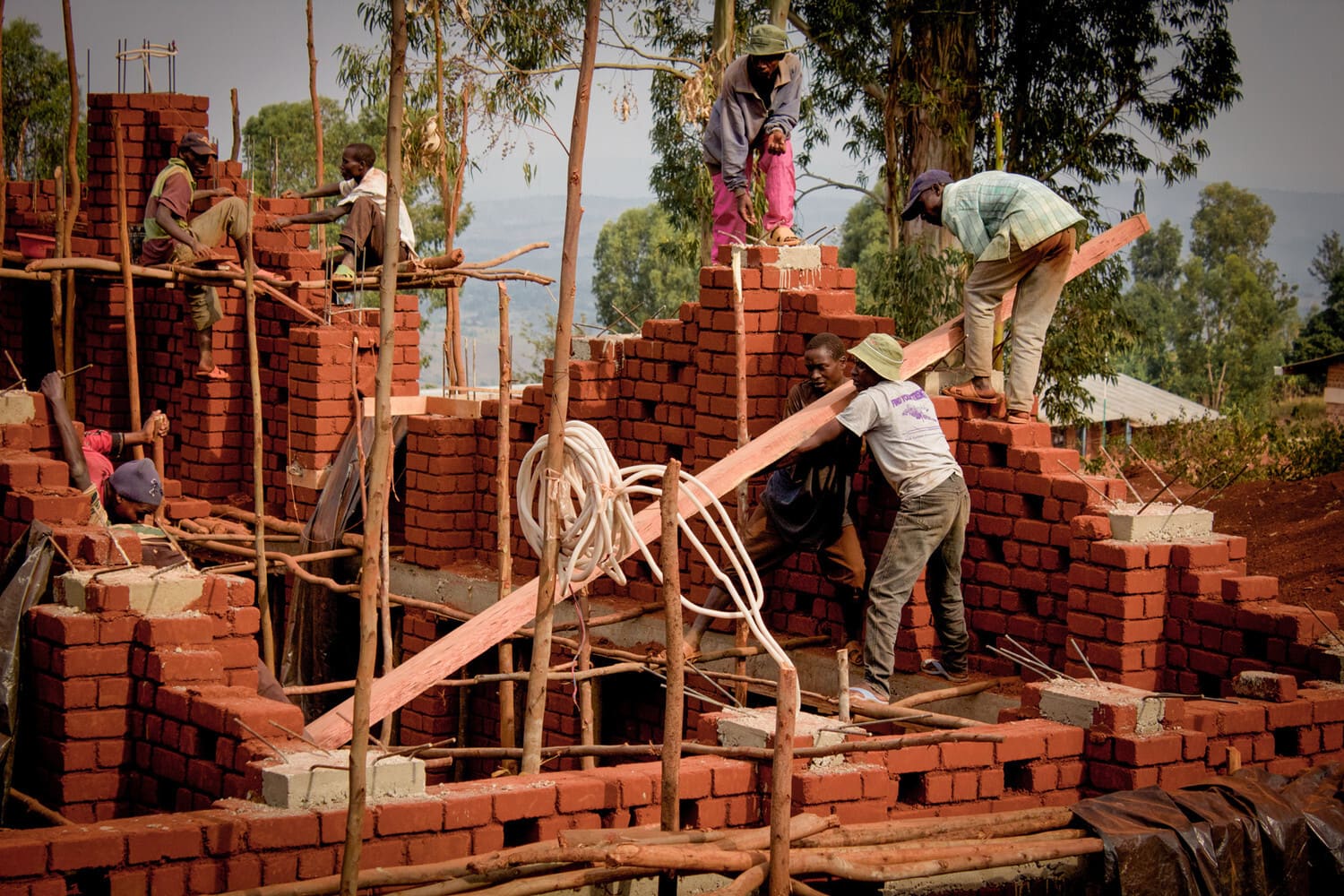
Consider what handmade construction actually requires. A lime plaster wall demands multiple coats applied at precise intervals, with curing periods that cannot be rushed. Rammed earth construction depends on moisture content, compaction technique, and continuous quality oversight throughout the building process. Bamboo joinery requires accumulated expertise in species selection, treatment, and structural detailing. Each of these processes introduces variables that sit uncomfortably within procurement models designed to eliminate uncertainty.
The economic premium attached to craft stems less from material scarcity than from the labor systems required to transform those materials into architecture. Earth, lime, bamboo, and brick remain widely available and relatively inexpensive as raw resources. The cost emerges through the knowledge needed to work with them - knowledge that cannot be industrialized simply by documenting techniques or creating digital workflows. That expertise depends on relationships between craftspeople, apprentices, contractors, and designers that develop over time and across multiple projects.
Where Craft Persists
Certain project typologies have proven more hospitable to skilled making. Boutique residences, cultural institutions, hospitality developments, and select public buildings increasingly feature handmade construction because they operate under fundamentally different economic conditions than speculative development. Their clients often accept extended schedules, iterative design processes, and close collaboration with specialist craftspeople. A carved stone threshold or hand-laid brick facade appears when the project structure can absorb months of coordination and adjustment.
Practices such as Studio Mumbai have built reputations around treating construction as collaborative dialogue rather than linear execution. Their approach involves carpenters, masons, and artisans from the earliest design stages, allowing details to emerge through the making process itself. BC Architects, working primarily in East Africa, integrates local earth construction and regional craft knowledge as foundational design tools. In India, Wallmakers experiments with compressed earth, debris walls, and rammed techniques through sustained relationships with skilled construction teams.
What unites these practices is not a shared material palette but an organizational model. They maintain long-term relationships with craftspeople, invest in skill development, and design around local construction capacities. Their environmental performance receives most of the publicity. Their procurement model may prove the more significant contribution.
The Labor Arithmetic
Construction employment in many rapidly urbanizing regions has become increasingly informal, project-based, and organized through short-term contractual relationships rather than stable craft traditions. Skilled workers find themselves called upon for exceptional commissions - projects seeking authenticity or cultural distinction - rather than for everyday building. The work exists, but it arrives sporadically, making it difficult for artisans to maintain practices, train apprentices, or build the continuity that deep expertise requires.
This fragmentation affects more than individual livelihoods. It erodes the knowledge networks that allow craft techniques to evolve and adapt. Traditional building methods have never been static; they develop through continuous practice, experimentation, and knowledge exchange across projects and generations. When economic opportunities become sporadic, that evolutionary process stalls.
Recent research, including work by UNESCO on artisan enterprises and economic studies examining craft sectors in countries like India, has begun framing craftsmanship less as heritage preservation and more as part of contemporary creative economies. The shift in perspective matters. It acknowledges that skilled making contributes significantly to employment and economic activity, even when formal statistics undercount it. What changes is not the knowledge base but the market structures through which that knowledge circulates.
Rethinking Architectural Agency
Material decisions are inseparable from decisions about procurement, sequencing, and collaboration. Together they determine whether craftsmanship shapes a building's fundamental logic or survives only as applied finish. When architects engage craftspeople after design decisions have been finalized, handmade work typically becomes a bespoke surface layered onto an otherwise industrial process. By contrast, involving artisans from the outset allows construction methods, structural systems, and material dimensions to evolve together.
This distinction reshapes what architectural practice looks like. Design-build models, extended timelines, workshop-based prototyping, and iterative detailing become essential rather than optional. Rural Studio in the United States has long demonstrated how construction can function as architectural research, with students and faculty working directly with builders to develop techniques through making. The Auroville Earth Institute combines technical innovation in earth construction with extensive training programs, creating networks of skilled practitioners across multiple countries.
These examples should not be read as proof that craft can replace industrial construction or scale effortlessly across contemporary housing markets. Urbanization rates, labor availability, housing demand, and construction finance create real constraints. Their significance lies elsewhere: they reveal principles that could reshape mainstream construction without requiring a wholesale rejection of technological innovation.
Policy Levers and Structural Change
If the barriers to skilled making are economic and organizational rather than purely technological, then interventions must address those structures. Procurement systems that reward long-term collaboration and quality rather than lowest cost alone would create different incentives. Public projects that invest in regional skill networks could stabilize opportunities for artisans. Contractor models that retain specialist knowledge across multiple commissions would allow expertise to accumulate. Educational programs that reconnect architectural training with construction practice could rebuild the knowledge exchange between designers and makers.
None of these proposals require abandoning technological advancement. Prefabrication, digital fabrication, and material science can coexist with skilled labor if construction systems are designed to accommodate both. The question is whether policy, procurement, and practice will evolve to make that coexistence viable.
Sustainability's Blind Spot
Discussions around low-carbon construction typically focus on material choices, operational energy, or emerging technologies. Labor systems receive comparatively little attention, despite their profound impact on environmental performance. Handmade construction often uses locally sourced materials, reduces transportation embodied energy, and avoids the high-temperature industrial processes associated with cement and steel production. Yet these benefits disappear from view when sustainability is framed primarily through technical specifications rather than construction processes.
Craftsmanship offers environmental advantages not because traditional materials are inherently superior but because skilled making tends to favor repair over replacement, adaptation over demolition, and regional material networks over global supply chains. These attributes emerge from the economic logic of craft rather than from any romanticized connection to the past. Recognizing that connection could shift how architecture approaches sustainability, moving beyond material substitution toward questions about how buildings get made and by whom.
What Scarcity Means
Architecture increasingly treats craftsmanship as rare. The scarcity, however, is constructed rather than inherent. Skilled labor remains available; what has become scarce are the economic conditions that allow it to be employed consistently. This distinction matters because it suggests that the decline of craft is neither inevitable nor irreversible. It is the result of specific policy choices, procurement structures, and market incentives that could, in principle, be redesigned.
The projects we celebrate for their handmade qualities are not anomalies or nostalgic throwbacks. They are experiments in alternative construction economies, demonstrating that other models remain possible. Whether those experiments can inform mainstream practice depends less on architectural ingenuity than on the willingness to rethink the systems that organize building production.
At World Archi Design, we have been tracking this tension for some time. The gap between craft's prominence in architectural discourse and its marginalization in actual construction reveals something fundamental about how value gets assigned in the building industry. Addressing that gap will require more than material innovation or design excellence. It will require confronting the political economy of construction itself.
Save this story. A free account keeps your reading list and the 07:00 email in one place.
CREATE FREE ACCOUNT →SIGN IN