
When Space Dictates Discipline
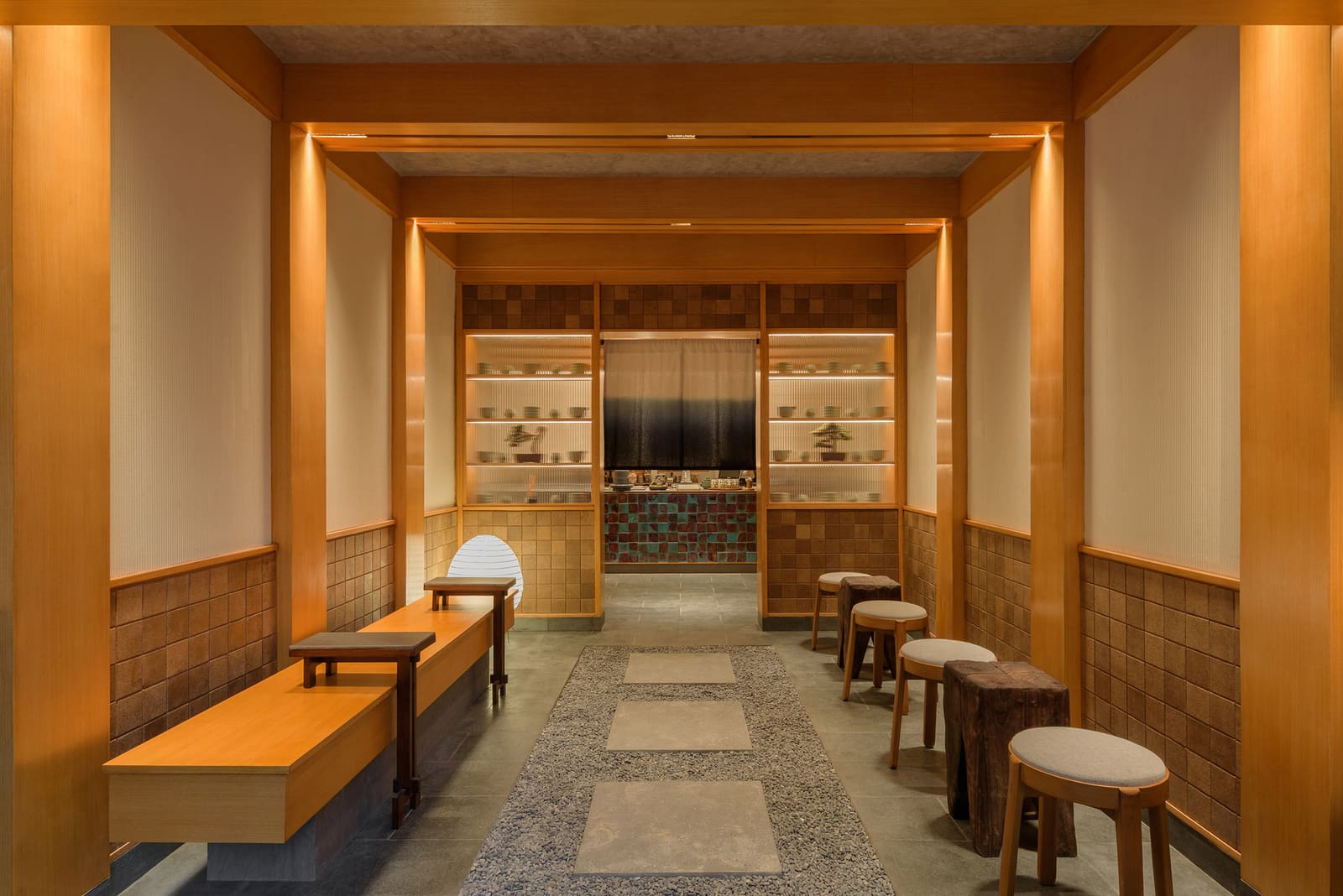
There is something instructive about designing within 33 square meters. The constraint forces clarity, a ruthless prioritization of what matters. At Jun Matcha Club in Jakarta's Panglima Polim neighbourhood, Steven Sundjaja and Kamilah Aisyi of Matter of Something have accepted that challenge, converting a former residential garage into a café that operates less like a coffee bar and more like a meditation on preparation itself.
The neighbourhood context is relevant here. Panglima Polim has become a testing ground for independent food and beverage operators, each vying for attention in a district where density and foot traffic reward novelty. Yet Jun Matcha Club refuses that logic. It slows the visitor down, structuring the interior around the deliberate, almost choreographed act of whisking matcha rather than the transactional speed of espresso service. This is not accidental. The project takes its organizational cues from the ceremonial traditions embedded in matcha culture, values that emphasize attentiveness, sequence, and material honesty.
Material Vocabulary: Craft as Anchor
The palette reads like an inventory of Indonesian artisanship. Banana paper from Greenman Banana Paper Studio wraps surfaces, its fibrous texture visible and tactile. Textiles from Enigma Art Textile introduce pattern without excess, their handwoven quality evident in slight irregularities that machine production would eliminate. Anjati and Pring Studio contribute bamboo and rattan elements, materials long associated with vernacular Indonesian construction but here deployed with precision rather than nostalgia.
What distinguishes this approach is the absence of pastiche. The designers are not recreating a Japanese tea room in tropical translation, nor are they grafting Indonesian motifs onto a minimalist box. Instead, the project operates in a third territory, one where the discipline of Japanese ceremonial space meets the material intelligence of Indonesian craft traditions. The result is neither hybrid nor fusion but something more integrated, a spatial language that feels coherent on its own terms.
Quadra Surface supplied stone finishes that anchor the interior, their cool mass providing thermal and visual counterpoint to the lighter, more pliable materials surrounding them. Venus Tiles contributes flooring that registers wear and use without degradation, a practical consideration in a high-humidity climate where maintenance is not optional. Uci Rock Paint finishes the walls in muted tones that recede rather than announce, allowing the material textures to carry the sensory load.
Sequence and Ritual: Spatial Choreography
The plan organizes movement as a sequence. Entry, pause, order, preparation, consumption. Each phase is spatially articulated, not through walls but through shifts in material, ceiling height, and light quality. The preparation counter becomes the visual and operational focus, positioned so that the act of whisking matcha is visible from most vantage points. This is not performance for its own sake but a deliberate framing of labor, a reminder that what arrives in the cup is the product of technique and time.
Lighting design by Hello Good Nite reinforces this sequencing. Illumination is low and directional, pooling around the preparation area and seating zones while leaving circulation paths in relative shadow. The effect is to create pockets of intimacy within a small footprint, allowing multiple visitors to occupy the space without visual or acoustic crowding. In a city where many cafés prioritize Instagram-ready brightness, this restrained approach feels almost radical.
Seating is minimal, accommodating perhaps a dozen people at capacity. The furniture, sourced from Bell Living Lab and Moonjar Design, is low and deliberately uncomfortable for extended laptop sessions. This is not a coworking space. The design communicates its expectations clearly: visit, drink, reflect, leave. The turnover is slow by commercial standards, but the spatial experience is richer for it.
Precedent and Position
The project invites comparison with other recent interventions that repurpose underutilized urban fragments. We think of Yusuke Seki's Blue Bottle Kyoto, which occupied a machiya townhouse and preserved its spatial rhythm while introducing contemporary service infrastructure. Or the work of Studio Adjective in Bangkok, where shophouse typologies are adapted to house specialty beverage programs without erasing their original character.
Jun Matcha Club operates in this lineage but with a distinctly Indonesian material sensibility. Where Seki worked with aged timber and clay plaster, Matter of Something employs banana paper and woven textiles. Where Studio Adjective navigated Thai spatial conventions around thresholds and courtyards, this project responds to Jakarta's particular urban density and tropical climate. The underlying design intelligence, however, is shared: an understanding that adaptive reuse is not about preservation for its own sake but about recognizing and amplifying the latent qualities of what already exists.
The garage typology itself is worth noting. Across Southeast Asia, garages occupy a peculiar position in the residential fabric, spaces that are neither fully private nor truly public, often used for storage, informal commerce, or occasional socializing. By converting this interstitial zone into a dedicated café, Matter of Something formalizes what was previously liminal, giving architectural definition to a space that typically resists it.
Craft Economy and Design Agency
The choice to work almost exclusively with Indonesian manufacturers and artisans is both aesthetic and economic. Anjati, Pring Studio, Greenman Banana Paper, Enigma Art Textile - these are not multinational suppliers but local workshops whose production methods retain a degree of handwork and regional specificity. Engaging them directly supports a craft economy that global supply chains often bypass, while also yielding material outcomes that industrialized production cannot replicate.
This is not romanticism. The decision to use banana paper, for instance, is as much about texture and sustainability as it is about supporting Greenman's production model. The material performs well in humid conditions, ages gracefully, and carries a tactile presence that synthetic alternatives lack. Similarly, the textiles from Enigma Art Textile introduce visual warmth and acoustic absorption, solving functional problems while contributing to the project's broader material narrative.
At World Archi Design, we have been tracking this shift toward localized supply chains in recent Southeast Asian projects, particularly among younger practices unwilling to default to the standardized material palettes that dominated commercial interior design in the 2010s. The trend is not universal, but it is growing, driven by designers who recognize that material choice is also a form of cultural and economic positioning.
Designing Against the Default
Jun Matcha Club succeeds because it resists the default settings of contemporary café design. It does not maximize seating density. It does not optimize for social media visibility. It does not prioritize turnover or upsell. Instead, it creates conditions for a specific kind of experience, one rooted in ritual, patience, and material attentiveness. The architecture is in service of that experience, not the other way around.
The project is small, and its impact will likely remain localized. But its design logic is exportable. As urban densities increase and commercial rents climb, underutilized residential outbuildings - garages, storage rooms, service annexes - become viable sites for adaptive reuse. The challenge is to approach them not as blank canvases but as spaces with embedded qualities worth amplifying. Matter of Something has demonstrated one way to do that, with discipline, restraint, and a clear sense of what the project is ultimately for.
Save this story. A free account keeps your reading list and the 07:00 email in one place.
CREATE FREE ACCOUNT →SIGN IN