
Dwelling as Dispersed Gesture
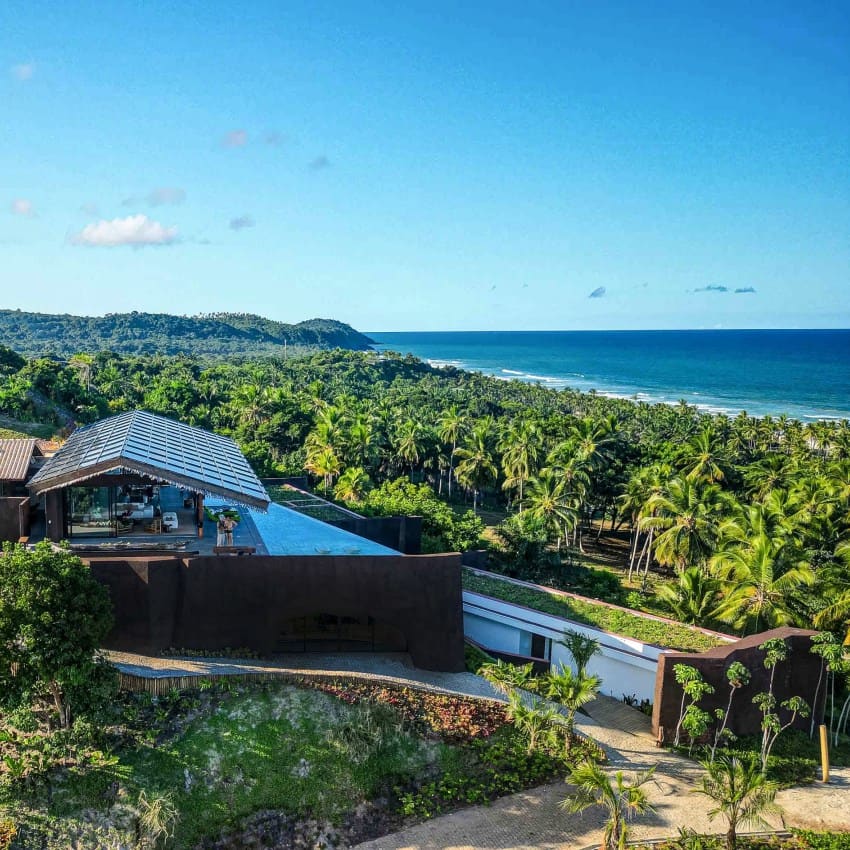
There is a recurring tension in coastal residential design: the impulse to claim a panoramic view versus the wisdom of yielding to terrain. TETRO's approach to Bangalo Txai in Itacaré, Bahia, leans decisively toward the latter. Rather than planting a single monolithic structure atop the hillside, the studio fragments the program into four separate volumes, each calibrated to the gradient and the existing vegetation matrix. The result is less a house than a choreographed sequence of pavilions, each occupying its own contour line while maintaining visual and circulatory links to the others.
Itacaré sits at the confluence of Atlantic surf culture and Atlantic Forest remnants, a landscape where development pressure often overrides ecological logic. Against that backdrop, the decision to distribute the residence across multiple footprints reads as both pragmatic and poetic. By minimizing cut-and-fill operations and preserving canopy cover between structures, TETRO allows the site's natural hydrology and shade patterns to persist. The architecture becomes episodic rather than totalizing.
Topography as Parti
The steep slope facing the ocean dictates massing from the outset. Each of the four volumes steps down the hillside, creating a cascading profile that mirrors the descent toward the water. This is not novelty; it is necessity. On grades this severe, any attempt to impose a horizontal datum would require either massive retaining walls or equally massive excavation. TETRO sidesteps both by working in section, treating elevation change as the primary organizing device.
The interstitial zones between volumes function as both circulation and threshold. Paths thread through preserved vegetation, turning the walk between sleeping quarters and communal spaces into a brief immersion in the Atlantic Forest microclimate. This strategy recalls the pavilion typology explored by architects like Marcio Kogan in his weekend houses, where program is parsed into discrete episodes and landscape becomes the connective tissue. Here, however, the verticality of the site introduces a sequential rhythm absent in flatter precedents.
Material and Enclosure
Details remain sparse in available documentation, but the project's logic suggests a material palette responsive to salt air and humidity. Coastal construction in Bahia typically demands corrosion-resistant fasteners, breathable wall assemblies, and robust waterproofing at horizontal surfaces. Timber framing, when used, must be either naturally durable species or chemically treated; otherwise, the combination of marine exposure and tropical heat accelerates decay.
The fenestration strategy appears calibrated to balance view access with thermal comfort. Large openings facing the Atlantic capture prevailing breezes, while smaller apertures on other elevations limit solar gain and maintain privacy between volumes. This kind of passive ventilation is not optional in a climate where air conditioning can dominate energy loads. By orienting the structures to harness cross-ventilation, TETRO reduces mechanical dependence and aligns the building's operation with its environmental context.
Precedent and Context
Bangalo Txai sits within a broader lineage of Brazilian coastal modernism, from Vilanova Artigas's uncompromising concrete frames to the lighter-touch interventions of contemporary practices like Bernardes Arquitetura. What distinguishes TETRO's project is the refusal to monumentalize. There is no single iconic gesture, no signature cantilever or dramatic overhang. Instead, the architecture operates through accumulation: four modest volumes that, together, form a coherent domestic landscape.
This restraint is notable in a region where luxury residential work often trends toward spectacle. The fragmented parti also mitigates visual impact from the ocean, reducing the perceived mass of the intervention when viewed from below. In an era of increasing scrutiny around coastal development and environmental footprint, such decisions carry weight beyond aesthetics.
Dwelling in Sequence
Living in a multi-pavilion residence demands a different choreography than conventional single-volume domesticity. Weather becomes a factor in daily movement; rain or wind can transform the walk between kitchen and bedroom into a negotiation with the elements. This can be read as inconvenience or as intentional exposure, depending on one's priorities. For occupants seeking immersion in the coastal environment, the lack of climate-controlled corridors is a feature, not a flaw.
The separation of functions also permits zoning strategies that enhance privacy and flexibility. Guests can occupy one volume without intruding on the daily rhythms of the main household. Work spaces can be isolated from sleeping quarters. The house becomes less a container and more a campus, with each pavilion serving a distinct role within the domestic program.
The View from Below
From the Atlantic, the four volumes register as a series of horizontal planes nestled into the hillside, interspersed with vegetation. This vertical layering contrasts with the typical coastal villa, which often presents a singular facade to the water. By distributing the mass, TETRO reduces the visual dominance of the built form and maintains a sense of the site's pre-existing topographic character.
This approach also has implications for site drainage and erosion control. Preserving vegetation between structures stabilizes soil and reduces runoff velocity, mitigating the risk of slope failure during heavy rains. In a warming climate where extreme precipitation events are becoming more frequent along the Brazilian coast, such design decisions carry long-term resilience value.
A Calibrated Dispersal
Bangalo Txai demonstrates that fragmentation can be a form of integration. By breaking the program into discrete episodes and threading them through the existing landscape, TETRO achieves a kind of architectural humility that is rare in high-end residential work. The project does not announce itself; it unfolds. And in doing so, it offers a model for coastal building that prioritizes terrain over tableau, sequence over spectacle, and coexistence over conquest.
Save this story. A free account keeps your reading list and the 07:00 email in one place.
CREATE FREE ACCOUNT →SIGN IN