When Botany Meets Craft
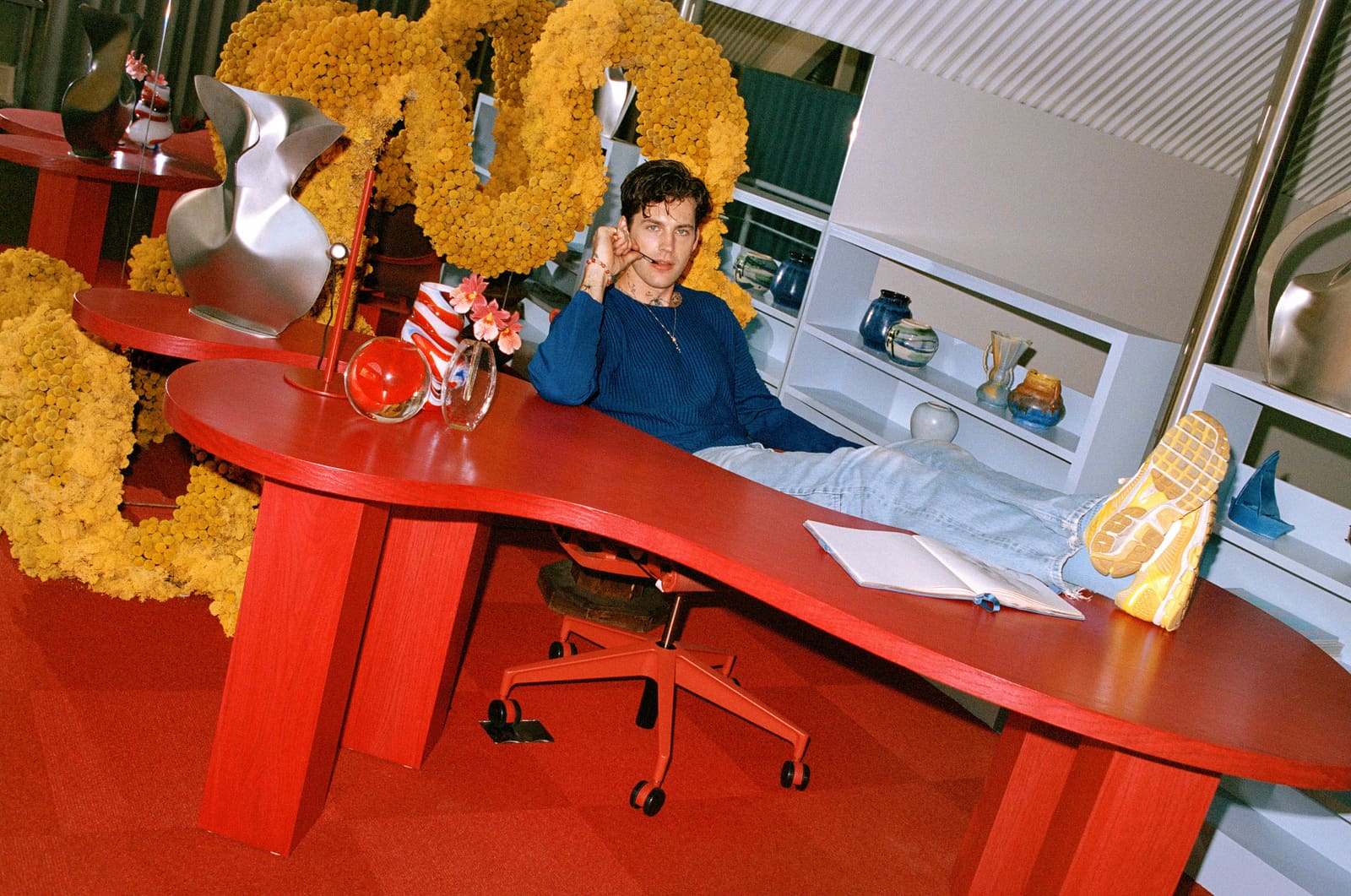
There is something peculiar about a space that calls itself a laboratory but deals primarily in beauty. Hamish Powell's new Camden studio, tucked beneath a railway arch that once carried commuters across North London, occupies precisely this territory. He calls it "the Vessel," a name that hints at both container and journey, and the moniker feels earned. Stainless-steel work surfaces catch the light like surgical equipment; crimson carpet grounds the space in something warmer. An amoeba-shaped desk, sketched hastily on a Post-it note and brought to life by a local carpenter, anchors one corner. It is the kind of environment where one might culture cells or arrange stems, and in Powell's hands, the distinction matters less than you might think.
Powell did not set out to become a florist. He studied plant science at The University of Manchester, aiming for a career in biotech before a part-time position at a flower shop redirected his trajectory. The shift was not a rejection of science but a reorientation toward its aesthetic dimensions. "People often separate beauty and science," he explains, "but I'm swimming in that blurred line where the two meet." That line runs through everything he makes.
The Architecture of Ephemerality
The studio itself, designed in collaboration with Maximillian Worrell, reflects Powell's hybrid thinking. Railway arches have long been a staple of adaptive reuse in London, their vaulted brick ceilings and industrial bones offering ready-made drama. But Powell and Worrell have resisted the temptation to soften the space too much. The steel tables remain clinical; the mezzanine level features a salvaged sofa from a shuttered East London gay bar, its stainless-steel frame a relic of another kind of gathering place. Palet tiles line the kitchenette backsplash, their geometric repetition a quiet nod to pattern and order.
What matters here is not comfort but function. Powell's work demands space for large-scale installations, room to hang and drape and suspend. The arch's height accommodates this verticality; its footprint allows for the sprawl of materials. On any given day, you might find hundreds of stems awaiting arrangement, foraged weeds piled in corners, or sculptural forms mid-construction. The studio is less a showroom than a working laboratory, a place where hypotheses about form and material are tested in real time.
Invasive Species as Medium
Powell's material palette skews unconventional. For a recent piece, he gathered more than four hundred stems of Rumex crispus, commonly known as curly dock, an invasive weed that colonizes roadsides and disturbed ground across the UK. "I love rumex because it's a really invasive weed," he notes, "so cutting it and using it in my art feels like a full-circle narrative change." The gesture is more than poetic; it is ecological. By harvesting what most would eradicate, Powell reframes waste as resource, nuisance as opportunity.
This approach extends to other commissions. For a Loewe project, he constructed towering mounds of tomatoes, their glossy skins catching light like blown glass. The leftover fruit became weeks' worth of pasta sauce. Grapes, too, have appeared in human-scale sculptures, their clustered forms suggesting both abundance and decay. Amaranthus, with its cascading tassels, drips like molten wax in his hands. Each material is chosen not only for its visual properties but for what it communicates about temporality, origin, and transformation.
The Science of Unfolding
Powell's plant science background surfaces in unexpected ways. When tasked with creating an elaborate installation for Victoria Beckham using peonies that had not yet opened, he recalled a detail from his university studies: ants often feed on the nectar that seals peony buds, protecting them in their early stages. If he could disrupt that sticky sap, the petals might release. The solution he arrived at was decidedly low-tech. "You whack them on the edge of the table," he says. "It's so brutal!" The method worked. The blossoms unfurled into cloudlike forms, soft and voluminous, their forced bloom a testament to understanding plant physiology at a cellular level.
This kind of problem-solving defines Powell's practice. He does not rely on floral foam, the ubiquitous green blocks that underpin most commercial arrangements. Instead, he constructs skeletal armatures from welded steel and chicken wire, shaping them first in sketch form before translating them into three dimensions. The approach is sculptural, closer to the methods of artists like Ruth Asawa or Harry Bertoia than to traditional floristry. It also demands a deeper knowledge of how stems behave, how weight distributes, how water moves through plant tissue.
A Career Sealed by a DM
Powell founded his practice in 2022, but his trajectory accelerated sharply the following summer when he received a direct message asking if he would create locally sourced arrangements for a wedding. The client was Charli xcx. The brief was simple: white blooms to complement a Vivienne Westwood gown. The resulting bouquet, restrained and elegant, circulated widely after the ceremony. Powell's name entered a different orbit.
What followed were commissions from brands and individuals drawn to his sculptural sensibility and material intelligence. His installations do not merely decorate; they occupy space, assert presence, provoke questions. A recent work using yellow craspedia, those spherical blooms that look like miniature suns, undulated across a gallery wall. Another piece layered potted plants into a dense, Edenic mass, blurring the line between horticulture and installation art.
Vessels Within Vessels
Powell has begun exploring ceramics, a medium that shares both history and function with his primary practice. "Vases and flowers are so tied together throughout history," he observes. The shift toward clay represents a move from the ephemeral to the enduring, from arrangements that wilt within days to objects that persist. Yet even here, his thinking remains rooted in the life cycles of plants. Clay, after all, is soil transformed by fire, the very substrate in which roots take hold.
The studio's nickname, "the Vessel," takes on additional resonance in this context. It is a container for Powell's work, yes, but also a site of transformation, where raw materials become something else entirely. The railway arch, once a conduit for movement, now holds stillness and growth. The stainless steel, the crimson carpet, the amoeba desk, all frame a practice that refuses to settle into easy categories.
The Humility of Cut Stems
Powell speaks often of humility, of yielding to what a flower requires. Large installations demand hidden water sources, careful hydration strategies, constant monitoring. "You really have to give in to what a flower needs," he says. This is not the language of control but of collaboration, of recognizing that living materials have agency. A stem will wilt if mistreated, a bud will refuse to open if forced. The florist's task is to create conditions for beauty, not to impose it.
This philosophy extends to his sourcing. Powell favors local and foraged materials, reducing the carbon footprint of long-haul imports while engaging directly with the ecology of his region. Invasive species become raw material; overripe produce finds sculptural purpose. It is a practice grounded in place, responsive to season and availability. In an industry often criticized for waste and environmental impact, Powell's approach offers a different model, one that treats flowers not as commodities but as collaborators.
At World Archi Design, we have long argued that the most compelling spatial practices blur disciplinary boundaries. Powell's work exemplifies this conviction. He is neither purely florist nor purely sculptor, neither scientist nor artist in the conventional sense. He is all of these, operating in the interstitial zones where categories dissolve. The Vessel, with its industrial bones and botanical inhabitants, stands as both studio and manifesto, a space where beauty and rigor coexist without contradiction.
Save this story. A free account keeps your reading list and the 07:00 email in one place.
CREATE FREE ACCOUNT →SIGN IN