
A Design Ethos Rooted in Refusal
There is something quietly radical about refusing the straight line. In a discipline governed by grids, right angles, and the pragmatic economies of rectilinear construction, the decision to work entirely in curves is both aesthetic and ideological. Wild Form Design Studio, led by Shigefumi Kabashima and Elias Popa, has made this refusal the organizing principle of Love Thy Neighbor, an all-day bar and dining space that opened in New York's West Village in late June 2026. The timing is deliberate: the venue sits adjacent to The Stonewall Inn, the site of the 1969 uprisings that catalyzed the modern LGBTQ+ rights movement, and it opened just ahead of the city's Pride celebrations.
The project is, at its core, an exercise in spatial empathy. Across the interiors we have covered in recent years, few articulate their social ambitions as clearly through form. Here, the absence of straight lines is not a stylistic flourish but a tectonic argument: that hospitality, like identity, resists containment within rigid boundaries.
Materiality and Memory
Descending into the below-grade space, visitors encounter a concrete threshold panel inscribed with a quotation from Marsha P. Johnson, the transgender activist and Stonewall veteran whose life and advocacy remain touchstones for the movement. The text, rendered in gold leaf, reads "No pride for some of us without liberation for all of us," followed by her signature. The choice to embed this message at the entry, rather than in a more ceremonial location, signals that the design seeks to integrate history into daily ritual, not to enshrine it at a remove.
Further inside, a single brick from the original Stonewall Inn rests in a carved niche at the end of the bar. The brick, a fragment of the building's fabric, also references the projectiles hurled at police during the June 1969 raid. It is a small gesture, but one that collapses decades: the object is both relic and symbol, a reminder of resistance made tangible.
These elements function as what the studio calls "understated reminders of the past." In architectural terms, they are acts of adaptive reuse applied not to a building envelope but to cultural memory. The design does not reconstruct history; it reframes it within a contemporary spatial language.
The Sculpted Interior
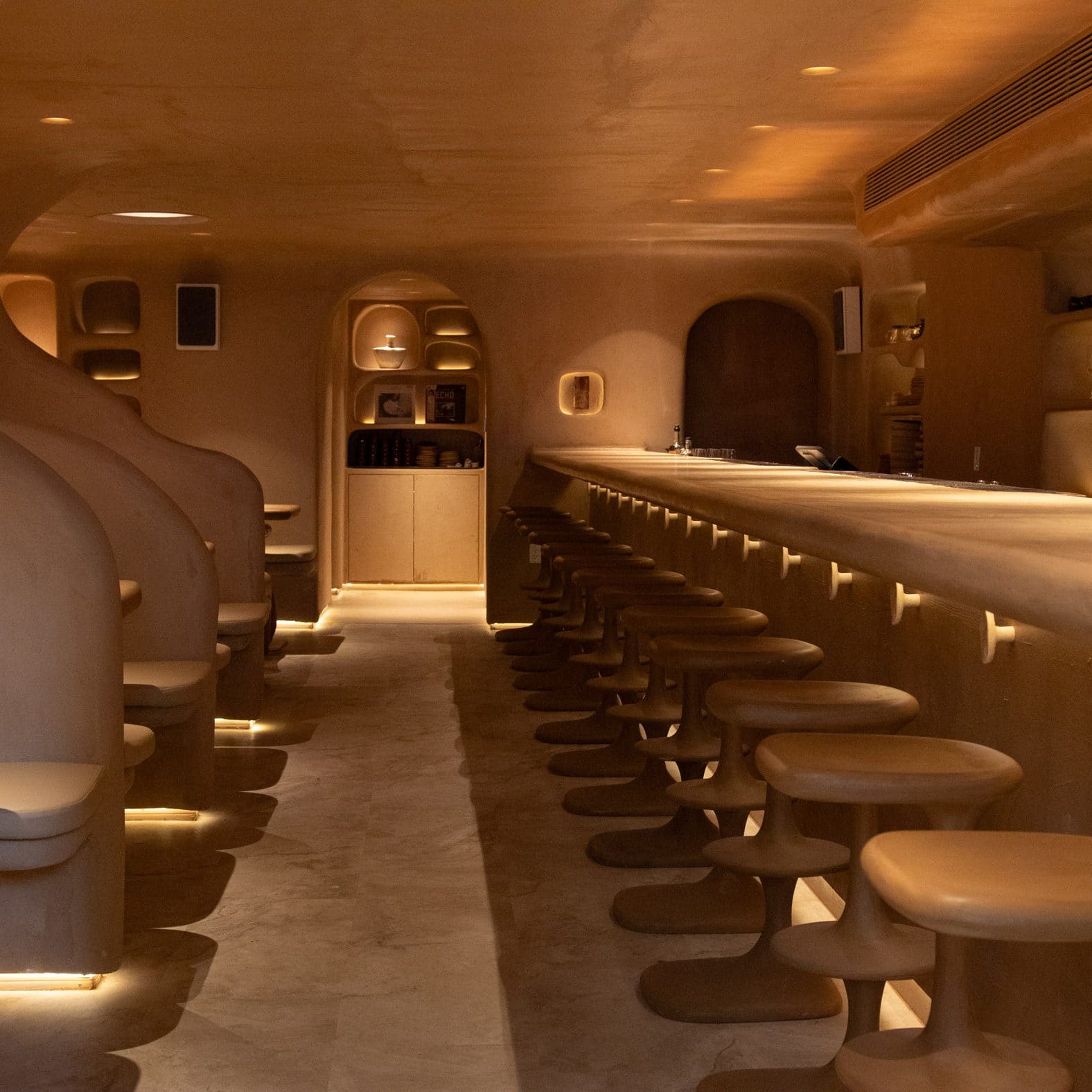
Love Thy Neighbor accommodates forty guests within a series of undulating walls and partitions that create a cavern-like intimacy. The surfaces, finished in warm beige plaster, flow continuously from banquettes on the left to the bar counter on the right. The curvature is not arbitrary: each wall and partition divides space while maintaining visual and acoustic continuity, a balance that requires careful control of massing and material thickness.
Behind the bar, shelving units follow the same fluid geometry, slanting and dipping to display bottles and glassware. The shelves are backlit, casting a soft glow that accentuates the irregular profiles. This approach to display, common in boutique retail but less so in hospitality, treats the bar itself as a sculptural element rather than a functional backdrop.
Lighting is deployed with precision. Spotlights are focused on the bar counter and individual dining tables, creating pools of illumination that draw attention to food and drink. Cove lighting traces the perimeter where walls meet ceiling, emphasizing the contoured edges and reinforcing the sense that the space has been carved rather than constructed. The effect is intimate without being claustrophobic, a quality that depends as much on the interplay of light and shadow as on the physical enclosure.
A Vocabulary of Fluidity
The design language extends into the rear bathroom, where a recessed mirror appears carved from thick plaster walls. The vanity, with its rough-textured edge, supports a long, contoured basin. Faucets, finished in bronze, are suspended from the ceiling, a detail that emphasizes verticality and detaches the functional elements from the horizontal plane. The result is a space that feels both grounded and weightless, a paradox that is characteristic of Wild Form's approach.
Kabashima has described the guiding principle as one that reflects "not only the design of the space, but also how we think about hospitality: fluid, open, and without boundaries." This rhetorical alignment of form and ethos is not new in architecture. What distinguishes the project is the rigor with which the studio has pursued it. Every detail, from the contour of a banquette to the profile of a shelf, reinforces the central argument.
The choice to avoid orthogonal geometry also has precedents. Alvar Aalto's undulating ceilings and walls in the Viipuri Library, completed in 1935, employed curves to modulate acoustics and light. More recently, studios such as Snøhetta and Heatherwick Studio have explored biomorphic forms as a way to humanize institutional and commercial interiors. What sets Love Thy Neighbor apart is the explicitness of its social agenda: the curves are not simply ergonomic or acoustic interventions but visual metaphors for queerness and individuality.
Culinary and Craft Precision
The bar program draws on Japanese bartending techniques, including clarification, infusion, and carbonation, to produce ingredients such as wasabi gin and house-made cola. Drinks are served in delicate glassware, a nod to the precision that characterizes Japanese hospitality. The food menu, similarly, emphasizes Asian-influenced bar snacks and shareable plates, presented on hand-crafted ceramics that echo the textured materiality of the interior.
This attention to craft extends the spatial narrative. Just as the architecture resists industrial modularity, the food and beverage program prioritizes artisanal production and presentation. The consistency is intentional: Popa has stated that the goal is for guests to "feel a sense of freedom here, both in how they experience the space and how they connect with others."
Context and Continuity
The project arrives at a moment when queer spaces face mounting pressure from gentrification, rising rents, and shifting social patterns. In many cities, bars and clubs that have served as anchors for LGBTQ+ communities are closing, their sites redeveloped for residential or commercial uses that offer higher returns. The challenge is not merely economic but cultural: these venues provide not only gathering places but also spatial expressions of identity and solidarity.
Love Thy Neighbor, by situating itself next to The Stonewall Inn and explicitly invoking the history of that site, positions itself within this lineage. The design does not replicate the aesthetics of mid-century gay bars, nor does it attempt a nostalgic reconstruction. Instead, it proposes a contemporary spatial language that honors the past while articulating a vision for the future.
The studio's emphasis on "chosen family" and "the joys of gathering and belonging" also speaks to broader shifts in how hospitality spaces are conceived. In an era when third places are increasingly scarce, the design of communal interiors carries social as well as aesthetic weight. At World Archi Design, we have been tracking this convergence: the recognition that architecture can, and perhaps must, do more than accommodate function or express brand identity.
A Space Without Boundaries
What remains to be seen is whether the spatial language developed here can be adapted to other contexts or scaled to larger programs. The intimacy of Love Thy Neighbor depends in part on its modest size and below-grade location, both of which limit the applicability of the design strategies. Yet the underlying principle, that form can embody values of openness and fluidity, is one with broader resonance.
The refusal of the straight line is, in the end, a refusal of a certain kind of order: one that privileges efficiency, standardization, and control. In its place, Wild Form Design Studio offers a vision of architecture as responsive, expressive, and fundamentally human. Whether that vision can be sustained beyond a single project, in a market that rewards predictability and cost control, is an open question. For now, Love Thy Neighbor stands as a compelling argument that design, at its best, is an act of imagination and care.
Love Thy Neighbor / Wild Form Design Studio, West Village, New York, 2026
Photo: Aichan Mama
Save this story. A free account keeps your reading list and the 07:00 email in one place.
CREATE FREE ACCOUNT →SIGN IN