
The Spatial Question Behind the Brief
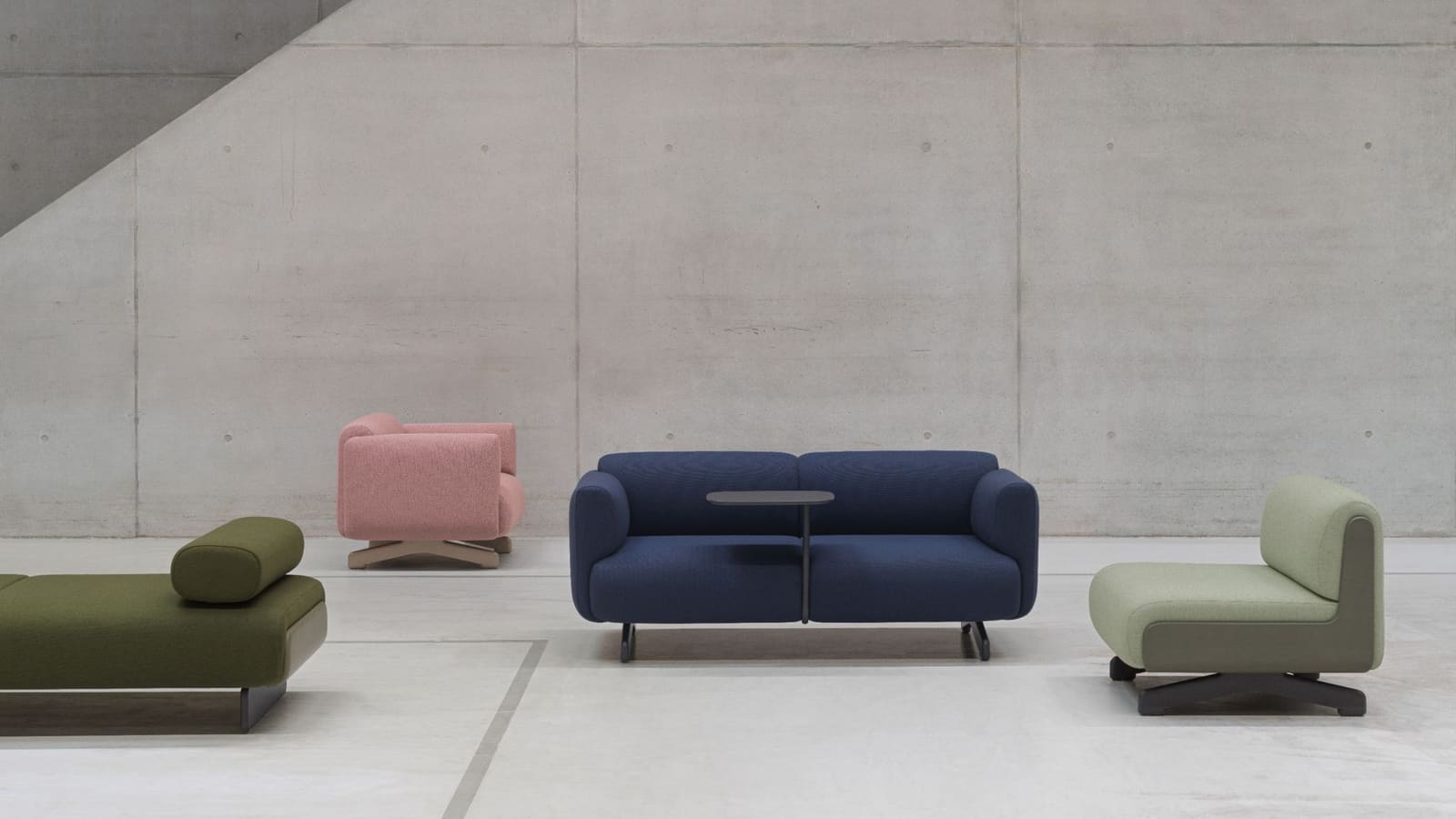
Can a chair influence how two people talk to each other? It sounds abstract, yet this question sits at the heart of Session, a 23-piece furniture system developed by London-based Doshi Levien for Brunner Group. Rather than treating workplace seating as isolated objects, the studio approached the brief as an exercise in spatial choreography: how might modular elements, arranged and rearranged, create pockets of intimacy or openness within an undifferentiated floor plan?
The collection reflects a broader shift in office design. Workplaces no longer orbit the desk. Instead, they have become hybrid environments where employees move between focused work, informal conversation, and downtime. Furniture must accommodate this fluidity without resorting to the visual clutter of mismatched pieces. Session addresses this by offering a kit of parts, each designed to stand alone or combine with others, forming larger configurations that subtly define zones without erecting physical barriers.
Material Strategy and the Logic of Repair
Doshi Levien structured Session around a principle of disassembly. Each component can be separated, its fabric cover removed for cleaning or replacement, and damaged parts swapped out without discarding the entire piece. This approach aligns with circular design thinking but also responds to practical realities: office furniture endures heavy use, and the ability to repair extends product life while reducing waste.
The studio worked closely with Brunner's upholstery specialists, known for their technical precision in shaping foam and fabric. The challenge lay in balancing soft, tactile surfaces with the structural rigidity required for commercial settings. Brunner, a family-owned German manufacturer established in 1977, has built its reputation on marrying craft traditions with engineering. For Session, this meant developing upholstery that feels domestic in comfort yet meets the performance standards of contract furniture, including fire safety regulations and durability benchmarks.
Improvisation as Design Vocabulary
The name Session evokes the unscripted energy of a jazz ensemble or an impromptu meeting. Doshi Levien translated this idea into formal language through the collection's modular grammar. Armchairs, sofas, curved segments, ottomans, and daybeds can be composed into countless arrangements. A curved element might wrap around an ottoman to create a semi-enclosed nook; a daybed paired with an L-shaped section could form a casual meeting point.
This flexibility operates at multiple scales. A single armchair functions independently in a small office. A cluster of six or eight pieces begins to articulate spatial boundaries, carving out sub-zones within an open-plan interior. The furniture does not impose a fixed layout but instead offers a vocabulary for occupants to configure space according to shifting needs, whether for collaboration, concentration, or rest.
The L-Shape as Architectural Anchor
Among the collection's elements, the L-shaped sections play a dual role. Functionally, they provide structural stability and anchor larger configurations. Visually, they introduce a graphic counterpoint to the collection's softer, upholstered components. Doshi Levien exploited this contrast by specifying different materials for the L-shaped pieces: wood, leather, and textile appear within the same unit, creating textural variation and visual rhythm.
These sections also support integrated accessories. Swivelling writing tables and side surfaces attach to the L-shaped frames, transforming seating into workstations. This hybrid typology reflects the blurred boundaries of contemporary office activity. A person might perch on a sofa with a laptop, pivot to face a colleague for discussion, then recline for a phone call, all without changing furniture. Session accommodates this sequence through incremental adjustments rather than discrete furniture types.
Upholstery Meets Engineering
Brunner's manufacturing expertise proved central to realising the collection. The company's German facilities combine hand-upholstery techniques with CNC machining and injection moulding. For Session, this meant prototyping foam profiles that maintain their shape under prolonged use while still offering the give of residential seating. The studio tested multiple foam densities and spring systems before arriving at a specification that met both comfort and longevity criteria.
The fabric specification also required careful calibration. Office environments demand abrasion-resistant textiles that withstand daily wear, yet Doshi Levien wanted to avoid the stiff, synthetic feel common in contract furniture. The solution involved selecting high-performance weaves with a softer hand, then engineering the upholstery construction to allow easy removal. Covers fasten via concealed zippers and clips, enabling facilities teams to refresh individual pieces without specialist tools or labour.
Degrees of Enclosure
One of Session's more subtle achievements lies in how it modulates privacy. Open-plan offices often suffer from a lack of acoustic and visual refuge. Employees crave spaces where they can retreat without leaving the floor entirely. Session addresses this through gradient rather than partition. A single sofa offers minimal enclosure. Combine it with a curved element and an ottoman, and you create a three-sided boundary that signals semi-privacy without requiring walls or screens.
The collection's proportions reinforce this effect. Seat backs rise high enough to provide a sense of enclosure when viewed from behind, yet remain low enough to preserve sightlines across the room. This balance allows managers to maintain visual oversight while giving employees the psychological comfort of defined personal space. The furniture thus operates as a mediator between competing demands: openness versus intimacy, collaboration versus focus.
Material Palette and Sensory Coherence
Doshi Levien specified a restrained material palette to ensure coherence across configurations. Upholstery fabrics range from neutral greys and beiges to deeper blues and greens, avoiding the bright accent colours that date quickly. Timber elements appear in oak and walnut, their grain left visible to contrast with the uniformity of textile surfaces. Leather, used sparingly on armrests and L-shaped sections, introduces a third texture that ages gracefully.
This material strategy reflects the studio's broader design philosophy. Doshi Levien often works at the intersection of craft and industrial production, drawing on cultural references from India and Europe while avoiding overt ornament. For Session, they applied this sensibility to create furniture that feels familiar yet refined, suitable for both corporate headquarters and creative studios. The collection does not announce itself through novelty but through careful attention to proportion, detail, and tactile quality.
Workplace Futures and the Role of Furniture
Session arrives at a moment when office design is under scrutiny. The pandemic accelerated remote work, prompting companies to rethink the value of physical workplaces. Those that remain have shifted focus from individual workstations to shared amenities: lounges, cafes, meeting areas. Furniture must now support a wider range of activities than the traditional desk-and-chair pairing.
Doshi Levien's response avoids prescriptive solutions. Rather than dictating how people should use the furniture, Session provides a flexible framework. An organisation might deploy the collection as informal meeting spaces, while another uses it to create quiet zones for phone calls. The same pieces serve both purposes, their meaning shaped by context and arrangement. This adaptability reflects a maturation in workplace design, moving away from one-size-fits-all solutions toward systems that accommodate diverse work styles and cultural norms.
At World Archi Design, we have observed this trend across multiple sectors. Furniture is increasingly understood not as static inventory but as a spatial tool, capable of influencing behaviour, mood, and interaction. Doshi Levien's work with Brunner exemplifies this shift, treating seating as an architectural element in its own right, one that can define, divide, and connect space without resorting to permanent construction.
Save this story. A free account keeps your reading list and the 07:00 email in one place.
CREATE FREE ACCOUNT →SIGN IN