
A Question of Translation, Not Replication
When an architecture studio sets out to design a restaurant rooted in a specific culinary tradition, the easiest path is literal reproduction: whitewashed walls for Greece, lattice screens for the Middle East, exposed brick for Italy. Red Deer's approach to Zylia, a Greek Cypriot eatery occupying a former Victorian blacking factory in Covent Garden, sidesteps that trap entirely. The project operates instead as a study in material translation, where objects and surfaces from one context are deliberately placed into tension with another.
The brief demanded a connection to Cyprus, but the site itself - a nineteenth-century industrial shell with all the weight and grit that implies - refused to be dressed up as something Mediterranean. Rather than fight that condition, founding director Lionel Real de Azúa leaned into it. The result is an interior where honey-toned limestone slabs rest against stainless steel, where delicate embroidery softens industrial precision, and where oversized woven pendants hover above diners like abstracted memory objects. It's a space that acknowledges two geographies at once, without collapsing into either.
Stone as Anchor
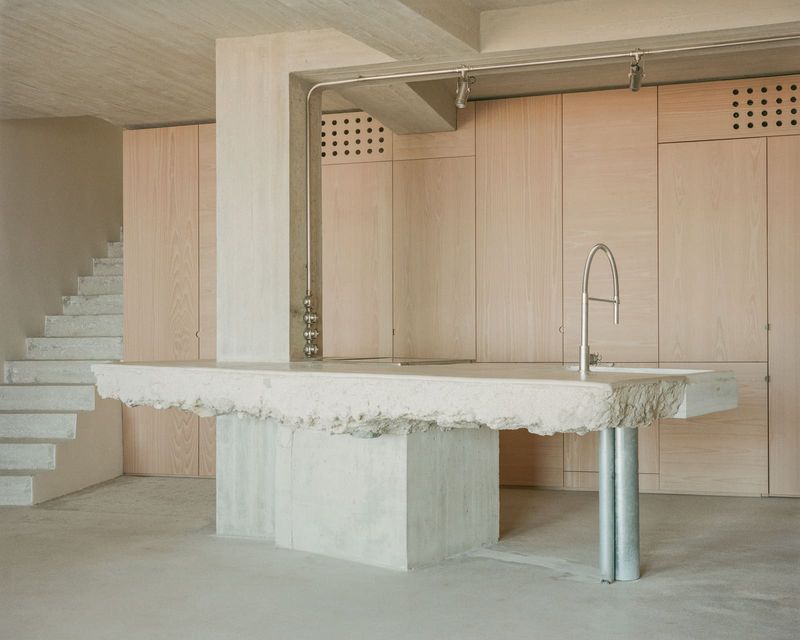
At the heart of the material palette sits Gerolakkos stone, known locally in Cyprus as pouropetra. This warm, ochre-hued limestone has been quarried across the island for centuries, appearing in everything from civic monuments to vernacular garden walls. Red Deer specified slabs for the main service counter and waiter stations, shipped directly from Cypriot quarries and arriving just days before the restaurant's completion.
The choice was both pragmatic and symbolic. Gerolakkos carries a tactile warmth that softens the harder edges of the existing factory architecture, but it also functions as a kind of material anchor, grounding the space in a specific geological and cultural context. Unlike marble or terrazzo, which have become near-universal signifiers of upscale dining, this limestone retains a regional specificity. It's not trying to be cosmopolitan; it's unapologetically Cypriot.
What makes the deployment effective, though, is Red Deer's refusal to let the stone dominate. Instead of cladding entire walls or creating monolithic surfaces, the studio used it selectively, allowing the limestone to coexist with - and be challenged by - other materials. The slabs read less as decorative veneer and more as deliberate insertions, objects placed into conversation with their surroundings.
Industrial Counterpoint
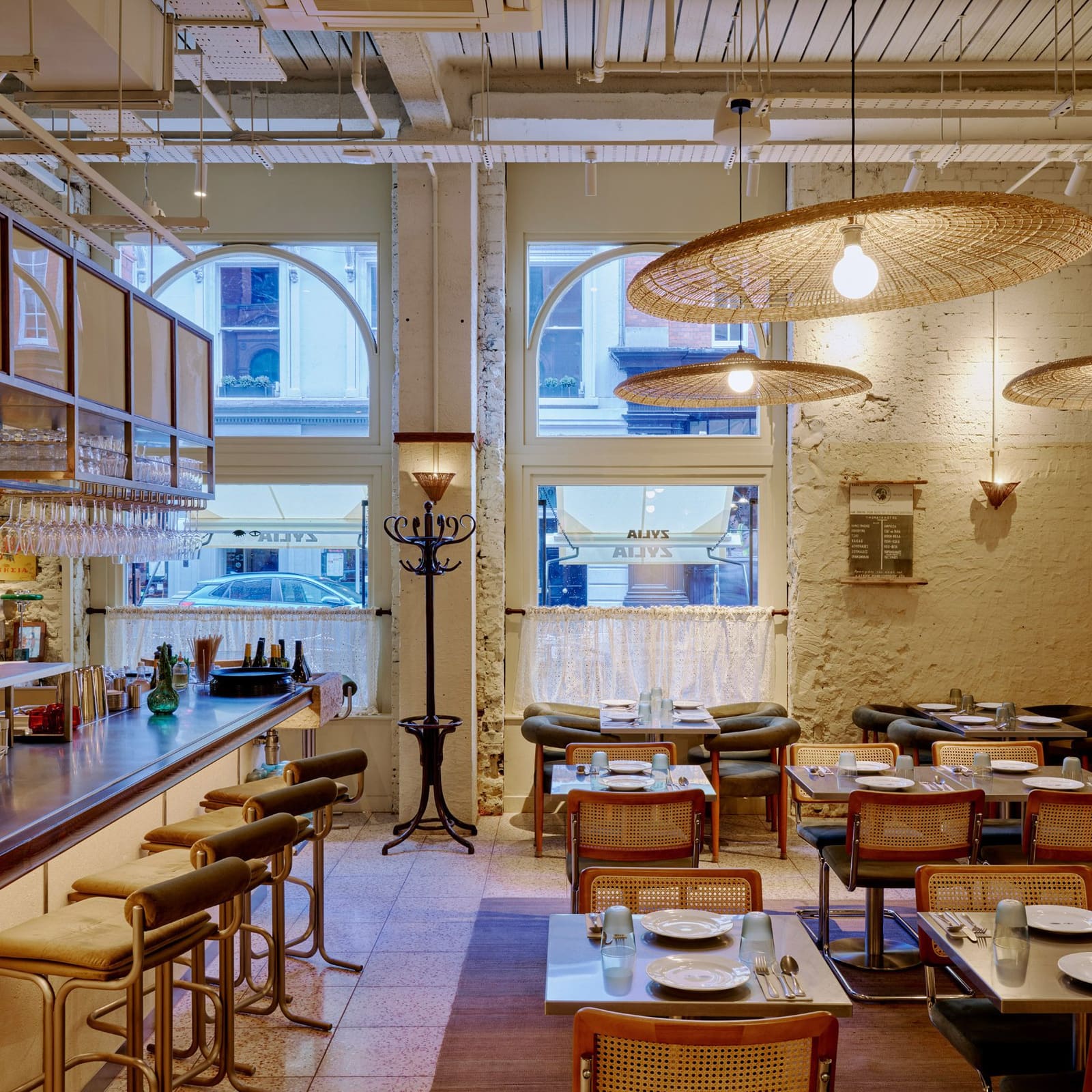
Against the warmth of Gerolakkos, Red Deer introduced stainless steel across tabletops and chair legs. The contrast is stark: cold versus warm, reflective versus matte, industrial versus geological. But the juxtaposition avoids feeling arbitrary. Both materials share a certain honesty of expression - they don't pretend to be something they're not - and both carry associations with labor, craft, and utility.
The stainless steel also serves a functional role, offering durability in a high-traffic dining environment. But more importantly, it reinforces the project's central thesis: that Cypriot materiality and London's industrial heritage can occupy the same space without one erasing the other. The steel doesn't apologize for being modern or hard-edged, and the limestone doesn't retreat into nostalgia. The tension between them becomes the point.
This kind of material dialogue has precedent in adaptive reuse projects where designers resist the urge to sanitize or homogenize. We've seen similar strategies in studios like Caruso St John's work on the Nottingham Contemporary, where new insertions acknowledge - rather than mask - the existing fabric. At Zylia, the approach operates at a smaller scale but with equal intentionality.
Craft as Intervention
Beyond the primary materials, Red Deer wove in elements of Cypriot handcraft, most notably traditional Lefkara lace. This embroidery, historically produced in the mountain villages of Cyprus, is characterized by intricate geometric patterns and a labor-intensive production process. At Zylia, pieces of this lace rest atop the stainless-steel surfaces, introducing what Real de Azúa describes as "an unexpected domestic intervention."
The gesture is subtle but significant. Lace, with its associations of domesticity, intimacy, and slowness, acts as a foil to the precision and speed implied by industrial materials. It's a reminder that restaurants, despite their commercial function, are fundamentally domestic spaces - places where people gather, share food, and linger. The lace doesn't try to soften the steel so much as it questions it, inserting a different temporality and scale of making into the composition.
This layering of craft within industrial contexts echoes strategies employed by designers like Ilse Crawford, whose work often integrates textiles and handmade objects to humanize otherwise austere interiors. At Zylia, the effect is less about coziness and more about creating moments of material surprise, where the hand and the machine coexist without one overwhelming the other.
Lighting as Architectural Presence
Perhaps the most visually arresting element of the interior is the series of oversized woven pendant lights that hang above the central dining area. These fixtures, developed in collaboration with Atelier Lighting, reference traditional Cypriot baskets but depart from direct imitation. Instead of reproducing the forms at scale, Red Deer enlarged and abstracted them, transforming everyday objects into architectural statements.
The pendants achieve a dual effect: they establish spatial definition within the open dining room, creating zones of intimacy beneath their woven canopies, while also retaining the tactile, handmade quality of their source material. Their scale is generous enough to command attention, yet their construction - intricate, light-filtering, almost porous - prevents them from feeling heavy or imposing.
This approach to lighting design reflects a broader trend in contemporary interiors, where fixtures are treated not merely as functional necessities but as opportunities for material exploration. Studios like Lindsey Adelman and Bec Brittain have built entire practices around this idea, crafting luminaires that blur the line between object and architecture. At Zylia, the woven shades perform a similar role, bridging the gap between craft tradition and spatial intervention.
Colour as Memory
The colour palette at Zylia draws on the muted greens and sun-faded ochres found across Nicosia, particularly the weathered timber shutters that line residential streets. These hues - neither bright nor fashionable - carry a sense of time and wear. Red Deer applied them to upholstery and cushions throughout the space, allowing the colours to work in concert with the natural tones of the Gerolakkos stone.
The decision to reference sun-worn surfaces rather than vibrant Mediterranean clichés is telling. It suggests a design sensibility more interested in patina and lived experience than in postcard imagery. The colours feel earned rather than applied, as if they've aged into the space rather than been freshly installed. This approach aligns with a growing interest in materiality that acknowledges time, use, and imperfection - qualities often scrubbed out of commercial interiors in favour of pristine, Instagram-ready finishes.
Dialogue Over Imitation
What makes Zylia compelling as a design project is its commitment to dialogue over imitation. Red Deer could have pursued a more literal evocation of Cypriot vernacular - whitewashed walls, rough-hewn timber, clay tile - but chose instead to engage with the existing architecture on its own terms. The Victorian factory remains legible, its industrial bones intact, while Cypriot materials and craft traditions are introduced as deliberate counterpoints.
This strategy requires confidence. It means accepting that the space will never feel fully "Cypriot" or fully "industrial," but rather something in between, something hybrid. It also requires restraint, knowing when to stop adding, when to let materials speak for themselves. At Zylia, that restraint is evident in the sparing use of Gerolakkos stone, the carefully placed lace, the singular gesture of the woven pendants.
The project joins a lineage of hospitality interiors that resist easy categorization, spaces that draw on specific cultural references without collapsing into theme-park literalism. It's a reminder that the most compelling design work often emerges not from consensus or harmony, but from productive tension - between old and new, local and imported, craft and industry. At Zylia, those tensions remain unresolved, and the space is stronger for it.
Save this story. A free account keeps your reading list and the 07:00 email in one place.
CREATE FREE ACCOUNT →SIGN IN