
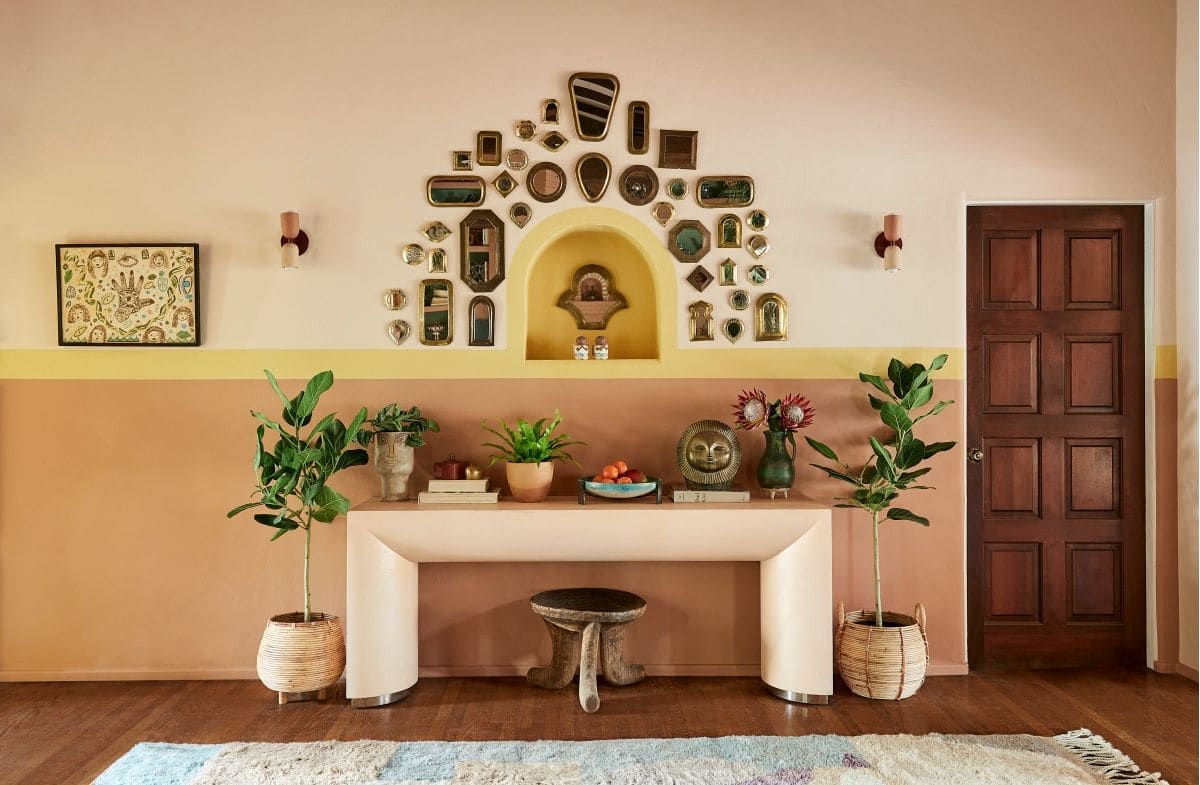
The Threshold as Canvas
Walk into almost any residential project featured in recent design discourse and you will find a console table stationed at the entry, performing a role that extends far beyond storage. These horizontal planes occupy a unique position in the vocabulary of interior architecture: too functional to be pure sculpture, too deliberate to be merely utilitarian. They anchor the vestibule, that liminal zone where exterior meets interior, guest meets host, and public presentation meets private life.
At World Archi Design, we have been tracking how architects and furniture designers approach this typology, not as a decorative afterthought but as a spatial gesture in miniature. The best examples compress decisions about massing, material, and structure into a piece that measures roughly thirty inches tall, fifty inches wide, and fourteen inches deep. What emerges is a surprising laboratory for testing ideas about weight, proportion, and the relationship between form and function.
Material Expression in Miniature
The shou sugi ban technique, a centuries-old Japanese preservation method, finds contemporary application in pieces like House of Leon's charred Douglas fir console. The process involves burning the wood surface to a controlled char, sealing it against moisture and insects while producing a finish that ranges from matte black to deep charcoal with exposed grain. The result is a surface that reads as both ancient and strikingly modern, particularly suited to interiors that draw from wabi-sabi principles or Japandi minimalism.
This approach to materiality stands in contrast to the glossy lacquered finishes seen in designs from makers like Arhaus, where poplar wood and birch veneer receive a high-polish treatment. The aesthetic divergence is instructive: one celebrates the raw, elemental quality of timber; the other embraces the refinement of applied finish. Both are valid responses to the question of how a horizontal surface can express material character.
Burl wood presents a third path. The irregular, swirling grain patterns formed by tree stress or injury create veneer that feels inherently maximalist. When applied to a console with curved edges and warm honey tones, as seen in pieces from makers like Millwood Pines, the result softens rectilinear spaces without sacrificing visual presence. The technique recalls Carlo Mollino's postwar experiments with organic forms, though executed here at a more accessible price point.
Structural Logic and the Question of Support
Jens Risom's 1970s console design, still in production through Design Within Reach, offers a study in restraint. The sleigh base, a continuous curve of solid oak, supports a narrow case with drawers so discreet they nearly vanish into the composition. The design prioritizes openness; there is no lower shelf, no bulky leg assembly, just a gentle arc that touches the floor at two points. This economy of means allows the piece to occupy space without dominating it, a principle Risom applied across his furniture work.
Other designs take the opposite approach, emphasizing the structural frame. Article's Tovi console, for instance, features interlocking wooden legs that create a visible lattice beneath the tabletop. The joinery becomes the primary visual event, transforming what could be a simple support system into a sculptural element. This recalls the tectonic honesty of George Nakashima's work, where the act of assembly is never hidden but celebrated as part of the design language.
Rattan construction introduces a different structural grammar. Woven rather than assembled from solid members, rattan pieces like those from Serena & Lily or available through Wayfair distributors rely on the accumulated strength of many small elements bound together. The cross hatch pattern creates a texture that diffuses light and adds warmth, making these consoles particularly effective in coastal or tropical settings where heavy, opaque furniture can feel out of place.
Proportion and the Problem of Scale
Console tables operate within tight dimensional constraints. Most fall between twelve and sixteen inches in depth, a dimension dictated by the width of a typical hallway minus clearance for foot traffic. This narrow profile creates a design challenge: how to achieve visual stability in a form that is inherently attenuated.
Some designers respond by lowering the center of gravity. Plank+Beam's Forma console places its lower shelf directly on the floor, creating a continuous vertical plane that grounds the piece. The curved leg cutouts prevent the design from reading as a solid block, maintaining permeability while adding structural mass where it matters most.
Others embrace the slenderness. The Sundays Frame console, crafted from American walnut and oak, features a bullnose edge that softens its angular geometry without adding bulk. The detail is subtle but crucial; it transforms what could be a stark rectilinear form into something more approachable, demonstrating how small interventions in profile can shift the entire character of a piece.
Width varies more dramatically than depth, ranging from compact forty-eight-inch designs suitable for narrow entries to expansive ninety-three-inch versions that function almost as credenzas. Pottery Barn's Chico console, with its eleven drawers and nearly eight-foot span, occupies the upper end of this spectrum. At that scale, the piece begins to challenge the definition of a console table, approaching the territory of a sideboard or storage wall.
Storage Typologies and the Vernacular of Concealment
The question of storage separates console tables into distinct camps. Closed storage, typically in the form of drawers, maintains a clean facade but limits the piece to holding smaller items. Open shelving offers greater flexibility and visual lightness but requires more curatorial attention; the objects on display become part of the composition.
Some designs split the difference. Article's Torme console combines a wide middle shelf with minimal framing, creating a display zone that feels intentional rather than accidental. The beveled edges reduce visual weight, a technique borrowed from the vocabulary of platform furniture where horizontal planes appear to float.
The gallery-edged console, represented by Serena & Lily's South Seas rattan design, adds a low rim around the tabletop perimeter. This small detail transforms the surface into a defined stage for objects, preventing items from sliding off while creating a subtle boundary between the table and the surrounding space. The feature has roots in campaign furniture and nautical design, where securing objects against movement was a practical necessity.
The Decorative Impulse and Its Limits
Not every console table aspires to quiet integration. Pieces like Soho Home's Locanda console layer scalloped olive ash burl veneer, flecked dark emperador marble, and stainless steel into a composition that demands attention. The combination of materials creates texture and pattern at multiple scales, from the tight grain of the burl to the broad veining of the marble.
This maximalist approach has precedents in the work of designers like Piero Fornasetti, who treated furniture surfaces as canvases for graphic elaboration. The risk, of course, is that such pieces can overwhelm smaller spaces or compete with architectural features. They work best in interiors with sufficient volume and restraint elsewhere, where a single expressive element can serve as a focal point without visual cacophony.
The Crate & Barrel Intarsia mosaic console occupies similar territory, combining mango wood, teak, and bone inlay in a geometric pattern that reads as both bohemian and structured. The triangular motifs create rhythm without repetition, each panel slightly different due to the handcrafted nature of the inlay work. This variability is part of the appeal; the piece resists the uniformity of industrial production.
Precedents and Parallels
The console table as a typology has a longer history than its current ubiquity might suggest. Eighteenth-century console tables were often bracketed directly to walls, functioning as fixed architectural elements rather than freestanding furniture. Their surfaces supported candelabra, clocks, and mirrors, creating vertical compositions that emphasized the wall plane.
The shift to freestanding designs in the twentieth century coincided with more flexible approaches to interior planning. As rooms became less formally defined and circulation patterns more varied, furniture needed to adapt. The console table, with its narrow profile and variable length, proved ideal for this new fluidity.
Contemporary designers continue to mine this history. The use of marble and polished wood in high-end consoles echoes the material palette of neoclassical furniture, while the emphasis on visible joinery and natural wood grain connects to Arts and Crafts ideals. These references are rarely literal quotations; instead, they function as a kind of material memory, grounding new work in established traditions of craft and making.
Where the Typology Moves Next
Recent experiments with console table design suggest several emerging directions. Modular systems that allow users to configure width and storage options respond to the reality of varied living spaces and changing needs. Sustainable material sourcing, particularly reclaimed and FSC-certified woods, addresses growing environmental concerns without compromising aesthetic ambition.
Digital fabrication techniques, including CNC milling and laser cutting, enable more complex geometries and precise joinery at lower costs. This democratization of craft-intensive processes may explain the current availability of well-designed consoles at multiple price points, from sub-three-hundred-dollar options to statement pieces exceeding four thousand dollars.
The console table will likely remain a fixture of residential design, its utility and adaptability too valuable to abandon. What continues to evolve is the range of formal and material strategies designers bring to the type, each piece a small argument about how we occupy and organize domestic space.
Save this story. A free account keeps your reading list and the 07:00 email in one place.
CREATE FREE ACCOUNT →SIGN IN