
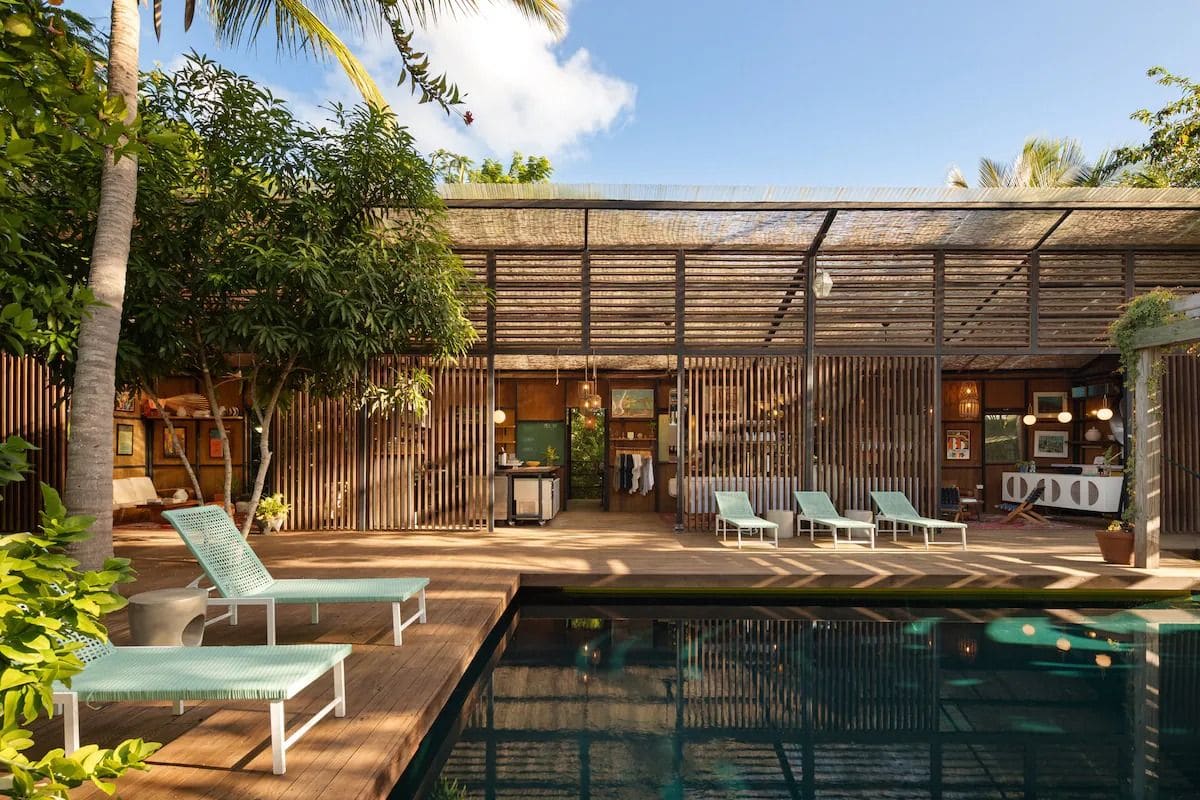
The Shifting Architecture of Island Hospitality
There's a particular kind of restraint visible in the best examples of Puerto Rican vacation architecture today. It isn't the minimalism of northern Europe or the calculated austerity of Japanese ryokans, but something closer to clarity: an understanding that when you have access to mountain light, trade winds, and year-round warmth, the building should step aside.
Across the island, property owners and local architects are translating this ethos into spaces that function less like traditional rentals and more like prototypes for contemporary tropical living. The results range from concrete volumes perched in the Cayey highlands to colonial-era shells in Old San Juan that have been carefully stripped back to reveal their tectonic logic. What unites them isn't a single aesthetic but a shared commitment to making the surrounding landscape legible, whether that's rainforest canopy, limestone coastline, or the dense urban fabric of the capital.
Material Choices and Climatic Realities
In Condado, a one-bedroom unit demonstrates how a compressed footprint can still accommodate luxurious gestures. The apartment sidesteps the typical resort palette in favor of layered greens: olive plaster walls, glossy teal tile in the wet areas, and sculptural stonework around a freestanding soaking tub. The material selection isn't arbitrary. In humid subtropical climates, darker tones can help mask the inevitable patina that comes with salt air and afternoon downpours, while stone and ceramic surfaces require less maintenance than timber or fabric.
The unit's layout follows a logic common to urban tropical housing: maximize cross-ventilation, compress circulation, and allocate square footage to outdoor zones. A private patio extends the living area without adding to the air-conditioned envelope, while an open-air shower turns a utilitarian function into something closer to ritual.
Elsewhere in the capital, a two-level duplex near the beach takes a similar approach but expands the material vocabulary. Fluted wood panels, woven fiber details, and textured plaster create visual depth without relying on color. The upstairs suite opens onto a balcony with partial ocean views, a modest claim that reflects the realities of beachfront real estate in San Juan, where true oceanfront access commands significantly higher prices.
Altitude as Design Driver
Move inland and the architectural language shifts. In the mountains outside Barranquitas, a contemporary residence uses floor-to-ceiling glazing to frame the surrounding peaks. The home's primary gesture is its handcrafted cedar sliding doors, which collapse to merge interior and exterior zones. When open, a private plunge pool becomes an extension of the main living area, a move borrowed from mid-century Californian precedent but adapted for Puerto Rico's steeper topography and more dramatic weather patterns.
The upstairs lounge and veranda are positioned to capture golden-hour light, a detail that suggests the architect spent time observing solar angles rather than defaulting to symmetry. In tropical mountain climates, where afternoon cloud cover is common, west-facing outdoor spaces become premium real estate.
A one-bedroom villa in Villalba takes the altitude question further. Set on nearly three acres of hillside, the structure uses black-framed windows and white interiors to create a graphic contrast against the dense greenery beyond. The architectural language is deliberately simple, almost diagrammatic, allowing the landscape to dominate. An infinity pool extends the sightline across the property, a technique that works best when the horizon line is either very far away or visually complex. Here, it's both.
Adaptive Reuse and Colonial Fabric
Old San Juan presents a different set of constraints. The district's Spanish colonial architecture, much of it dating to the 16th and 17th centuries, is protected by strict preservation codes. Renovation work here isn't about invention but excavation: removing later additions, restoring proportions, and inserting contemporary comforts without erasing historical legibility.
A two-bedroom villa near Plaza de Armas demonstrates this approach. Arched windows, ornate doors, and high ceilings remain intact, while the interior has been reconfigured to accommodate modern expectations around privacy, lighting, and climate control. The walls display works by Puerto Rican artists, a curatorial decision that situates the space within a broader cultural conversation rather than treating it as a neutral backdrop.
This kind of adaptive reuse requires a delicate calibration. Too much intervention and you lose the texture that makes these structures compelling; too little and you're left with a museum rather than a livable space. The most successful examples find a middle ground, preserving the architectural bones while upgrading infrastructure in ways that remain invisible to guests.
Alternative Typologies
Not every noteworthy rental fits neatly into conventional categories. In Cayey, a geodesic dome offers a different model entirely. The structure houses a single sleeping area with panoramic views of jungle and distant mountains, while cooking and bathing functions are relocated outdoors. An alfresco kitchen and open-air shower turn daily routines into opportunities for environmental engagement, a strategy that works in Puerto Rico's climate but would be impractical in regions with more temperature variation.
The dome typology has a long but uneven history in residential architecture. Buckminster Fuller's mid-century experiments promised efficient, affordable housing but often struggled with waterproofing and thermal performance. Contemporary iterations have addressed many of these technical issues, though the form remains more popular as a novelty than a scalable solution.
On Vieques, a treehouse-style structure at a small farm takes a similar approach to dissolving boundaries. Open terraces and strategically placed windows maintain visual connection to the surrounding greenery even from interior spaces. Communal areas encourage interaction with other guests, a feature that distinguishes farm stays from more isolated vacation rentals. The property includes access to yoga classes and vegan breakfast, amenities that signal a wellness orientation common among rural hospitality projects in Puerto Rico.
Infrastructure and Resilience
A less visible but equally important consideration across these properties is infrastructural resilience. Puerto Rico's electrical grid has faced significant challenges over the past decade, particularly following Hurricane Maria in 2017. Many of the more remote rentals now include backup power systems, water storage, and reinforced construction methods that weren't standard a generation ago.
A tented stay near Luquillo, part of Little Hills Farm, advertises backup power and water as selling points alongside its four-poster bed and hot tub. This reflects a broader shift in how travelers evaluate accommodations on the island. Reliability has become a design feature, not just a technical footnote.
Similarly, a villa on Vieques' southern coast uses open concrete construction and strategic overhangs rather than glass walls to manage heat and airflow. The nearly 100-foot infinity pool runs alongside the primary living area, while multiple outdoor showers and a rooftop deck distribute programmatic functions across the five-acre site. With capacity for up to 16 guests, the property functions more like a compound than a single residence, a typology that suits multigenerational trips or group travel.
Regional Variations and Local Context
Where you stay in Puerto Rico shapes not just your view but your experience of the island's ecological and cultural range. Surf towns like Rincón and Aguada offer proximity to consistent breaks and a slower pace oriented around ocean rhythms. A cabin in Isabela, surrounded by mountains, prioritizes sunrise and sunset views over beach access, with an outdoor shower and hammock serving as the primary amenities.
In contrast, a loft-style rental near San Juan's beaches combines Brutalist concrete walls with warm textures and pops of greenery. Two private terraces expand the usable area, while the seven-minute beach proximity ensures easy access to the coast. The design language here is more urban, reflecting the property's location within the capital's denser residential fabric.
A four-bedroom villa in Cayey takes yet another approach, incorporating African-inspired furniture and artwork within a hillside setting. The property includes a koi pond, swimming pool, and hot tub, amenities that signal a more resort-like experience despite the private-home format. With room for up to eight guests and four full bathrooms, the villa addresses the logistical realities of group travel in ways that smaller rentals cannot.
Looking Forward
At World Archi Design, we've been tracking how vacation rental architecture evolves in response to both environmental pressures and shifting traveler expectations. Puerto Rico offers a particularly rich case study because the island's recent history has forced a reckoning with infrastructure, sustainability, and community impact in ways that other Caribbean destinations have not yet faced.
The most compelling properties emerging from this moment aren't necessarily the most expensive or the most photographed. They're the ones that demonstrate a clear understanding of site, climate, and use, translating those factors into spatial decisions that feel both considered and inevitable. Whether that's a dome in the highlands or a renovated colonial townhouse, the underlying principles remain consistent: respect the landscape, design for resilience, and make sure the architecture enhances rather than competes with the reasons people came to the island in the first place.
Save this story. A free account keeps your reading list and the 07:00 email in one place.
CREATE FREE ACCOUNT →SIGN IN