
A Designer's Epiphany in Stockholm
In the late 1940s, Jean Royère returned from Scandinavia with an observation that would reshape his approach to lighting design. Walking through Svenskt Tenn - Josef Frank's Stockholm emporium - he encountered something the austere modernism of his French contemporaries had largely dismissed: the deliberate entanglement of nature and interior space. Ivy wound around picture frames. Virginia creeper descended into dining room chandeliers. The Nordic custom of weaving living plants through domestic architecture struck Royère not as quaint folklorism but as a spatial strategy, one that softened the boundaries between structure and ornament.
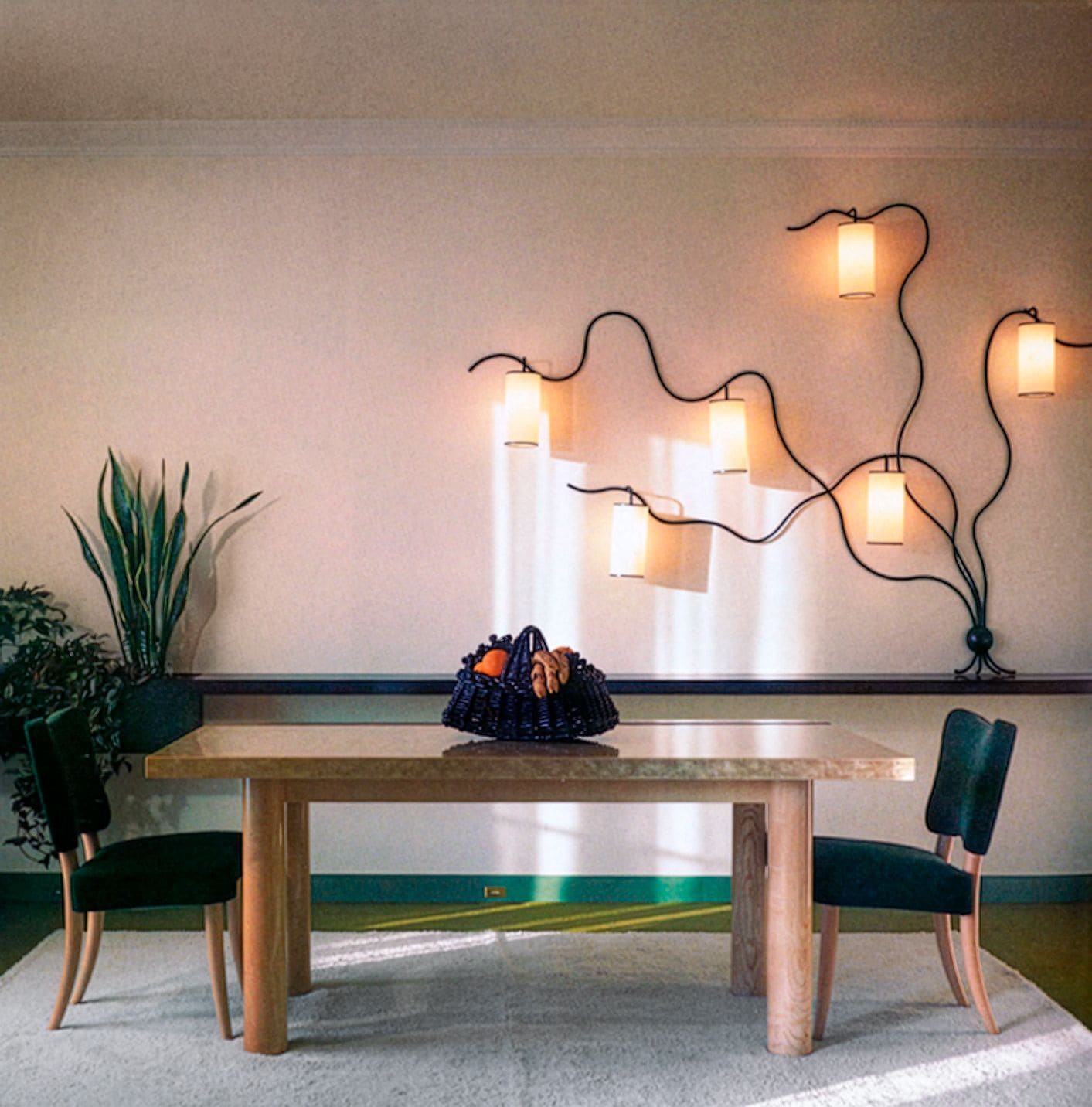
What emerged from that encounter was Liane, a family of lighting fixtures that translated botanical growth patterns into hand-forged tubular steel. The name itself - French for "vine" - telegraphed Royère's intent. These were not lamps that merely referenced nature through applied decoration. They were objects whose structural logic mimicked the wayward, asymmetric trajectories of climbing plants.
From Wall Drawing to Three-Dimensional Form
Royère's earliest Liane iterations, created in the mid-1950s, were site-specific wall pieces. Steel tubes twisted across plaster surfaces in configurations that responded to the architecture of individual rooms. Each stem emerged from a clustered base - a kind of anchoring bouquet - before spiralling outward in trajectories that appeared improvised but were, in fact, meticulously planned.
The fixtures evolved quickly. Wall-mounted versions gave way to chandeliers, sconces, and a floor lamp so tangled it resembled a thicket more than a conventional standing light. Royère finished them in coral, blue, black, or gold leaf, applied with the matte irregularity of house paint rather than the industrial sheen typical of tubular steel furniture. The cylindrical shades - cellulose acetate with colour-matched paper trim - added a soft, diffused glow that contrasted with the assertive linearity of the steel armature.
Sketches from the period, now held in the collection of the Musée des Arts Décoratifs, reveal the precision behind the apparent spontaneity. Each curve was drawn freehand, yet the resulting forms maintained structural integrity. The decorative gesture was never purely expressive; it bore load, distributed light, and articulated space.
Tubular Steel, Unchained
Royère's relationship with tubular steel places him in dialogue with the Bauhaus, yet his work diverges sharply from the movement's geometric rigour. Where Marcel Breuer and Mies van der Rohe bent steel into right angles and controlled arcs, Royère allowed the material to wander. His early experiments in the 1930s featured modest undulations - a gentle wave here, a restrained curve there. By the 1950s, those gestures had loosened into something closer to calligraphy, each fixture a three-dimensional sketch.
This evolution reflects a broader tension within mid-century modernism. The International Style privileged orthogonal clarity and industrial repetition; Royère's practice, by contrast, retained the marks of the maker's hand. His steel was forged, not extruded. His finishes were brushed on, not powder-coated. The result was a kind of vernacular modernism, one that acknowledged craft traditions even as it engaged with industrial materials.
At World Archi Design, we have tracked the resurgence of hand-forged metalwork in contemporary lighting, from the blackened steel chandeliers of Bec Brittain to the sinuous brass fixtures of Allied Maker. Royère's Liane series offers a useful precedent for designers seeking to reconcile the expressive potential of handwork with the formal vocabulary of modernism. The fixtures demonstrate that biomorphic form need not collapse into kitsch, provided the underlying structure remains legible.
The Question of Authenticity and Proliferation
Since the revival of the Royère brand in 2018 - overseen by Vladimir Markovic, great-nephew of Royère's business partner Micha Djordjevic - the market has seen a surge in Liane reproductions. Some are licensed reissues; many are not. The contemporary catalogue includes 35 original Liane configurations, now fabricated in powder-coated steel with Japanese paper shades. Bespoke commissions are not accepted. The rationale, articulated by Jonathan Wray, creative director at Royère, frames each fixture as a discrete work rather than a customisable product. The design's value lies in its specificity - the particular rhythm of a curve, the precise angle at which one stem intersects another.
This stance raises questions about the nature of design authorship in an era of widespread reproduction. Unlike a chair, which can be scaled or upholstered in varied fabrics without losing its essential identity, a Liane fixture depends on the exact choreography of its lines. To alter the trajectory of a single tube is to create a different object altogether. In this sense, the fixtures resist the logic of industrial production even as they are manufactured in series.
The comparison to wall drawing is instructive. Like the site-specific works of Sol LeWitt or Richard Serra, Liane fixtures inhabit the space between sculpture and architecture. They are environmental interventions that reshape the perception of a room not through mass but through line. The steel traces a path across the wall or ceiling, pulling the eye along a route that defies the grid.
Legacy and Contemporary Resonance
Royère's work occupies an unusual position within the canon of 20th-century design. He was neither a strict functionalist nor a pure formalist. His furniture and lighting operated in a middle register - modernist in material and technique, yet unafraid of decoration, asymmetry, and whimsy. The Liane series exemplifies this hybridity. It is simultaneously rational and organic, planned and spontaneous, industrial and handmade.
For contemporary designers navigating similar tensions, Royère's example suggests a way forward. The challenge is not to choose between modernism and craft, but to find the point at which they converge. The Liane fixtures achieve this through a kind of disciplined freedom: every curve is intentional, yet the overall effect is one of unforced vitality. The steel does not merely support the shades; it performs a spatial dance, animating the architecture it inhabits.
As the market for mid-century design continues to expand, the risk is that objects like the Liane fixtures become mere signifiers of taste rather than active participants in spatial discourse. The best contemporary interiors treat these pieces not as museum artefacts but as tools for shaping light, rhythm, and movement. A Liane chandelier in a double-height space can modulate verticality, its tendrils drawing the eye downward. A wall-mounted version can activate an otherwise inert plane, introducing dynamism without clutter.
Royère understood that lighting is not simply a functional necessity but a means of articulating space. The Liane series remains relevant because it addresses this fundamental architectural task with both rigour and imagination. It proves that a lamp can be many things at once: a source of illumination, a structural element, a drawing in three dimensions, and a fragment of nature translated into steel.
Save this story. A free account keeps your reading list and the 07:00 email in one place.
CREATE FREE ACCOUNT →SIGN IN