
Where Landscape Dictates Form
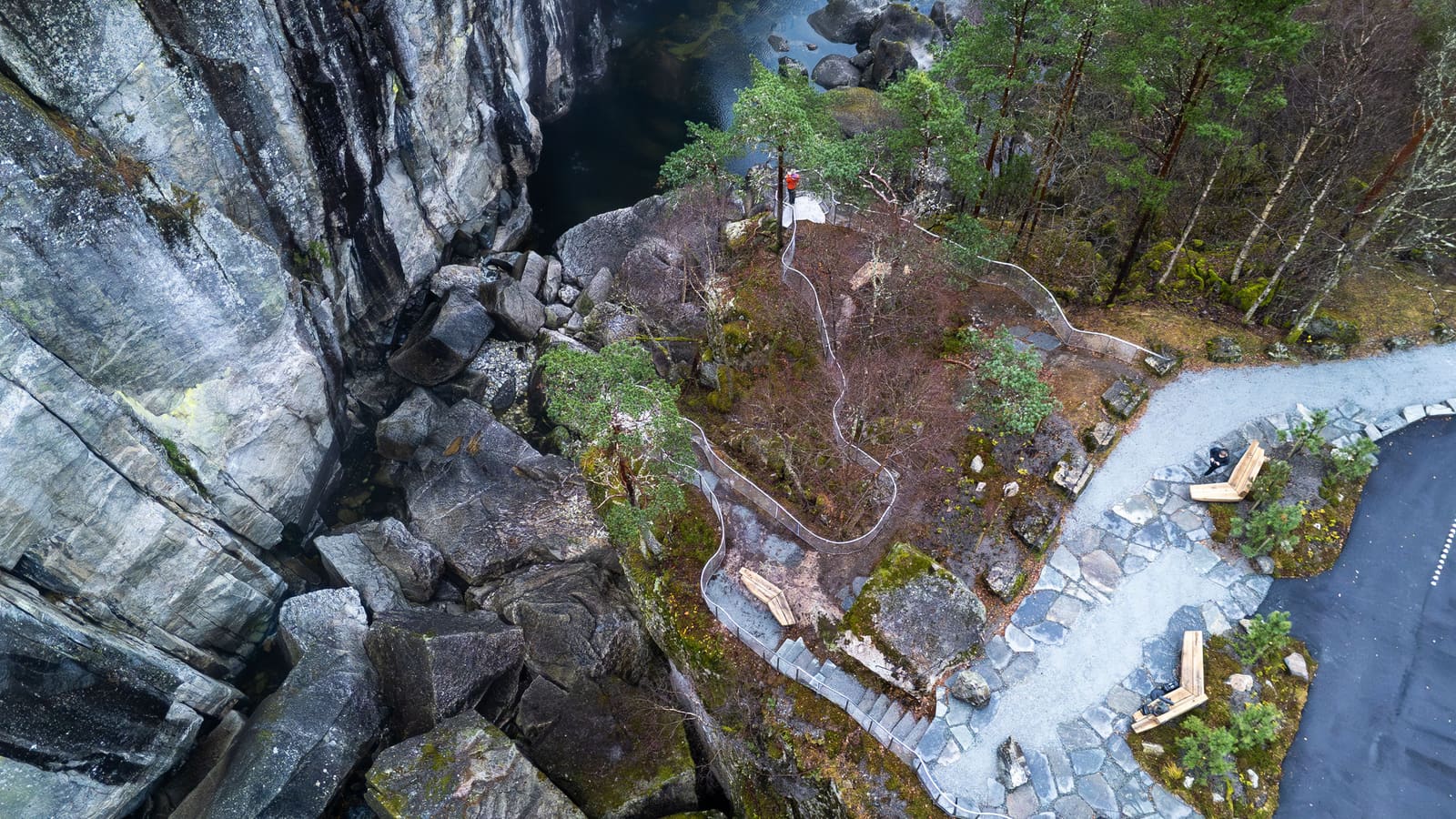
There is something humbling about designing for a place where geology speaks louder than any architect ever could. In Brattlandsdalen, a narrow gorge carved by water and time along National Road 13 in southwestern Norway, the verticality of the site is absolute. Steep mountainsides press in from both sides, and the road itself is a testament to human persistence, threading through a corridor shaped by glacial force. It is here that ATSITE completed JUVO in 2025, a resting area and viewpoint that occupies 1,000 square meters of this dramatic terrain.
The project does not announce itself. Instead, it defers to the gorge's own narrative, one written in stone and water over millennia. Lead architects Anne Truelsen Schultz, Imke Wojanowski, and Pia Rosshaug Gjermo approached the commission as an exercise in restraint, understanding that the site's rare geological formations, including glacial potholes, and its layered history of roadmaking demanded a light touch. JUVO becomes less about destination and more about pause, a momentary withdrawal from the linear logic of the highway.
The Historical Thread
Norway's National Tourist Routes program has long understood that infrastructure can be more than utilitarian. The Scenic Routes initiative, led by Statens vegvesen (the Norwegian Public Roads Administration), has commissioned dozens of interventions along the country's most striking roadways, transforming rest stops into spatial experiences. JUVO joins this lineage, but it does so with particular sensitivity to the site's past.
The gorge itself has been a corridor for centuries. Stone posts and steel railings mark the historical pathway, remnants of an earlier era when local travelers and early tourists navigated this terrain on foot or by horse. The Kvelven Tunnel, a historic passage cut into the mountain, remains as a physical archive of engineering ambition. ATSITE's intervention does not erase these traces. Rather, it layers a new stratum onto the site, one that acknowledges both the monumentality of the landscape and the incremental human efforts to traverse it.
Material and Tectonic Strategy
The design vocabulary is deliberately minimal. Working with structural engineers Bollinger+Grohmann and safety consultants Agder Områdesikring, ATSITE developed a series of platforms and pathways that follow the contours of the gorge. The materials, robust and weather-resistant, are chosen to endure the harsh climate without competing visually with the surrounding rock faces. Steel and timber predominate, both materials with a long history in Norwegian construction, yet deployed here with a contemporary lightness.
The structural system responds to the site's verticality. Rather than imposing a horizontal datum, the platforms step down in response to the topography, creating a series of overlooks that shift perspective as visitors move through the space. This strategy recalls the work of Peter Zumthor at the Therme Vals, where architecture becomes a choreographed sequence of views and pauses, though JUVO operates at a more exposed scale, without the enclosure of walls or roof.
The Act of Stopping
At World Archi Design, we have been tracking the evolution of roadside architecture, particularly in Scandinavia, where the typology has moved beyond the functional rest stop into the realm of experiential infrastructure. JUVO exemplifies this shift. It is not merely a place to pull over and stretch one's legs, though it serves that purpose. It is also a spatial prompt, a designed moment that encourages visitors to reckon with the scale of geological time and the fragility of human intervention.
The viewpoint itself is oriented toward the glacial potholes, circular depressions carved into bedrock by swirling water and stone over thousands of years. These formations are rare and scientifically significant, and JUVO makes them legible to the lay observer. The design does not interpret or mediate excessively; it positions the body in space such that the landscape can be read on its own terms.
Context Within the National Tourist Routes Canon
JUVO sits within a broader portfolio of interventions commissioned by the National Tourist Routes program, a body of work that includes Reiulf Ramstad Arkitekter's Trollstigen viewpoint and Snøhetta's Stegastein platform. These projects share a common ethos: infrastructure as cultural project, the road as a site of aesthetic and phenomenological engagement. Yet each responds to its specific landscape in distinct ways.
Where Stegastein extends horizontally into the void, offering a vertiginous cantilevered platform above Aurlandsfjord, JUVO works vertically, descending into the gorge rather than projecting outward. Where Trollstigen emphasizes the drama of the serpentine road itself, JUVO foregrounds the geological substrate beneath. These are not merely stylistic differences; they reflect a responsiveness to site that transcends formula.
Engineering the Pause
The collaboration with Bollinger+Grohmann was essential to realizing the project's ambitions. The firm, known for its work on complex structures including several of Zaha Hadid's projects, brought expertise in steel detailing and load distribution to a site where foundation conditions are challenging. The platforms are anchored into bedrock, a process that required careful coordination with Agder Områdesikring to ensure slope stability and visitor safety.
The engineering is legible in the final work. Slender steel columns support timber decking, and the joints are expressed rather than concealed. This tectonic honesty aligns with a broader Scandinavian tradition, one that values clarity of construction and material authenticity. It also ensures that maintenance and eventual replacement of components can be carried out without compromising the overall system.
A Threshold Between Movement and Stillness
What JUVO ultimately offers is a spatial threshold. The highway is a space of velocity, of forward momentum and temporal compression. The resting area, by contrast, is a space of deceleration, where time expands and perception sharpens. This duality is fundamental to the National Tourist Routes program, which recognizes that the experience of landscape is not merely visual but temporal, requiring both movement through space and moments of stillness.
The design achieves this through spatial sequencing. Visitors arrive from the road, transition through a sheltered zone, and then emerge onto the platforms. Each stage modulates the relationship between body and landscape, from the enclosure of the car to the exposure of the viewpoint. The final platforms are open to the elements, a deliberate choice that ensures the experience is unmediated by glass or shelter. This is not architecture as refuge but as frame, a device for heightening awareness of place.
Forward Implications
As climate patterns shift and tourism pressures increase, the question of how to design for visitation in fragile landscapes becomes more urgent. JUVO offers one model: restrained, site-specific, and durable. It does not seek to dominate or entertain. It provides infrastructure for pause, a spatial condition increasingly rare in a culture oriented toward speed and consumption.
The project also suggests that the roadside typology, often dismissed as peripheral or utilitarian, holds potential for architectural innovation. In the hands of thoughtful designers working within a supportive public framework, the rest stop can become a site of cultural production, a place where infrastructure and landscape architecture converge to produce something greater than the sum of their parts.
Save this story. A free account keeps your reading list and the 07:00 email in one place.
CREATE FREE ACCOUNT →SIGN IN